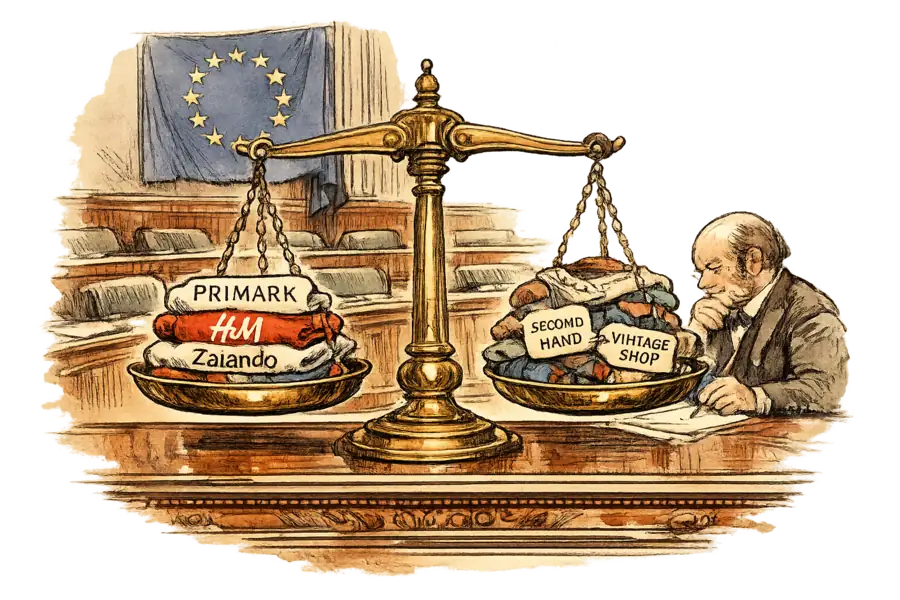
Primark, H&M and Zalando Asked Brussels to Subsidise the Thing They Make Possible
Sixty-nine fashion brands — value, fast and platform — asked the EU, US and Canada for resale and repair tax relief. When Primark and Zalando sign the same petition as Vinted, circularity has stopped being a sustainability claim and become a margin question.
Sir John Crabstone
On 21 May, sixty-nine fashion and textile organisations asked governments in Brussels, Washington and Ottawa to cut VAT on resold clothing, lower labour taxes on repair, and expand producer-responsibility schemes for textile collection. The signatories include Vinted and Vestiaire Collective, which surprises no one. They also include Primark, H&M Group and Zalando, and Inditex, which deserves a second reading.
The coalition is coordinated by the Ellen MacArthur Foundation, and the economic case is sober enough. Resold goods are taxed at every transaction rather than only at the original point of sale. Repair is labour-intensive in a way manufacturing is not; labour represents half the unit cost of repair, and payroll taxes hit accordingly. Targeted relief, the Foundation models, could raise gross margins to up to 55% for resale and around 41% for repair, inside a market it expects to reach $393 billion by 2030 — growing at twice the pace of the wider industry.
The harder question is who is signing.
Primark exists because new clothing is cheap to produce at volume. H&M built a sixty-year business on the same proposition. Zalando distributes more first-hand clothing in Europe than anyone. None of them is the charity wing of Vinted. They are signing a petition that calls their core economics structurally over-subsidised and asks the state to subsidise the disposal end of that same model.
The honest read is acquisition.
Inside the Foundation’s Fashion ReModel cohort, circular revenue is growing roughly four times faster, in the participating parts of those businesses, than the rest of their operations. H&M’s chief sustainability officer described “fixing the economics of resale” as one of the fastest concrete ways to scale circularity. It is also the fastest concrete way to scale a margin line H&M does not meaningfully own. The same applies to Primark, which has spent three years engineering its garments under a Circular Product Standard, and to Zalando, whose pre-owned category now runs across fourteen European markets. Each is acquiring the layer; each would prefer the layer be cheaper to operate.
Cross-segment alignment is the diagnostic. Primark sells on value, H&M on turnover, Inditex on speed, Zalando on platform reach. When all four sign the same brief as Vinted, they are no longer disagreeing about strategy. They are agreeing on where the next margin pool lives.
This changes what the petition is. The Foundation supplies the framing; the fast-fashion balance sheet supplies the urgency. Sustainability was the entry point. Margin is the reason the door stayed open.
The test for whether a corporate commitment has matured into strategy is whether the company would still sign in a recession. Resale in 2026 is already operating in one; Kearney found, as R&R reported, a consumer rearranging the cart rather than spending less of it. Primark, H&M and Zalando are signing anyway. The ask is for cost of goods, not goodwill.
Vinted needs the policy to grow. The bigger signatories need it because the next decade of unit margin in fashion sits in goods they did not just manufacture.
What Brussels does next will say more about its industrial preferences than its environmental ones.