Meituan Built a Browser. The Funnel Starts Before the App.
Meituan's AI browser Tabbit positions the local-services giant at the top of the browsing funnel, before purchase intent forms. The real competition among China's tech giants is for the AI-mediated entry point where sessions begin, not the checkout page.
Neritus Vale
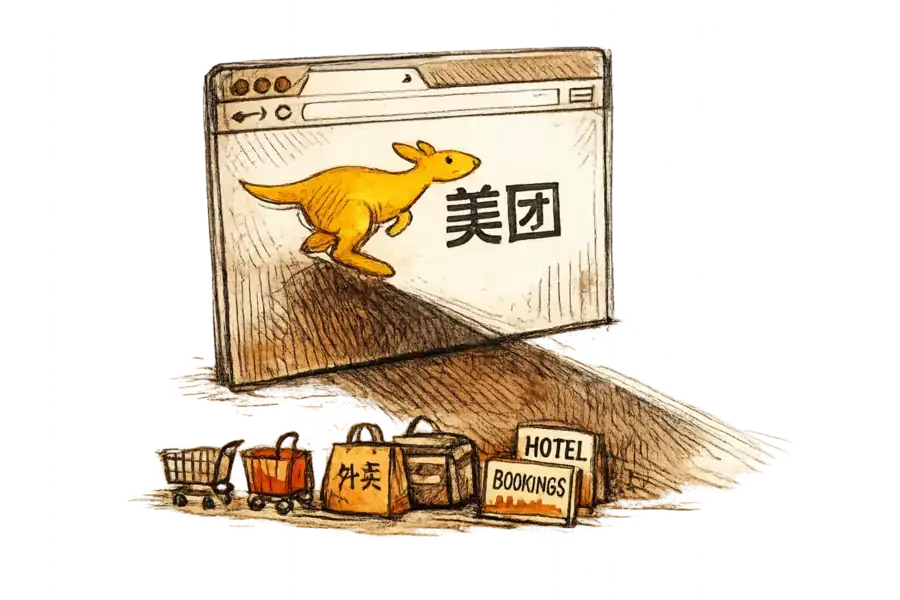
Meituan launched a web browser on 2 March. Tabbit is a free AI-native browser with autonomous agent capabilities, built by GN06, the team behind Light Year, which Meituan acquired for ¥2.1 billion in 2023. The product has no visible connection to food delivery, hotel bookings, or instant retail. That is the strategy: Tabbit positions Meituan at the top of the browsing funnel, before purchase intent forms, where none of its commerce competitors currently sit.
Tabbit ships seven large language models, including Meituan’s own LongCat alongside DeepSeek, Doubao, Kimi, Qwen, GLM, and Minimax, letting users switch between them per task. Its differentiating feature is an agent mode that executes multi-step web operations autonomously: opening pages, extracting data, filling forms, and delivering structured results without user intervention. Tasks run in isolated tab groups while the user browses normally. The browser supports one-click migration from Chrome, Safari, and Edge, preserving Chrome’s interface to reduce switching cost. In isolation, this reads as a general-purpose productivity tool. The commerce logic is in the position, not the feature set.
China’s tech giants are spending billions to become the default AI entry point. During the 2026 Lunar New Year campaign, Alibaba committed ¥3 billion in AI-linked consumer incentives, Tencent spent ¥1 billion, and Baidu allocated ¥500 million. Tencent’s Yuanbao chatbot hit 50 million daily active users by February. The prize is the layer where a user’s session begins. Whoever controls that layer shapes which services surface first, which models process the query, and which platform captures the resulting transaction.
Meituan’s commerce rivals already own their entry points. Alibaba has Quark and Taobao; ByteDance has Douyin and Doubao; Baidu has Ernie embedded across its search and app suite. Meituan’s core app opens only when a user has already decided to order food, book a hotel, or buy groceries. Tabbit intercepts users earlier, during ambient browsing and research where intent has not yet crystallised into a specific purchase. Industry analyst Zhuang Shuai has described the AI search track as “a new focal point of competition for tech giants”; for Meituan, the focal point is narrower: the gap between idle browsing and opening a shopping app.
The first plausible integration scenarios reveal the commercial logic. If Tabbit connects to Meituan’s local-services infrastructure, the likeliest initial application is cross-store meal ordering, a scenario with low decision thresholds and high repeat-purchase rates where AI automation is likeliest to succeed. A 2022 projection by the China Chain-Store & Franchise Association put China’s instant retail market above ¥1 trillion by 2026. A browser that autonomously researches options and places orders across merchants converts the browsing layer into a transaction layer.
The ¥2.1 billion Meituan paid for Light Year bought a team; Tabbit is the first product that explains why.
The counter-argument has weight. Browsers have historically been poor vehicles for commerce monetisation, and Meituan’s ¥23.4 billion net loss leaves thin margin for another money-losing front. Alibaba’s Quark is already in market; Tabbit is in public beta with no disclosed user count. The condition that would break the thesis is straightforward: if users treat Tabbit as a utility browser rather than a habitual starting point, the funnel capture never materialises. But Meituan holds the asset its browser-only competitors lack: a local-services platform that can execute whatever transaction Tabbit initiates.
The browser does not need to generate revenue. It needs to prevent purchase journeys from starting inside a rival’s AI. As we reported earlier today, Meituan is already blocking employees from using Alibaba’s Qwen to prevent proprietary data from leaking into competitor models. Tabbit completes the defensive logic — if you cannot let staff query a rival’s model, you cannot let customers begin their shopping inside a rival’s browser. The race among China’s tech giants has moved past who processes the order. It is now over who owns the ten minutes before the user decides to buy.