Alibaba Is Paying 380 Billion Yuan for a Moat Its Rivals Do Not Need
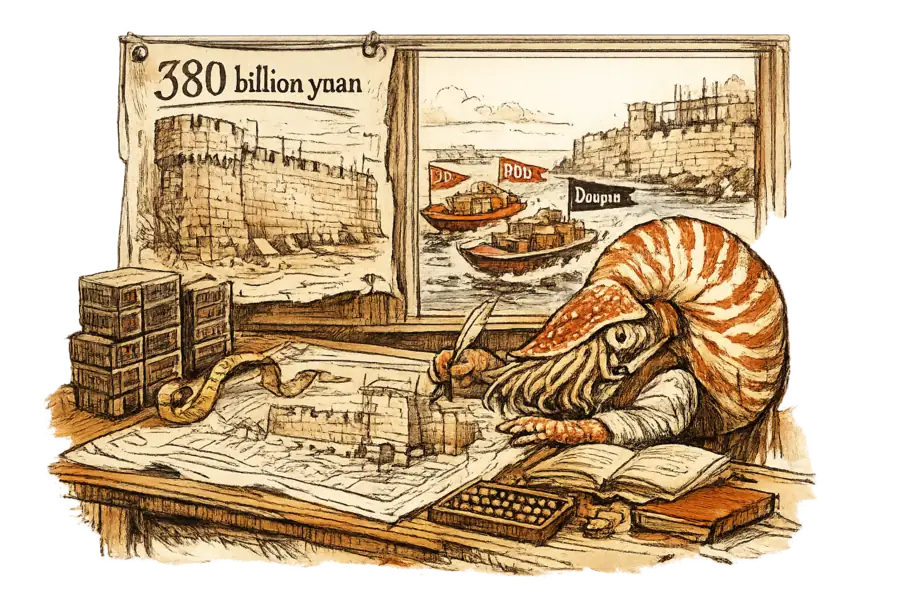
Alibaba's 380-billion-yuan AI infrastructure pledge is the largest private computing commitment ever made in China and a signal that its consumer business is no longer compounding the moat on its own. JD, Pinduoduo, and Douyin are taking share through logistics, sourcing, and content: layers that a frontier model does not yet replace.
Neritus Vale
Alibaba has pledged 380 billion yuan over three years to AI and cloud infrastructure — the largest private computing commitment ever made in China and a signal that its consumer business has stopped building the moat on its own. Customer management revenue in the China e-commerce group rose 1 per cent year on year last quarter, and the annual active buyer growth Taobao posted came from quick-commerce subsidies, not margin. The company is buying compute because consumption is no longer doing that work.
The stall is structural, not seasonal, though Alibaba offered the opposite reading. Management pinned the miss on weak consumer sentiment, a warm winter, and the late timing of Lunar New Year; Jiang Fan also reported a significant GMV and CMR rebound in Q4 FY2026 once the headwinds lifted. Net income fell 66 per cent as quick-commerce subsidies and AI capex both ran ahead of the revenue they were meant to generate. The two engines the company names — consumption, and AI plus cloud — now finance each other out of a single balance sheet, with the implicit ask that consumption stabilises long enough for compute to mature. A recovery driven by subsidy is not a structural repair. That is where the loop breaks.
What the money buys is legible: data centres, T-Head silicon, and a further generation of the Qwen model that has given Alibaba a credible foundation model position in the domestic market. None of those line items, on any timeline a quarterly earnings call can defend, persuades a top-tier live-commerce creator to leave Douyin, a Shenzhen rider to quit Meituan, or a Pinduoduo group-buy user to re-enter the Taobao funnel. Those migrations run on the economics the operators control: take-rate, payout speed, order density, and price pressure in the categories that move merchandise. Alibaba has merged Taobao, Tmall, Ele.me and Fliggy into a single China E-Commerce Group to close gaps on all four. The move is rational. It is also a defensive move made from the position of a company that, until recently, set the terms other platforms reacted to.
The rivals taking share are not doing it through better models. JD has grown its consumer base on the strength of food delivery and instant retail, building its own central kitchen and dark-store network while competing directly against Meituan in same-day fulfilment. Pinduoduo has entered the same market on the strength of its own supply chain, while Douyin and Kuaishou have already passed Taobao and Diantao in live-commerce GMV share, per Statista. None of those gains required a frontier model. They required warehouses, riders, creators, and the willingness to absorb margin in the categories Alibaba is now trying to reacquire through subsidy.
Each of those operator moats is specific enough to describe. JD’s first-party logistics keeps order-to-door time shorter and after-sales experience more consistent than any marketplace can guarantee; in categories where goods break or the wrong SKU ships, that is the moat. Pinduoduo’s manufacturer-to-consumer flow compresses the distance between factory and shopper in the categories where unit price matters more than trust. Douyin’s creator economy retains supply because payout mechanics and discovery dynamics make moving to another platform a demotion, not a lateral transfer. These are not features released in a quarterly update. They are organisational positions accumulated over years.
A moat you can buy is not the same as a moat you can keep.
The counter-argument is that compute eventually reshapes the ground beneath the operators, and they discover they cannot reach the moat from where they are standing. For that to hold, two things must be true: Qwen and Alibaba Cloud must keep compounding, and that growth must convert into consumer-platform tooling rivals cannot replicate on rented GPUs. The first condition has a data point behind it: Cloud Intelligence revenue grew 36 per cent in the most recent quarter, and Eddie Wu has put a five-year target of $100 billion in AI-and-cloud revenue on record as the compounding’s destination. The second is what Alibaba has not yet demonstrated. Every consumer-facing deployment to date is replicable by any competitor willing to license the same tier of model: Taobao Flash Sale’s AI layer, Quark search, the 88VIP personalisation suite. Until compute underwrites a shopper experience Meituan or JD cannot rent, the moat is corporate, not consumer.
The price of buying a moat late is that you pay at full retail while the rivals who do not need one keep eating your margin. Alibaba’s consumption business subsidised its way back to annual active buyer gains, and that subsidy is a running cost, not a fixed one. It compounds until compute produces a consumer product nobody can clone, or until consumption stabilises without the drip. The 380-billion-yuan bet is defensible if the first outcome arrives in time, and a margin event if the second does not. Which of those conditions holds is the question Eddie Wu has not answered on any earnings call yet, and the operators are not waiting for him to. They are still taking shoppers.