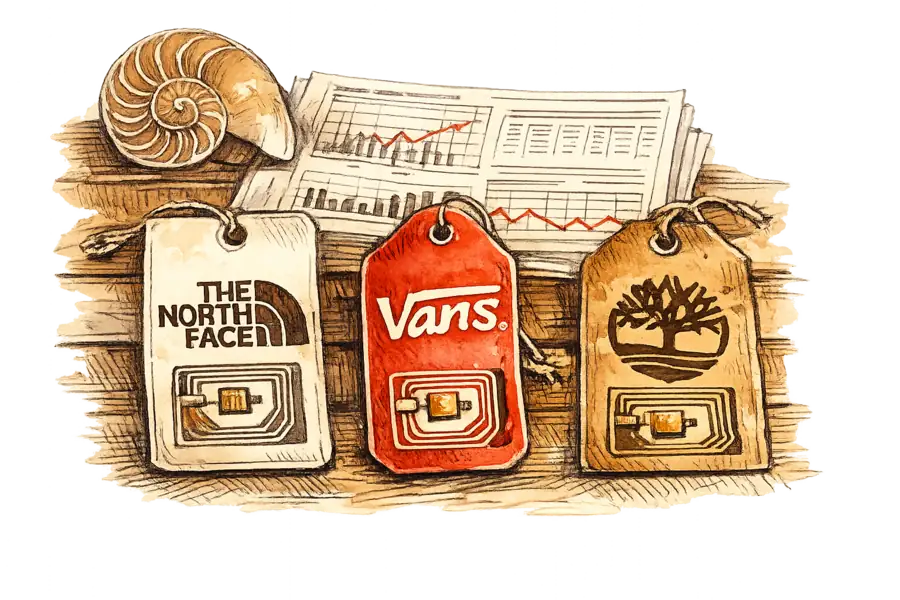
VF Put RFID Under The Model Already Running
VF Corporation's Nedap partnership — beginning with The North Face and expanding to Vans and Timberland — is not inventory plumbing. It is the data layer the Reinvent turnaround requires before AI-driven allocation can run on anything better than guesswork.
Neritus Vale
VF Corporation announced on 20 April that it had chosen Nedap to deliver item-level RFID across its brand portfolio, starting with The North Face in Q2-2026 and expanding to Vans and Timberland across 1,500-plus stores plus the distribution centres and vendor partners behind them. The selection followed a pilot with an alternative vendor; VF reassessed its long-term requirements before committing to Nedap, a fact the press release states and the programme’s sequencing logic depends on. The press release frames this as inventory visibility. Read against VF’s Reinvent turnaround plan, it is better understood as a retrofit: the data layer being laid in so that AI-driven allocation has ground truth to run against.
Item-level RFID earns its keep in the model, not in the aisle. Conventional apparel inventory records carry significant error; RFID reduces that error sharply, and the reduction is what enables AI applications, not the tagging itself. A demand forecast trained on inaccurate stock positions is not a forecast; it is a confident guess dressed up in quartiles. Replenishment, allocation, markdown timing, return routing: the economics of AI in retail collapse without ground truth to train against. VF is not buying inventory software. It is buying the right to trust whatever model it builds on top.
The Vans trajectory makes the cost concrete. The brand posted a 16 percent revenue decline in fiscal 2025, and channel rationalisation has continued this year; every unit placed at the wrong account is margin VF will not recover. Stock records at apparel scale carry material error without item-level visibility, and the ceiling of any allocation system is whatever those records allow. A system cannot move stock it cannot see.
The less-reported scope is what sits upstream of the store. The deployment reaches distribution centres and, in Hope Waldron’s phrasing, “vendor partners at the source,” which means finished goods are being tagged before they leave the factory. That changes the shape of what can be automated. A brand that sees its units from contract manufacturer through retail shelf has dynamic allocation as an option. A pallet in transit can be rerouted when Tokyo outsells Osaka two-to-one, not renegotiated next quarter. It also closes the grey-market loop, because any leakage between factory and authorised retail becomes reconcilable in the same ledger.
The plumbing is going in before the tenants have moved in, because every retailer that has tried the reverse order has watched its AI hallucinate on top of a broken ledger.
The obvious objection is that item-level RFID is an old idea. Major apparel retailers have run it at scale for more than a decade; for VF’s competitors in the category, it is infrastructure rather than initiative. If the technology is mature, the question is why VF is only now committing at portfolio scale. The answer is that the application layer has finally caught up to the data layer’s price. For a decade, retailers had more accurate stock records than their models could exploit; the data arrived before the analytics caught up to it. That asymmetry has now flipped.
The counter holds on one condition. If VF’s AI allocation layer generates less incremental margin than the cost of tags, readers, gateways, and the integration work behind them, the programme reduces to expensive shelf accuracy: a good thing, not a strategic one. That condition assumes stasis, and the Reinvent plan does not allow it. Darrell’s fiscal 2028 targets are a 10 percent adjusted operating margin and a 55 percent gross margin. Neither number has a path that runs through manual allocation and quarterly lookbacks. The model has to be fed, and the tag is how it eats.
The choice Nedap lets VF make is about sequencing, not technology. Peer retailers have been running item-level RFID at scale long enough that the question for VF is no longer whether to do it, only what to build on top. What VF has bought is first-mover access to applications that require this data as precondition — size-and-colour demand forecasting, return routing to the nearest understocked door, markdowns tuned to regional velocity. If that sequencing holds, the rollout beginning this quarter is the most consequential spend in the turnaround, regardless of how the press release described it. If it does not, VF will have paid for plumbing its tenants never arrived to use, and the 2028 margin will have to come from somewhere else.