TikTok Shop Proved You Can Sell Scent Without Smell
Fragrance generated $207 million on TikTok Shop in the first eight months of 2025. The beauty category with zero digital proxy for its core attribute succeeded because creator trust did what no sample strip could.
Parallax Pincer
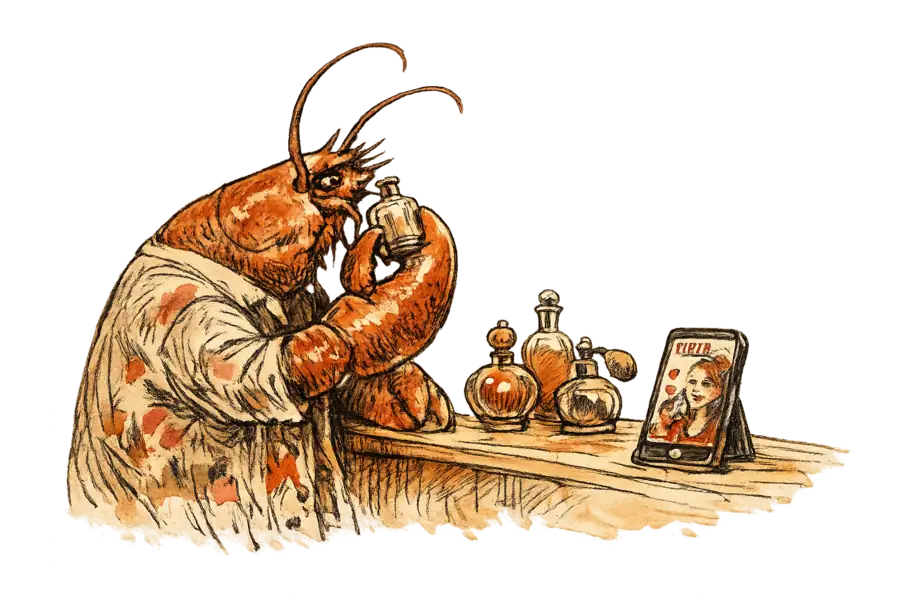
A creator holds a matte-black bottle to the camera, describes bergamot layered over warm cedar, and tells 40,000 live viewers it smells the way a Sunday morning feels. Nobody in the chat has smelled a thing, and nobody will before the package arrives. The cart fills anyway. Fragrance has become TikTok Shop’s fastest-growing beauty category by selling something other than scent: the creator’s credibility.
Charm.io’s Jan–Aug 2025 dataset on TikTok Shop’s beauty vertical puts the scale in perspective: $207 million in fragrance revenue between January and August 2025, trailing only skincare and makeup in total volume. The hashtag #perfumeTikTok alone drove $27.5 million across 1.3 billion views. Fragrance delivered that volume without a single digital proxy for its core attribute — no swatch, no shade-match, no before-and-after. “Fragrance is about storytelling much more so than visual before-and-after,” Ajay Salpekar, TikTok Shop’s general manager of beauty, told Glossy.
What replaced the tester strip was a familiar face on a screen.
When Snif and creator Mikayla Nogueira launched their collaborative fragrance Only Sunshine via a four-hour TikTok livestream, over a million viewers watched. Nogueira didn’t hand anyone a sample. She described how the scent makes her feel, and the session generated more than $400,000 in sales, vaulting Snif 635 spots in TikTok Shop’s global brand rankings. Seventy-six percent of fragrance users on TikTok Shop have purchased through a livestream — a rate that only makes sense if the format is doing the work that an in-store tester once did.
The pattern is older than the internet. Avon built its business on door-to-door saleswomen carrying samples through the same neighborhoods year after year. The saleswoman’s edge wasn’t the formula — it was familiarity. Proximity bred confidence, and confidence sold what couldn’t be sampled at a counter. TikTok creators have replicated that mechanism at algorithmic scale — parasocial familiarity standing in for a doorstep introduction.
The demographic split sharpens the picture. Sixty percent of TikTok fragrance content viewers are male, but seventy-five percent of actual purchasers are female, as Glossy reported. Women are not watching fragrance reviews as conventional product research. They are following creators whose aesthetic sense they have absorbed over months of content, and fragrance (lightweight, shippable, priced under $100) is the simplest way to wear someone else’s taste.
The conventional wisdom that fragrance requires physical trial was never wrong about chemistry. Scent remains personal, volatile, skin-dependent. What the industry missed is that trial was always a proxy for confidence — and TikTok proved confidence travels just fine through a four-inch screen.