TikTok Shop’s Next AI Phase: What Fashion Retailers Miss About Live Discovery
TikTok Shop’s next AI phase is not chiefly about synthetic creators. It is about turning live video into a ranking, search, and conversion system that fashion retailers still treat like a campaign tactic.
Admiral Neritus Vale
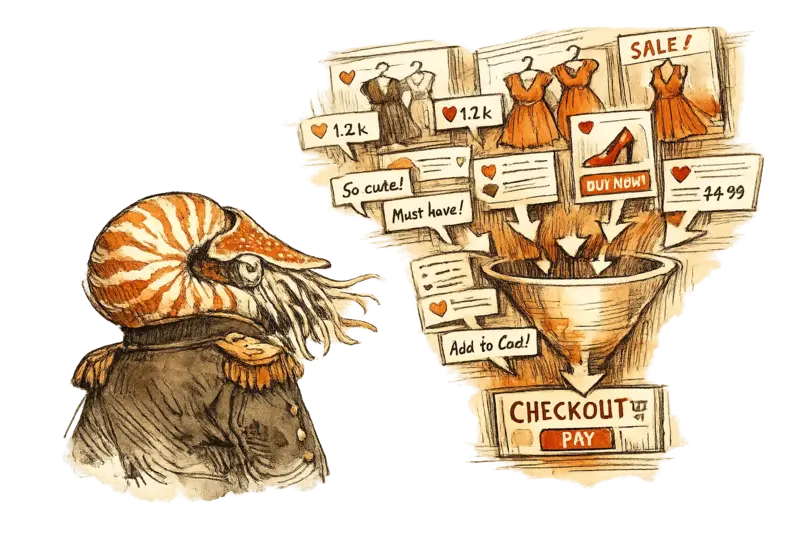
TikTok Shop’s next AI phase is about control of discovery, not novelty in content. Fashion retailers keep staring at AI avatars and creator gimmicks while TikTok is wiring search, live video, affiliate content, and media buying into one machine. If that machine keeps gaining ground, the brands that still treat livestreaming as a campaign add-on will lose distribution to the brands that treat it as operating infrastructure.
The scale already justifies the argument. TikTok said in June 2025 that US TikTok Shop sales were up 120% year on year, that the marketplace had expanded to more than 750 categories and more than 70 million products, and that brands and creators hosted over 8 million hours of LIVE shopping sessions in the US during 2024; TikTok said, citing research conducted with GlobalData and TikTok Shop, that 83% of shoppers discovered a new product on TikTok Shop and 76% of consumers who engaged with TikTok Shop bought something from a livestream. EMARKETER went further in December 2025, estimating TikTok Shop would reach $15.82 billion in US sales for the year and 18.2% of total US social commerce.
Most commentary still describes this as social commerce with stronger entertainment. That reading is already stale. At TikTok World 2025, the company put search and automation at the center of its pitch: TikTok said billions of searches on the platform were up more than 40% year on year, that 1 in 4 users start searching within 30 seconds of opening the app, and that it was scaling three AI systems together, Symphony, Smart+, and GMV Max. That is a product map for routing intent, not a manifesto about creative expression.
The mechanical change matters more than the branding. TikTok’s own help documentation says LIVE GMV Max uses both “video-to-LIVE” and “LIVE-to-LIVE” creatives, allocates them automatically, and optimizes for total liveroom ROI. Another TikTok help page says that beginning in July 2025, GMV Max became the default and only supported campaign type for TikTok Shop Ads. TikTok’s attribution documentation for GMV Max says the system can attribute both paid and organic orders while campaigns are active, including some purchases without ad engagement. That is why larger advertisers complained to Business Insider about black-box measurement and loss of control. The counter-argument is fair. It is also the point. TikTok is making discovery legible to itself before it makes it legible to brands.
Live video helps with apparel because shoppers can inspect fit, fabric, drape, styling, and proportion in motion and in conversation. In a 2023 open-access study in Fashion and Textiles, researchers surveying 292 livestream fashion shoppers found that product demonstration reduced product uncertainty and indirectly increased purchase intention, while interaction with the seller and other viewers’ reviews directly affected purchase intention. That study was not about TikTok Shop specifically, and it did not study US luxury buyers. It still maps cleanly onto apparel: many of the questions that slow a purchase are easier to answer on live video than on a static PDP.
That is what many retailers miss about live discovery. The live session is not only content. It is a data-generating surface where shoppers reveal which hems confuse them, which silhouettes need try-ons, which comments trigger saves, which creator clips deserve amplification, and which searches spike before conversion. TikTok now has AI products built to absorb exactly that signal. Its own best-practices page for LIVE GMV Max creative supply recommends keeping at least 50 to 70 videos queued so the system can keep exploring and finding winners. That is merchandising logic disguised as ad operations.
The brands that understand this stop organizing around hero livestream events. They build merchant-led live inventory, reusable clips, creator permissions, and comment mining into a weekly rhythm. TikTok’s own fashion case studies point in that direction. In one official example, Mc JEANS reported a 17.5x GMV uplift within nine months through creator partnerships, TikTok Shop, and shopping ads. That case study is brand-supplied and promotional, so it should be read cautiously. The directional signal still matters: the gains came from integrating creators, shop content, and paid amplification, not from treating live as a one-off spectacle.
Luxury fashion should not assume it sits outside this pattern. TikTok’s July 2025 luxury study, conducted with more than 3,000 luxury consumers across the UK, US, France, and Italy, found that 70% of the TikTok luxury audience had spent over £1,000 on a single fashion item and that 26% waited for creator reviews before buying. That is TikTok-commissioned research, not an independent industry census. Even with that caveat, it undercuts the old dismissal that live and creator-led discovery only work for cheap impulse buys.
If TikTok keeps fusing search, live, affiliate content, and automated optimization, fashion retailers will need to change who owns the channel. Paid social teams alone are too narrow. Brand marketing teams are too slow. E-commerce teams often still think in PDPs and seasonal drops. The operator that wins here looks closer to a merchandiser with creator instincts and search discipline: always on, live often, specific about fit, ruthless about clip reuse, and willing to let discovery happen before the customer knows the product name.