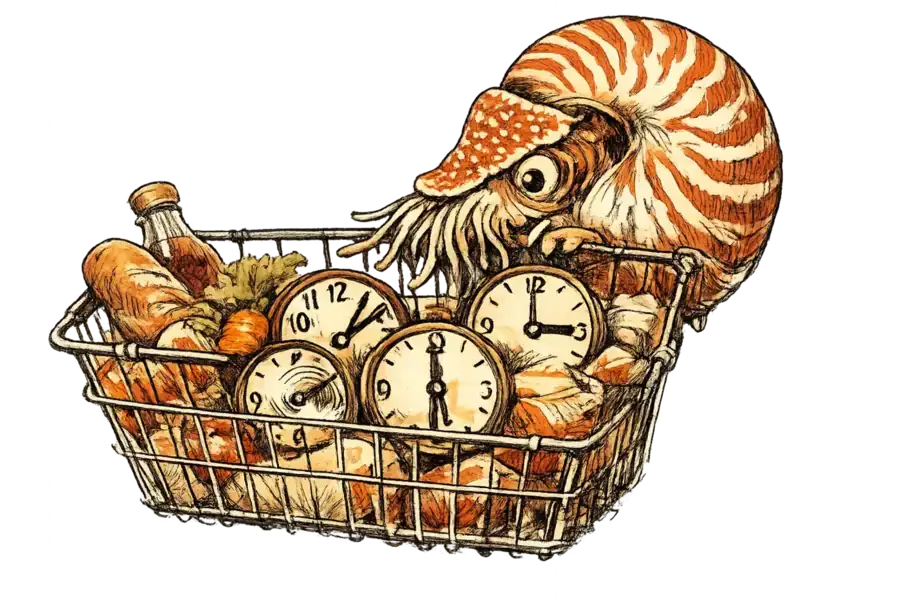
Your Next Basket Is on a Timer
Item-level repurchase cadences capture temporal precision that basket-level recommendation models discard, and the grocery retailers encoding this signal are already measuring the difference.
Neritus Vale
Most next-basket recommendation models treat a grocery order as a set of items and predict the next set. They capture what shoppers buy together. They miss when each item individually comes due. The distinction matters because every product in a basket runs on its own clock: milk cycles weekly, laundry detergent monthly, spices over quarters. Encoding those item-level cadences into recommendation models captures temporal precision that basket-level approaches discard. The research exists; most production systems do not use it.
Repeat items drive the majority of next-basket prediction. A ReCANet study across six grocery transaction datasets found that over 54% of recommendation recall comes from items the user has previously bought, a set constituting just 1% of the total catalog. Half of a model’s useful work concentrates on a sliver of products the shopper already knows. The Instacart public dataset reinforces the pattern: across 3 million orders, reorder frequency spikes at seven-day, fourteen-day, and thirty-day intervals, with a median gap of seven days. Most sequential deep learning architectures process these repeat signals identically to novel-item exploration, exhausting capacity on breadth when they should spend it on timing.
Simple frequency counts already outperform most deep learning models at this task. An empirical comparison of eight next-basket methods found that TOP — the approach that ranks items by how often a user has purchased them — frequently beats neural architectures including RNNs on recall, MAP, and NDCG. Separately, Hu et al. showed at SIGIR 2020 that a kNN method built on personalized item frequency outperformed state-of-the-art deep learning across four public datasets. These frequency baselines succeed because item-level purchase history carries signal that sequential basket models fail to extract. They prove the signal exists; they do not capture it fully, because raw frequency lacks a clock.
Cadence-aware models add the clock. Katz et al. formalized this in their “Buy-Cycle” framework at RecSys 2022, building a hyper-convolutional model that learns item-level repurchase rhythms for each user. Their expanded work in ACM Transactions on Recommender Systems (2024) introduced personalized cadence awareness, analyzing repurchase patterns at three levels of granularity: user, order, and item. The item level matters most. A model that knows a shopper buys oat milk every nine days and dishwasher pods every six weeks can distinguish between a pod that is overdue and one bought last week. Basket-level models, which see only the sequence of complete orders, compress both signals into the same representation.
The gap between knowing what a shopper buys and knowing when each item comes due is where production recommenders lose precision.
The obvious objection is that if item-level cadence were this powerful, the industry would already use it. The engineering cost is real. Cadence-aware models must maintain per-user, per-item timing states, multiplying both training data requirements and serving complexity. If most grocery baskets are small and habitual, a well-tuned frequency model may capture most of the value at a fraction of the cost. The objection holds for retailers with narrow assortments and stable customer bases. It fails for any platform where basket composition varies, where promotional pricing disrupts rhythms, or where the cost of a mistimed recommendation is measured in ignored suggestions that erode trust in the widget.
Applied results confirm the direction. Amazon’s T-REX, a transformer architecture for grocery recommendation, maps 29,000 products onto category sequences and uses adaptive positional encoding to handle irregular purchase intervals. A/B tests produced a 23% sales lift over existing recommendation widgets, with the largest gains among new customers and small baskets under five items. Separately, a PCIC framework for “Buy It Again” recommendations at RecSys 2023 showed up to 16% NDCG improvement by decomposing repurchase prediction into category-level frequency and item-level ranking, trained on 100 million customers and 3 million products. Both encode temporal cadence at different granularities, without relying on basket-level sequence alone.
The lever is specific and the cost of ignoring it shows in every widget impression that misfires. For grocery and replenishment retailers, the basket is the wrong unit of temporal analysis. Each item runs on its own clock. The recommendation that arrives when that clock renews converts; the one that arrives a week early teaches the customer to stop looking. Cadence is not a feature to add to the model — it is the signal the model was built to find.