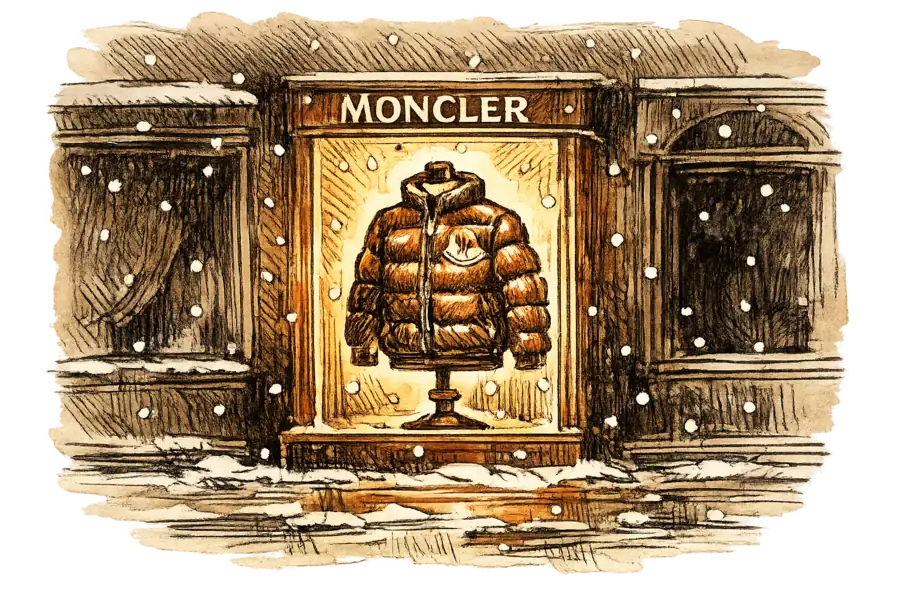
Moncler's 12% Was The Coat, Not The Brand
Moncler reported 12% constant-currency growth in a Q1 when the rest of European luxury softened. The growth came from the puffer category, the half of the brand Ruffini spent two decades trying to step away from.
Sir John Crabstone
Moncler reported €880.6 million in Q1 2026, up 12 percent at constant currency. The rest of European luxury used the same fortnight to explain why it had not. The number to keep is the spread.
Gucci shed 14.3 percent year on year. Kering as a group fell 6.2; the share price fell 9.3 percent in a single session. Part of that spread reflects one-time geopolitical disruption across the sector; the structural part is what matters. The conventional read on Moncler’s outperformance is that Asia carried it; +22 percent at constant currency makes that case. The harder argument is that Moncler is no longer on the same demand curve as its peers. Q1 made it visible.
Remo Ruffini has spent two decades pulling Moncler away from the word technical. The brand left the sporting goods aisle; the Genius shows staged the puffer as couture. The strategy worked: Moncler grew to roughly twice the size of Canada Goose and ten times more profitable, by one measure drawing on company filings. What is awkward, in a soft luxury quarter, is that the half of the brand Ruffini tried to leave behind appears to be carrying the half he built.
When the bonus pool shrinks, the coat does not become less warm.
Hermès trades on patience; Gucci on visibility. Both fail when discretionary confidence wobbles. A puffer is harder to defer; the weather is less elastic than the CFO. The buyer who used to spend on a Gucci belt to signal status can talk himself into a Moncler coat by the same logic, with the added defence that the thing keeps him warm. Aspiration purchases that justify themselves functionally are the last to be cut.
Watch where the growth concentrates. Moncler DTC ran up 14 percent and Stone Island DTC 17; Moncler EMEA dipped one percent at constant currency, on weak inbound tourism and soft online demand. The customer who came for the coat showed up; the one who came for the photograph did not.
Ruffini’s ‘Have a Puffy Summer’ campaign, launched this spring, is the tell. A brand whose category is so seasonally cyclical that it must manufacture summer relevance is a brand that knows which leg is structural. Ruffini’s stated ambition is a 365-day relationship with the customer. The luxury houses spend their summer selling year-round leather. Moncler spends it teaching the customer to wear nylon in July.
The risk runs the other way. A function-anchored luxury brand keeps a floor in soft years and surrenders ceiling in great ones. Hermès’ margins, even now, are something Moncler cannot reach by selling outerwear at any price. Pure aspiration, when it works, prints multiples that category-anchored brands do not. The 12 percent is bought with the coat’s utility floor, not a desirability premium.
For this quarter, in this market, against this set of comparables, Moncler has answered a question the sector has been carefully not asking. Aspiration is not the demand floor. It is the layer that breaks first. What sits beneath it — a coat, a watch movement, a saddle — is what carries a quarter like this one. Ruffini built the aspiration. The coat is paying the rent.