Luxury's AI Budget Is Buying Training, Not Automation
Kering and LVMH describe their AI investment in almost identical terms: not a replacement for retail staff, but a way of training and supporting the client advisors who remain. Their own executives said so, on the record, months before anyone reported it that way.
Sir John Crabstone
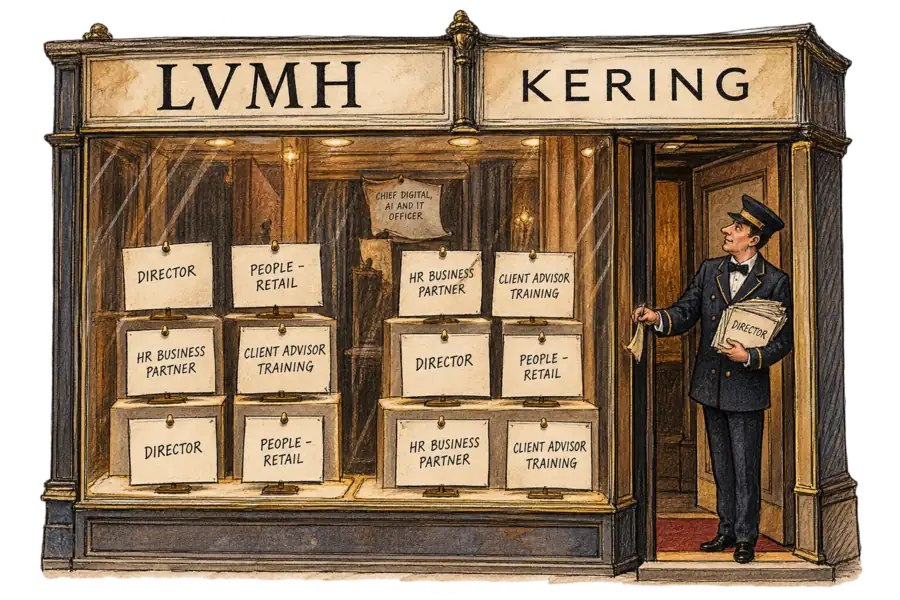
Kering is advertising 1,466 open positions this morning. One of them is instructive.
Gucci wants a director of people for retail in North America. A group racing to automate the shop floor does not spend a hire on the person who explains the software to shoppers. It spends the hire on the software.
That is the tell, not the total. Kering put technology on its executive committee in March, appointing Pierre Houlès Chief Digital, AI and IT Officer, briefed to accelerate the group’s technology architecture. A committee seat is a signal sent upward, to a board and to the analysts watching it. A recruitment ad for a retail HR partner is a signal sent nowhere; it just needs to be filled.
Six months sit between that appointment and this morning’s job board. In that window, Gucci filled a human role for the sales floor, not an artificial one. A group that meant to automate the shop would have spent those six months differently.
A payroll is the only strategy document a company never writes for an audience.
LVMH has been the more candid of the two, and almost nobody noticed. At VivaTech in June, its chief omnichannel and data officer, Gonzague de Pirey, gave the reason for the group’s AI programme: “Our Group has more than 90,000 client advisors worldwide. Training them to the highest standards is essential.” That makes the model a teaching aid, and the teacher the purchase.
The same announcement names the rest of the programme: a digital-twin cutting system built with Comelz for Louis Vuitton, a traceability effort called TRACE, an internal agent built by Celine called CelIA. None of it replaces a client advisor. Each piece sits behind one, or hands one a faster answer.
Kering has said as much itself, in different words. Vincent Bibonne, quoted by Payments Consulting Network from an NRF APAC panel in June, put it plainly: “What we are really building is not a technology platform. We are building the ability to deliver excellence consistently across brands, countries, and every client interaction.” The platform is not the product; the discipline is, taught to people who stay on the floor.
Both companies describe the same purchase from opposite directions. One executive names the students. The other names the ambition. Neither describes a machine built to replace the person it was hired to brief.
Investors hear the committee seat and the conference panel. They rarely see the job board, because the job board was never addressed to them. That asymmetry is the story: the more honest document is the one written for an audience of applicants.
None of this is what the market heard in March. A Chief Digital, AI and IT Officer earns a seat at the top table; a training programme earns a line in a transcript nobody quoted until now. The gap between the two is not concealment — it is emphasis, and emphasis is a choice a company makes about who is meant to be listening.