Luca de Meo's Triage: Gucci Gets Time, McQueen Gets Cuts
Kering's capital markets day gave each house in the portfolio its own diagnosis, prescription, and deadline. The conglomerate-synergy logic that produced the margin collapse is gone; operational pooling has been reinforced, not dismantled.
Neritus Vale
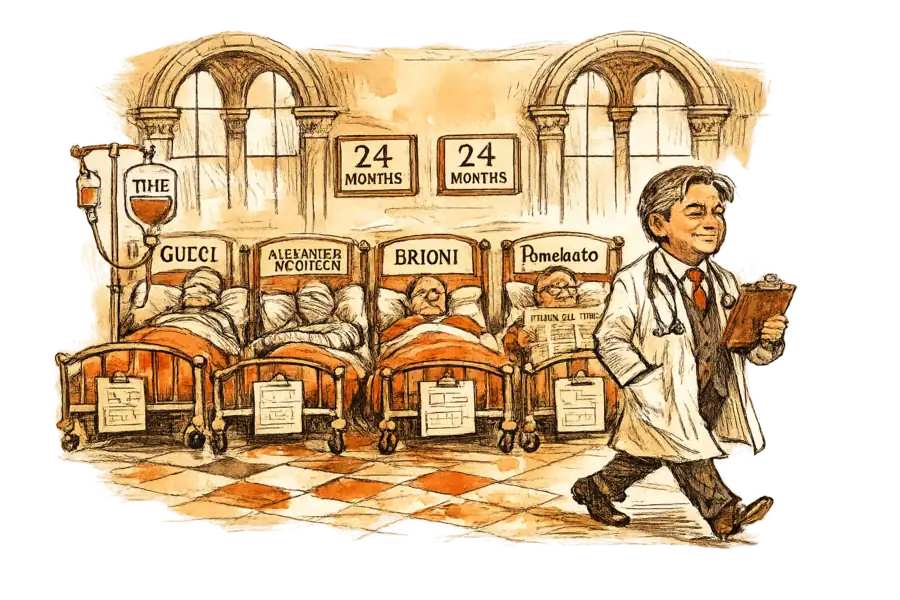
Kering’s capital markets day on Thursday abandoned the conglomerate logic that had defined the group for two decades. Luca de Meo, the former Renault CEO seven months into the job, presented each of the group’s houses as a separate financial case with its own diagnosis, prescription, and deadline. Gucci gets years of patient work on icons, leather goods, and tightened creative direction. McQueen, Brioni, Pomellato, and Ginori 1735 get twenty-four months to return to profit or, in de Meo’s phrase, be ejected from the system. The cross-subsidy logic that produced the group’s margin collapse from 28% in 2021 to 11% in 2025 has been replaced by portfolio triage.
Gucci got time because Gucci’s problem cannot be rushed. The brand has posted ten straight quarters of decline, a duration that rules out quick-fix narratives. De Meo did not announce a new designer or a volume push. He announced a product pyramid rebuild: pared SKUs, icon handbags targeted to double their share of leather goods to 20% by 2030, and boutique renovations staggered across the network. “In one second,” he told investors, “you must know it is Gucci” — a line that reads as diagnosis of how badly the brand codes had slipped. Recovery, he conceded, is a matter of “months, a year,” not weeks.
The houses that got cuts got them fast. McQueen’s store count will drop by roughly 50% by the end of 2026, with the brand refocusing on British sartorial tailoring and eveningwear rather than commercial sneakers. Brioni, Pomellato, Ginori 1735, and McQueen share a two-year deadline to return to profitability, after which de Meo has signalled he will remove them from the portfolio — in his phrase, “eject them from the system.” The pattern rewards financial clarity over historical attachment: houses that cannot clear profitability will be cut, and houses that grew ahead of demand will be sized to the demand that exists.
The old Kering deal, in which Gucci’s cash flow silently underwrote everyone else’s autonomy, has been retired.
The cross-subsidy model has ended; operational pooling is being reinforced. De Meo is building five group-level platforms (Industry, Client, Technology, Sustainability, and Support Functions) to centralize supplier management, AI tools, and digital infrastructure group-wide. Kering will close at least 250 stores by 2030 and run marketing, supply chain, and supplier procurement through a consolidated Paris operation. Operational pooling saves money; financial pooling let the holding company avoid asking whether each house was worth owning.
The strongest case against the new model is that luxury runs on patient capital and the new model has less of it. Brands like Brioni and Ginori are heritage businesses whose value accrues over decades of craftsmanship and signalling; demanding they clear profitability in twenty-four months can force them to skimp on materials, cut the artisans who justify the price points, and trade brand equity for quarterly numbers. The comparison critics reach for is LVMH: the argument that Louis Vuitton’s cash flow has long funded investment across Celine, Berluti, and Loewe through down cycles, buying those houses the patient capital Kering is now refusing to extend. The condition under which Kering’s strategy fails is specific: if the deadline forces the smaller houses into short-term trade-offs that erode the product quality that defined them, de Meo will have saved the group’s P&L by killing the brands that made Kering worth owning.
The answer is that the old Kering model was not patient capital; it was opaque capital. Cross-subsidy let Brioni and Ginori avoid the question of whether their current economics worked; it did not supply them with additional investment to make those economics work. The two-year deadline is brutal, but it forces a choice the group had been avoiding for a decade: either these houses can be rebuilt to earn their cost of capital, or they cannot, and selling them releases capital for houses that can. Patient capital becomes a euphemism for indefinite loss when the creditor refuses to check the books.
Analysts were unconvinced and said so quickly. Kering shares closed down 3.9% on the day. The move suggested investors accepted the restructuring framework but doubted the revenue targets for Gucci specifically. Jefferies trimmed its price target to €250, and RBC’s Piral Dadhania called Gucci’s 2026 revenue ambitions “optimistic.” Bernstein’s Luca Solca named the hole at the centre of the plan: management “still seems to miss a clear idea of how the Gucci spiciness could be relevant in the current social and cultural times.” The market’s doubt is not about whether de Meo has done the portfolio work but whether the portfolio work can produce a Gucci that customers want back.
If the two-year deadline holds, de Meo will have used a capital markets day to redefine what it means for Kering to own a brand: custody has become conditional. The price is already visible in the cuts. What is not yet visible is whether the houses that survive the triage will still look like themselves at the end of it.