John Lewis Paid Retail For The Funnel £800m Couldn't Build
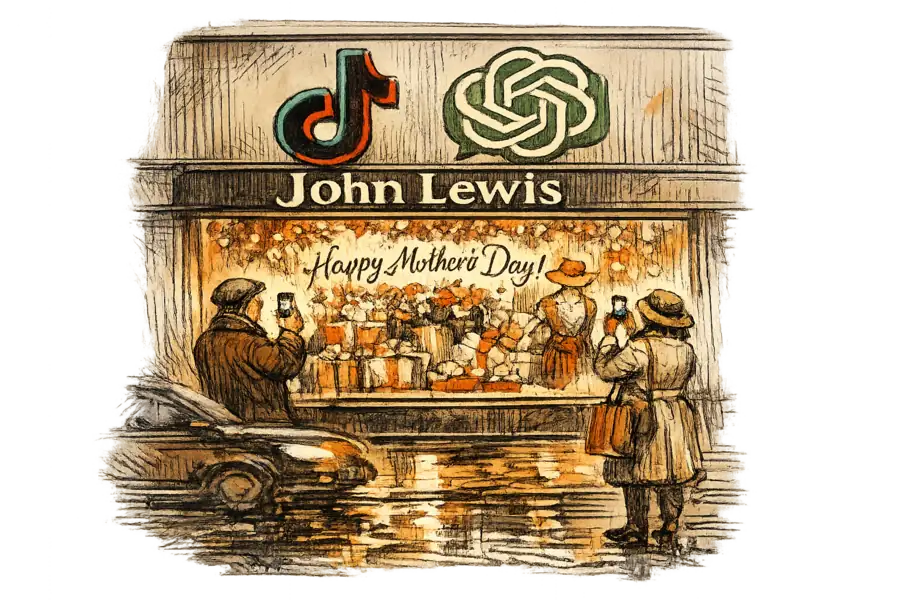
John Lewis bundled a TikTok Shop debut, ChatGPT and Gemini integrations, and an Uber Eats push because the discovery layer it has spent £800m refurbishing no longer carries the audience it needs. The destination is built; the funnel is rented.
Neritus Vale
John Lewis bundled a TikTok Shop debut, ChatGPT and Google Gemini integrations, and an Uber Eats expansion into a single 9 March announcement because its own discovery layer no longer justifies the £800m transformation budget on its own terms. The package launched a commercetools-powered agentic-commerce roadmap alongside a 90-day Mother’s Day pilot focused on beauty and gifting. The bundling tells you what £800m has not bought: an audience large enough to need only one front door.
The numbers behind the announcement explain the urgency. John Lewis department-store sales reached £4.9bn in 2025/26 at an operating margin of 1.6 percent. The headline 3 percent growth spans a 53-week trading year; the partnership also reported a net loss before tax of £21m, after £120m in exceptional charges. Recovery, not a thesis. The £800m programme announced in 2024 has paid for the Oxford Street refit, the Liverpool refurbishment, and a new commerce stack at commercetools, but it has not delivered an audience to put through them. The original line items were store-led; the channels the partnership now needs to reach customers were not in the budget when the budget was built.
The discovery problem cannot be solved by physical investment. Online already takes around 60 percent of John Lewis revenue, which means the next cohort of customers will not be found by upgrading dressing rooms. They have to be found upstream of johnlewis.com, where the partnership owns neither the page rank nor the algorithm.
The TikTok Shop pilot is honest about what John Lewis is buying. The window opens with a Mother’s Day Beauty Box and a curated edit of Jo Malone, Augustinus Bader, and Estée Lauder — categories that already sell on TikTok Shop UK, the country’s fourth-largest beauty retailer as of 2025. John Lewis is not testing whether the platform sells; the platform sells. It is testing whether the John Lewis name still adds margin to a category that no longer needs department-store curation to find a buyer. If the answer is yes, TikTok becomes a permanent third channel. A no would confirm that the brand premium does not survive contact with the For You feed.
The ChatGPT and Gemini integrations are a different kind of admission. John Lewis is not building agentic commerce; it is buying it through commercetools’ new agentic capabilities, including AgenticLift, launched in January to plug enterprise catalogues into ChatGPT, Gemini, and Copilot. That is the right call given the alternative cost, and a confession that the partnership cannot carry a meaningful retail-AI roadmap on its own engineering. The exposure is to the platform fee structure, which has not yet been written. Until OpenAI and Stripe’s Agentic Commerce Protocol decide what a referral is worth, John Lewis will be a price-taker on its own customers. The partnership has joined the queue of retailers betting that early access matters more than terms not yet published.
The Uber Eats expansion is the same logic in physical form. Stratford, Kingston, Cambridge, and Liverpool customers will receive John Lewis orders within 45 minutes on a courier network the partnership does not own. Rapid delivery is now table stakes for premium non-food retail; the question is whether John Lewis can extract a margin from the basket once Uber’s commission is subtracted. Next and M&S built that fulfilment capability into their own operations. John Lewis is leasing it on courier terms it does not set.
The audience the £800m was supposed to reach lives on platforms John Lewis does not own.
The case for John Lewis’s strategy is that retail discovery has already moved, and refusing to follow the customer is the more expensive mistake. If TikTok Shop and ChatGPT become the default product-search surfaces in the UK, retailers absent from those layers will look like Debenhams looked five years before it failed. The condition that would make this a winning bet is that the platform fees stay rational long enough for the partnership’s thin operating margin to absorb them. There is no evidence yet that they will. John Lewis is wagering that the brand pulls enough loyalty traffic to keep the basket profitable when discovery stops being free.
The cost of this announcement is the admission it makes about sequencing. The partnership has spent two years positioning John Lewis as a premium destination and is now telling the market that the destination alone is no longer sufficient. That admission is overdue. The coming year will reveal whether the brand survives in environments where the only cue is a price tag and a five-second video. If beauty travels and home does not, the £800m will have funded a profitable department store inside its walls and a discovery loss outside them. The partnership will then have to decide which version of John Lewis it is willing to operate.