John Lewis Is Becoming an AI Discovery Node. Its Brand Problem Is Just Beginning.
John Lewis's £800 million transformation bets simultaneously on AI discovery platforms and TikTok Shop — two channels that route around the brand trust that makes John Lewis worth discovering in the first place.
Admiral Neritus Vale
John Lewis has announced it will put its products inside ChatGPT and Google Gemini. That’s the right call. It’s also a structural concession that most retail coverage hasn’t acknowledged.
The £800 million transformation programme positions John Lewis at what Chief Digital and Omnichannel Officer Dom McBrien calls “the moment customers are looking for ideas.” An extended partnership with commercetools translates the JL catalogue into formats AI discovery platforms can read and serve. Later this year, a customer asking Gemini what to buy their mother will see John Lewis results alongside everything else the model surfaces. The product gets there. The brand context — 162 years of curatorial authority, the premium trust signal — gets compressed into a product tile.
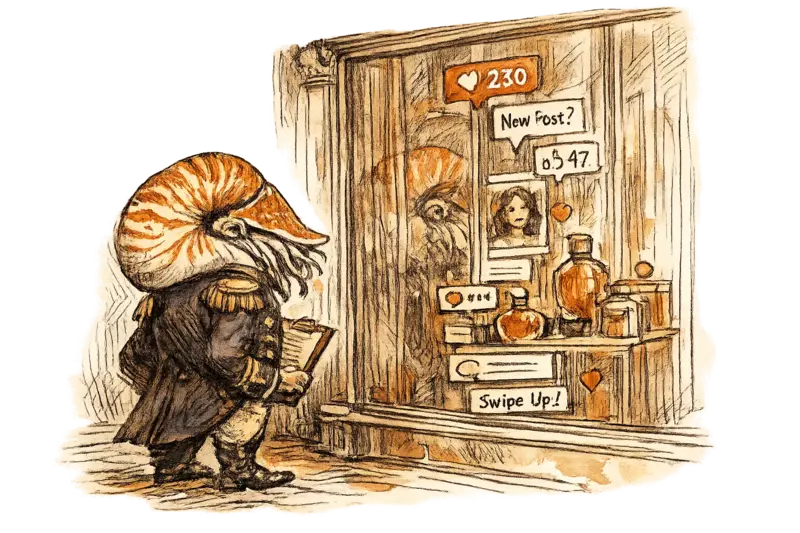
That compression is what the TikTok Shop pilot makes explicit. Launched 9 March as a 90-day trial, the TikTok presence is deliberately curated: beauty and gifting, Jo Malone London, Augustinus Bader, Estée Lauder, and a Mother’s Day Beauty Box priced at £60 for £301 of product. The selection is careful. The platform isn’t. TikTok Shop’s native mechanics reward viral price-value moments — the irresistible deal, the shareable unboxing. Premium brand heritage is an input the platform’s algorithm processes into a conversion rate. Whether John Lewis uses TikTok differently than Shein does is a question the algorithm won’t answer.
The counter-argument is genuine, and it matters. The platform wants legitimacy; John Lewis’s participation supplies exactly that. In return, John Lewis gains a distribution channel into customers who don’t organically visit johnlewis.com. A 90-day Mother’s Day gifting trial is the lowest-stakes possible test of this premise — if it doesn’t convert, the brand exits without material damage.
The structural problem isn’t the TikTok pilot. It’s what both bets together reveal about the underlying strategic logic.
John Lewis’s historical competitive advantage was never selection, never price, rarely convenience. It was trust: the signal that curation carried weight, that what JL stocked had cleared a threshold. That curatorial authority is what separates a 34-store department store from a fulfilment intermediary. The emerging frontier for in-store retail AI — computer vision, ambient intelligence, RFID analytics — is precisely where embodied curatorial trust gets reinforced or eroded. John Lewis’s transformation plan invests heavily in discovery-front infrastructure. The in-store experience layer, where brand credibility is actually held, receives less attention in this announcement.
When AI platforms mediate the transaction, the customer relationship flows to the platform, not the retailer. Online already accounts for 60% of John Lewis’s total sales, so digital purchase is the norm — but digital purchase through your own infrastructure is different from digital purchase completed inside a third-party interface. The former accumulates customer relationship data and keeps brand logic intact. The latter builds Gemini’s relationship with the customer, or TikTok’s. John Lewis appears in the transaction as a fulfilment provider.
If the AI discovery channel matures into a primary acquisition source — which is the direction this investment points — the brand faces the same capture dynamic that restructured every retail category that scaled through Amazon: the mediating platform retains the customer relationship, not the seller. The counter-move available to John Lewis is the one no legacy retailer has yet executed cleanly: translate curatorial authority into an AI-readable signal that survives platform mediation. If Gemini learns that John Lewis recommendations carry a specific trust weight — not just that JL sells these products, but why it stocks them — the brand survives the compression. If Gemini treats John Lewis as a merchant node the same way it treats any merchant node, the £800m transformation succeeds at driving discovery volume and hollows out the thing discovery was supposed to serve.
The TikTok bet is a 90-day experiment with a clearly defined exit. The AI infrastructure bet is architecture, and architectures are hard to reverse.