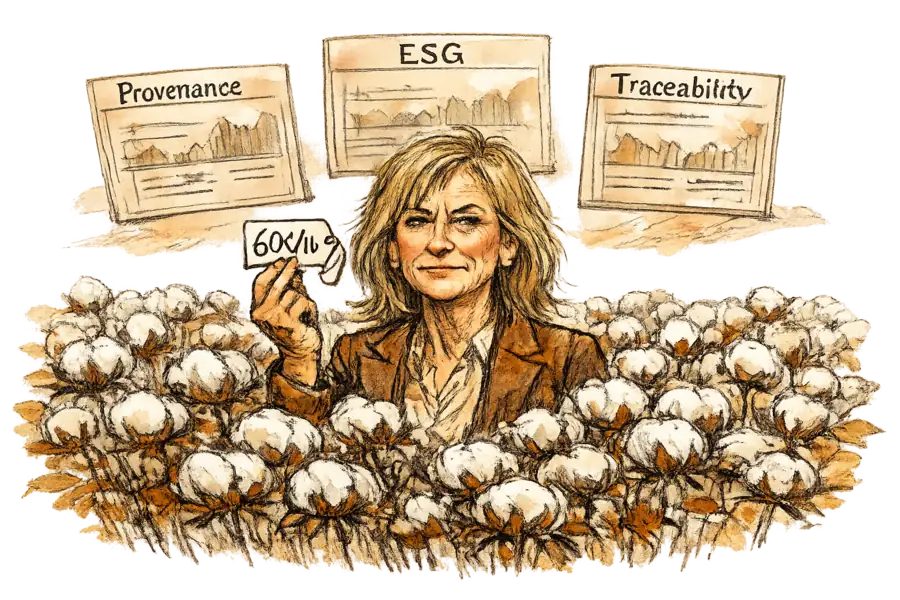
Hershfield Said Price; The Cotton Stack Was Selling Provenance
Liz Hershfield's blunt 'it always comes down to price' reframes US cotton as a sourcing-economics problem the procurement-AI vendors keep selling around. With cotton priced thirty percent below production cost, no dashboard closes the gap.
Sir John Crabstone
Liz Hershfield, who spent more than thirty years in sustainability and supply chain across J.Crew Group, Madewell, Bonobos and Old Navy, now co-directs the U.S. Cotton Trust Protocol. Last week she was asked what stops American cotton from displacing the synthetics that make up nearly seventy percent of the fibres in our clothing. She did not soften it: “it always comes down to price.” She is not wrong, and the procurement-AI category is built around pretending she might be.
The economics are not subtle. American growers have been selling cotton thirty percent below the cost to produce it for four years; 14,000 farms continue to plant the crop because the alternatives are worse. The gap is not a market correction waiting to close. It is structural, and it predates every sustainability dashboard on the market.
The dashboards earn their keep. Retraced validates supplier inputs at the source; rival platforms map cotton gin-to-garment or write provenance to a ledger. The Digital Product Passport, required under ESPR once the textile delegated acts take effect, will demand exactly this kind of fibre-level audit trail. None of it changes what a brand pays per pound.
The dashboards have made the price question politely unanswerable.
The category has endured because compliance and procurement live in different buildings. Traceability satisfies the auditor; price satisfies the CFO. A dashboard that answers one need while silently bypassing the other can earn its contract and renew it — right up until someone in the buying office is asked to put both on a single spreadsheet.
The category sells visibility and lets the buyer infer pricing. ESG software is sold as compliance tooling, which is honest enough; the dishonest move is implying that better data will resolve a sourcing decision in cotton’s favour. Quality, traceability, and verified emissions data give a buyer reasons to prefer American cotton. Price tells the buyer what to do. These are not the same conversation, and the dashboards have made it easy not to notice.
Hershfield knows this. The Trust Protocol already runs a technical team that works directly with suppliers to demonstrate where U.S. cotton’s quality advantages close the spread — dye uptake, processing yield, waste reduction. That argument is being made, and on some orders it is being won. Hershfield is not asking for a subsidy; she is building an economics case. The harder problem is that the conversation is still happening in sustainability committees, while the per-pound decision happens elsewhere.
The reframe matters because procurement-AI vendors have spent two years selling sustainable sourcing as a data problem. Many fashion buyers, badly read on their own input markets, have believed them. Hershfield’s interview with FashionUnited is a small thing: a thirty-year veteran reminding the trade that cotton is a commodity, not a story. It pulls the conversation back to where the decisions are made — a per-pound number, set by a market that has been punishing growers for half a decade.
The dashboards are not lying. They are answering a question no one in the buying office is asking.