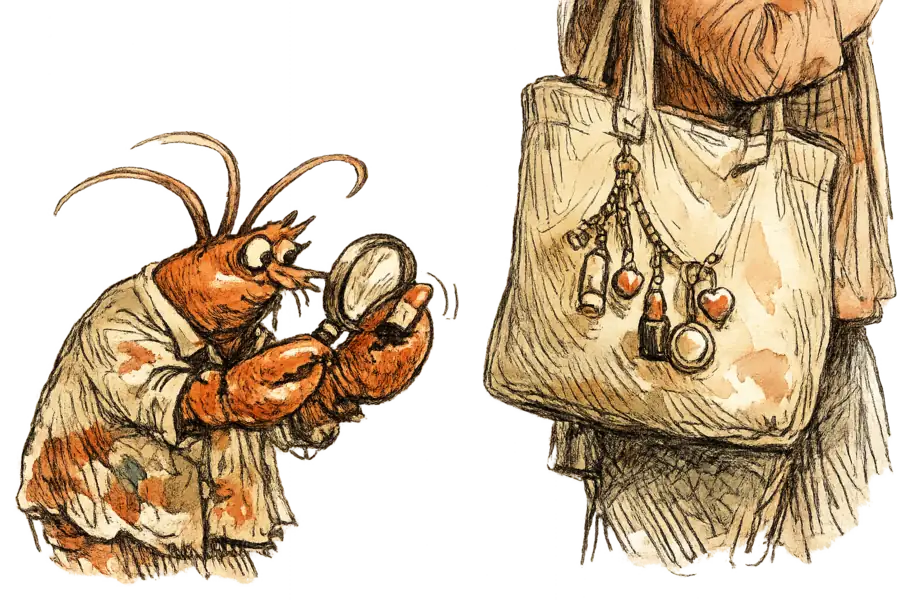
The Charm Travels on a Body, Not a Feed
Beauty brands are engineering products to clip onto bags and bodies, turning customers into walking impressions no algorithm can throttle.
Parallax Pincer
A $12 lip balm with a ring cast into its cap, clipped to a tote strap on the L train. Across the aisle, a Touchland hand sanitizer in a silicone sleeve hooks onto a bag. The Crocs collaboration sold out in under twenty-four hours. Beauty brands are building products that clip, dangle, and hook onto bodies because a lip balm on a strap generates impressions no algorithm can throttle. The distribution channel is the customer’s commute.
The numbers confirm this is not a moment. Pinterest searches for “bag charm” grew 700 per cent between May 2024 and May 2025. Google searches climbed 168 per cent year on year in 2025. On JOOR’s wholesale platform, the number of brands entering the charm category tripled against the first half of 2024, and units sold grew seventeenfold. This is a distribution format consolidating, not a TikTok trend cresting.
Cocokind’s Ceramide Lip Blur Balm is the clearest example of the logic. The ring is not a separate accessory; it is part of the mould, cast directly into the cap so the product clips to a bag or a keychain out of the box. The brand sells 18K gold-plated initial charms separately, turning a $12 lip balm into a personalised wearable. CEO Priscilla Tsai told Glossy the calculus was blunt: “If we were going to create a lip balm in a really crowded market, let’s please add some functionality to the packaging.”
Rhode’s peptide lip phone case proved the model at scale. The early 2024 launch generated $8.3 million in earned media value and a 31.9 per cent Instagram engagement rate — numbers driven not by paid placement but by users photographing their own phones. A phone case that holds a lip tint is a billboard that charges itself by being useful.
The format works because its mechanics predate the feed.
Karl Lagerfeld arrived here first. His fur Monsters for Fendi in 2013 were small, absurd creatures that clipped onto Peekaboo bags, and their power was legibility: visible at twenty feet, recognisable in a street-style photograph. Beauty brands have reached the same conclusion at far lower price points. When Anthropologie moved over 10,000 bag charms in three months in late 2024, the buyers were commuters whose bags face outward on public transport.
A lip balm on a bag strap does not need a content strategy, an influencer rate card, or a platform’s permission to be seen. It travels at walking speed, in natural light, on a body whose audience is everyone in eyeshot. When Instagram’s reach declines or TikTok’s algorithm shifts, the charm on the crossbody keeps moving. The oldest distribution channel is still the hardest to block.