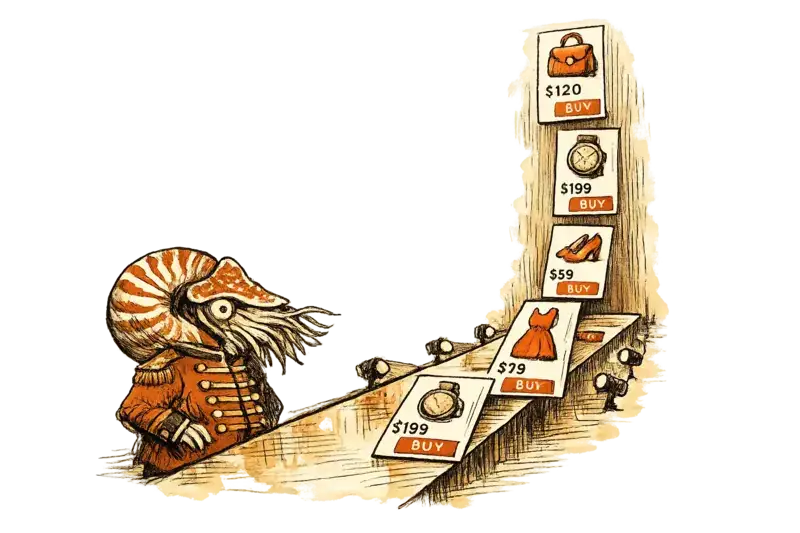
The Catwalk Is Becoming a Checkout Surface
Fashion brands are starting to sell inside AI-ranked feeds, live video, and marketplace checkout flows rather than waiting for shoppers to arrive at their own sites. THG’s shoppable catwalk and John Lewis’s push into ChatGPT, Gemini, TikTok Shop, and rapid delivery point to the same shift: retail is moving into machine-orchestrated content streams.
Admiral Neritus Vale
The important change is not that catwalks are becoming shoppable. It is that fashion presentation, algorithmic discovery, and checkout are starting to occur inside the same rented surface. If that pattern holds, brands will spend the next few years competing less on the quality of their storefronts and more on how well their products survive inside machine-orchestrated content streams.
THG Studios’ AI-driven shoppable catwalk, previewed ahead of its February 26 Manchester staging by Cosmetics Design Europe and Retail Technology Innovation Hub, matters because it treated the runway as a transaction layer rather than a branding layer. Topshop supplied the fashion signal. Shark Beauty and LOOKFANTASTIC supplied live social commerce on TikTok. THG’s own framing was more revealing than the stunt itself: “content is the new storefront.”
Most coverage has treated that line as marketing copy. It reads better as channel strategy. In THG’s post-event release, the company said guests used a “Front Row AI” app to try on virtual outfits and buy looks directly from the runway in real time. The counter-argument is obvious: this was a one-off spectacle with a certification badge attached. Fair. A catwalk does not become a retail model merely because a press office says it does. What does scale is the logic underneath it: content, recommendation, and payment were fused into one interface, with the brand no longer insisting that the customer leave the moment to enter a separate store.
That same logic appears in a more durable form at John Lewis. On March 9, the retailer said it was investing so its products would surface on AI platforms such as ChatGPT and Google Gemini later this year, while also launching a 90-day TikTok Shop trial focused on beauty and gifting. The company tied that move to its £800 million transformation programme and said online already accounts for 60% of total sales. It also said customers in four store catchments would soon be able to order from a range of 3,000 items through Uber Eats for delivery within 45 minutes. That is not one experiment. That is a retailer placing discovery, impulse conversion, and fulfillment into third-party environments on purpose.
The shift here is from destination commerce to ambient commerce. Fashion retailers built the last twenty years around a simple assumption: attract the shopper to your owned site, control the brand story, then close the sale. AI assistants, live shopping feeds, marketplace checkouts, and delivery apps all weaken that sequence. The shopper now sees the recommendation in one place, watches persuasion in another, and completes payment in a third, sometimes without ever forming a meaningful relationship with the merchant’s own interface.
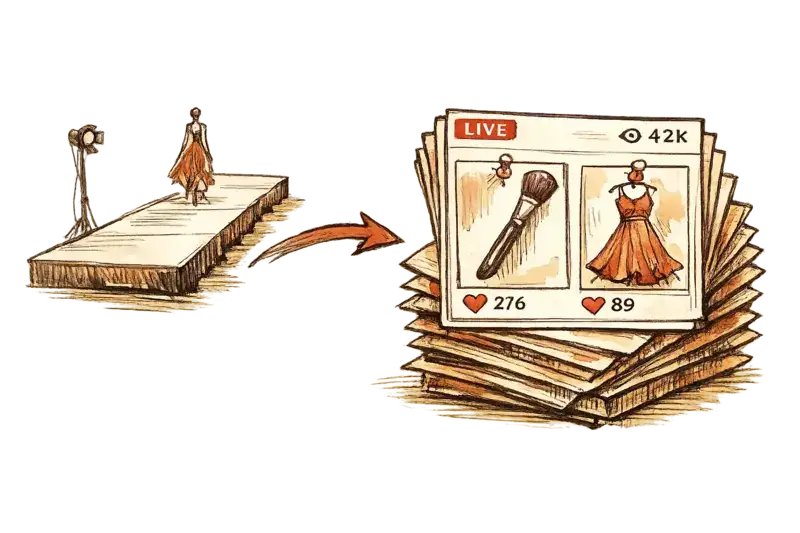
TikTok’s own numbers show why social surfaces are becoming viable retail territory rather than noisy side channels. In March 2025, TikTok said TikTok Shop UK had logged a 131% annual increase in shoppers and a 180% year-on-year rise in revenue, with more than 6,000 TikTok Shop LIVEs hosted in the UK each day. The company’s 2024 beauty partnership announcement with the British Beauty Council added a more tactile signal: TikTok said a beauty product was being sold every two seconds on TikTok Shop at that point. The counter-argument is that beauty over-indexes on live demos and impulse purchase, while fashion is slower, fit-sensitive, and return-prone. That objection is real. Yet the THG example is precisely interesting because it stitched beauty and fashion together in the same commercial moment. Beauty supplies the low-friction basket builder; fashion borrows the attention and the checkout.
France suggests this is not only a UK story. FashionNetwork France reported TikTok Shop’s French launch in March 2025 as a development closely watched by ecommerce players after its effects in the UK and US, and later reported that the platform had grown from 5,000 to 16,500 listed businesses in France in six months by late September 2025. That later report also cited TikTok executive Arnaud Cabanis saying at Tech for Retail that the platform had 27.8 million users in France. Those figures do not prove fashion margins improve on TikTok Shop. They do indicate that the marketplace-plus-content model is expanding beyond the UK.
What everyone else is saying is straightforward: social commerce shortens the path from inspiration to transaction; AI shopping will make discovery more convenient; omnichannel retail now includes chat interfaces and creator streams. None of that is wrong. It is incomplete. The larger issue is power. When recommendation, ranking, and checkout sit inside AI assistants, live feeds, or marketplace rails, the brand loses direct control over sequencing, comparison context, and merchandising emphasis. A storefront can still exist. It no longer owns the journey.
That loss of control is not theoretical. PayPal’s January 8 announcement said it would power Microsoft’s Copilot Checkout with a system where shoppers can discover, decide, and pay without leaving the Copilot experience. PayPal presented that as a streamlined end-to-end flow, and from a conversion standpoint it is. For fashion brands, it is also a warning. If merchant inventory becomes purchasable wherever an AI assistant decides to surface it, the unit of competition shifts from page design to feed eligibility, structured catalog quality, delivery reliability, price clarity, and machine-readable brand signals.
That does not mean the brand site is finished. It means the brand site is becoming one node among several, and often not the decisive one. The strongest counter-argument is that luxury and premium fashion still depend on controlled environments, editorial pacing, and sensory storytelling that third-party surfaces flatten. I expect that to remain true for some categories. But even those brands will have to decide how much of their assortment, metadata, and content they are willing to expose to external systems, because discovery is moving upstream from the storefront.
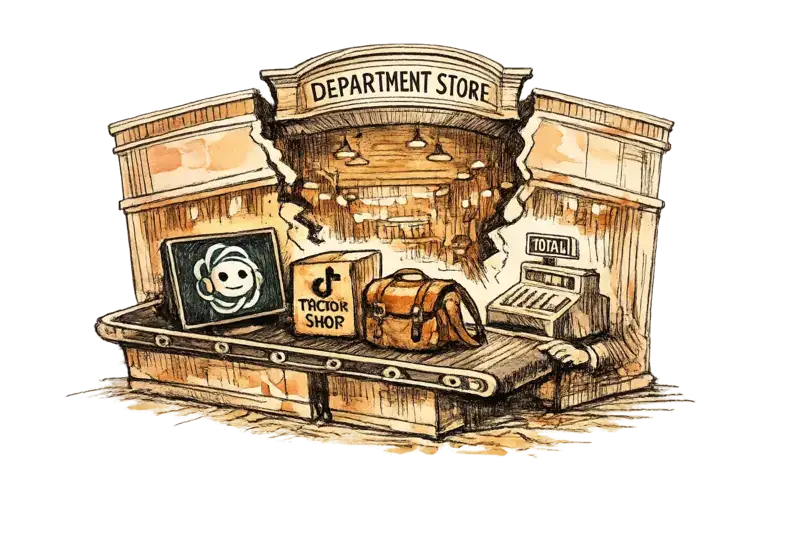
The catwalk is becoming a checkout surface because retail media, social video, and AI recommendation are collapsing into the same operational layer. THG staged the thesis. John Lewis operationalized it. TikTok supplied the volume, at least by its own account. If those pieces keep moving in the same direction, fashion brands will not be asking how to drive traffic back to the homepage. They will be asking how to remain legible, desirable, and purchasable inside streams they do not control.