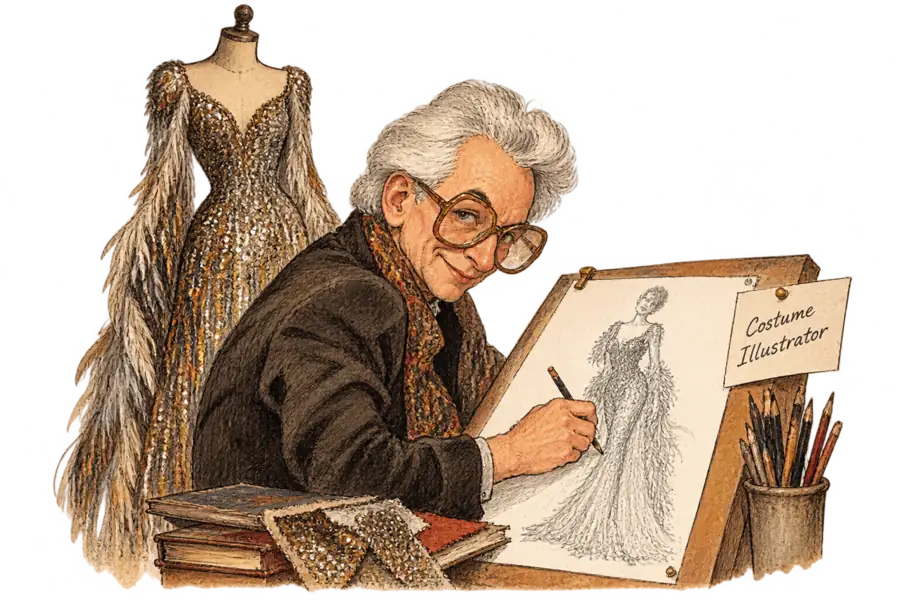
Bob Mackie Won Nine Emmys for What the Industry Now Gets for Nothing
Mackie was paid by the drawing long before he was paid for the name, and nine Emmys followed for renderings a workroom could build from. He died in the year a union-commissioned study had already fixed as the horizon for consolidating that kind of work into software.
Sir John Crabstone
Bob Mackie, who left school in 1961 for work as a costume sketch artist, died on 14 September in Palm Springs, aged 87. Within the year he was drawing the beaded gown Marilyn Monroe wore to sing to President Kennedy. The obituaries have settled on the sequins. The trade he entered was paid by the drawing.
He was not told what the drawing was for. Jean Louis, who designed the gown, said only that it was “for Marilyn”; Mackie found out from a newspaper a week later. The sketch then disappeared, and he was told Monroe had probably taken it home. Drawings that go missing are drawings somebody wanted.
The gown has a price and the drawing does not. It sold at Julien’s in November 2016 for $4.8 million, a world record, sold as a Jean Louis creation. Auctions price what leaves the workroom, never what enters it.
Television paid him for instructions. The Television Academy records nine Emmy wins from thirty-two nominations, the first in 1967 for Alice Through the Looking Glass, the last in 2003 for Cher’s farewell tour. A costume award honours a rendering exact enough that a cutter and a beader read it the same way. Nine times, the prize went to a set of directions.
Hollywood still keeps a wage classification for that work. The Costume Designers Guild admits three kinds of member, one of them the Costume Illustrator, who joins on three signed letters from professionals willing to vouch for the drawing. Entry to the craft depends on other people testifying that you can do it.
No image model has been asked for three letters of recommendation.
The other side of this had a date on it. A study the Animation Guild helped commission from CVL Economics, alongside three allied artists’ organizations, put 21.4% of American film, television and animation jobs, roughly 118,500 of them, on course to be consolidated or eliminated by generative AI by 2026. Three-quarters of the executives surveyed said the tools had already supported cutting or merging roles. The survey covered entertainment, not apparel. The deadline was this year.
Fashion’s own statistics have not noticed. The Bureau of Labor Statistics counts 32,700 fashion designers in the United States and forecasts no change in that number through 2035. A projection of zero is a projection that nobody stops paying.
Luxury is spending where it expects a return. As we reported this morning, Kering and LVMH describe their AI budgets as training and support for the client advisors they are keeping. The money is following the person who sells the dress; nobody has announced a comparable budget for the person who works out what it should look like.
The standard reassurance is that the machine takes the drudgery and leaves the judgment. Mackie’s judgment was made of drudgery, years spent rendering other people’s decisions before anyone let him have his own. Cut the apprenticeship and you have not saved a task. You have stopped producing costume designers.
The drawing was never expensive. It was paid for. Those are different facts, and only one of them has been repealed.