Platform Fees in Vietnam Doubled. The Cure Costs 800,000 Đồng a Month.
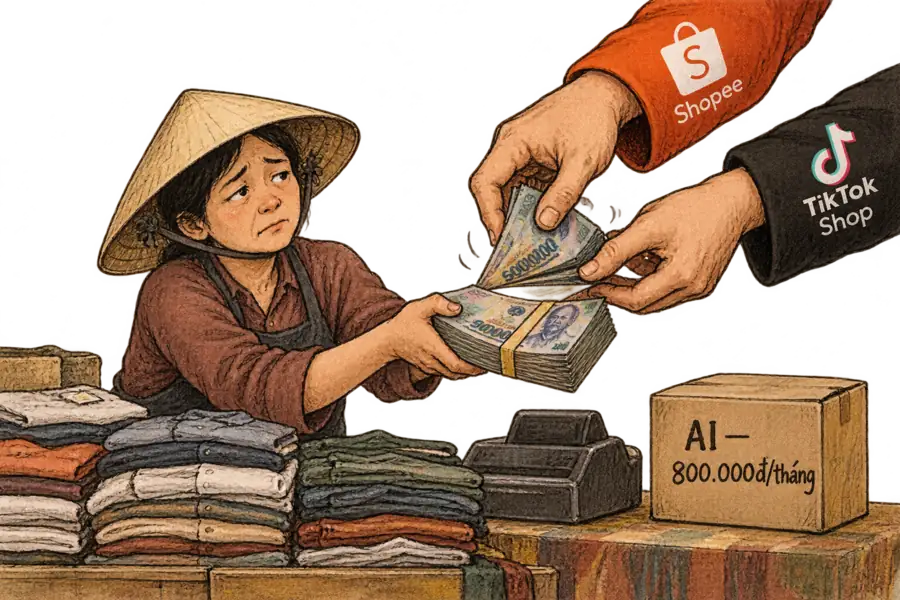
Total platform fees on Vietnam's marketplaces rose from 9–14% of seller revenue to between 21.8% and 33.8%, and the remedy the trade press prescribes is an AI subscription costing 800,000 đồng a month. The saving lands on the one line of the bill the seller still controls.
Sir John Crabstone
Vietnamese marketplaces have more than doubled the price of selling on them. Total platform fees rose from 9–14% of a seller’s revenue to between 21.8% and 33.8%. Fixed commission alone climbed from 2–5% to as much as 17.8%, on an SHS Securities analysis reported by CafeF. The remedy the trade press prescribes is AI, bought to cut what the seller spends. It presses on the one cost the seller still controls.
Apparel took its share of the increase and has nowhere to put it. TikTok Shop lifted the fashion commission from 14.6% to 16.1% in May. Sellers put their total platform burden at 23–24% of revenue, on a Dân Việt report carried in English by Vietnam.vn. They expect to pass three to five points of it to shoppers. A seller who raises the price of a shirt on Shopee competes against the same shirt, listed by someone who did not.
Scale explains why apparel is where the increase pays. Vietnam Briefing’s read of the half-year data puts women’s fashion at 40.35 trillion đồng across the four big platforms in the first half, second only to beauty. One point of commission on that base outruns any efficiency programme a seller could run in a year. The same read shows Mall revenue, from verified storefronts, up 54% even as seller count fell 6%; the fee increase is not landing evenly.
AI came into Vietnamese commerce this year priced as a cost defence, as we reported in August. The fee schedule explains why. Basic tools run about 800,000 đồng a month. One construction-equipment firm cut hotline and chat staffing from five people to the equivalent of half of one, on Thời Báo Ngân Hàng’s account of the squeeze. The same report puts operating costs near 30% of sales. Ninety percent off a chat rota is a real saving; it recovers a fraction of what May took.
Every đồng a seller saves is a đồng the platform now knows is there.
Shopee wrote that knowledge into the payment rail. Its Duy trì hiển thị programme, due on 29 May, would have taken a slice of each completed order and deposited it in the seller’s promotion account on Shopee. The deduction ran before the money reached the seller: one percent of pre-VAT revenue by default, adjustable up to fifty. Vietnam’s National Competition Commission ordered the platform to reassess the basis and the impact; Shopee then proposed the postponement itself. Revenue was to become advertising inventory before anyone decided to spend it.
The objection is that maturing marketplaces always charge more. Nguyễn Quốc Tuấn, who founded Scareup after running Juno, said at a Người Lao Động-hosted panel in March, as carried by CafeBiz, that platforms reaching a level like Amazon’s 35–40% could push 80% of sellers off. Nguyễn Minh Đức of VECOM, quoted in the same piece, argued the opposite: Vietnam’s market is open enough that sellers and shoppers can switch freely, which caps how far any single fee schedule can run. Headroom, it turns out, is a claim with a rebuttal already attached to it.
The National Competition Commission is the only party that has lowered a Vietnamese seller’s costs this year, and it did it by reading a fee schedule. No software was installed. Sellers are being sold a cheaper way to work inside an arrangement whose price the other side sets. The tools will do what they promise. They have no view on who ends up with the money.