Unilever Spent The Laundress's Price on Target's Footfall
The only executive quoted on The Laundress's arrival at Target runs Unilever's North American home care division, and the largest expansion in the brand's history was settled on her desk. The volume growth behind that push belongs to Unilever's global home care business, not to her underperforming region. The premium price is what the brand is spending to buy doors regardless.
Sir John Crabstone
The only executive quoted on The Laundress’s arrival at Target runs a division, not a brand. Kathleen O’Brien’s remit is Unilever’s home care business in North America, and the largest retail expansion in the brand’s history was settled on her ledger: 600 stores now, a thousand by March 2027. Shelf has become the cheaper introduction, and the premium price is the toll.
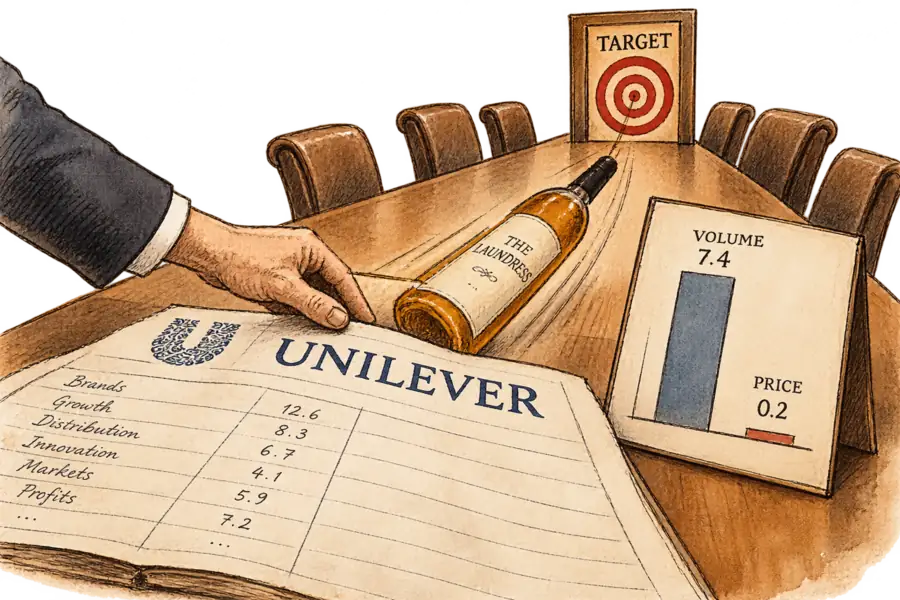
That ledger is not hers alone. Unilever’s global home care division turned over €6.0 billion in the first half of 2026 and grew 7.6%, with 7.4 points of that from volume and two-tenths from price, against 4.8% for the group as a whole. The lift came from India and Brazil; Unilever’s North American business, all categories combined, managed just 2.7% in the same period, with price actually falling. The instruction travels down regardless: chase volume, not margin. A thousand Target doors is how a home care executive obeys that order when her own region isn’t generating it.
The brand had been renting its shoppers for years. Unilever has owned it since 2019, and sales have lately split roughly evenly between its own site and Amazon. Half the revenue of a direct-to-consumer business arrived through a search box in Seattle. September adds a landlord, not an escape.
Consider what was rebuilt to suit the host. The Target range arrives with enhanced formulas, refreshed packaging, fifteen SKUs, a fragrance called Cloud sold nowhere else and scent testers built into the display. A brand guarding its position does not hand a retailer something its own customers cannot buy.
A brand that can be reformulated for its host was never the one choosing the host.
The trade files this under premiumisation. Diana Melencio of XRC Brand Capital Fund appeared on a Modern Retail podcast that cited her firm’s research: fragrance grew 15% in mass last year, against 5% in prestige. Growth sits in the cheap aisle, which is why the expensive brand was sent to it.
Target had sold that space once already. Laundry Sauce, a direct brand built on fragrance, reached the same aisle in March and called it the biggest retail expansion in its history. That sentence is available to anyone Target admits.
The timing is a verdict on paid media. One marketer at a closed-door dinner told Modern Retail that search and display advertising had lost their grip as shoppers put their questions to language models instead. Brands are turning back to stores and to people. Six hundred doors is a media buy that ships product.
Unilever says the direct business stays. It will partner exclusively with Target for the foreseeable future while keeping its own site and its Amazon trade. Exclusivity of that kind is granted from above, and it goes to whichever channel holds the most strangers.
The toll is the reference point. On its own site the brand sets the comparison, down to a $30 wool and cashmere shampoo. In an aisle measured in loads, somebody else sets it. The price stops describing scarcity and starts describing nerve.
O’Brien’s division means to double its business by 2030. Four years will not teach the world a new price. It is ample time to put a bottle where the world already walks. The arithmetic says nothing about which part of the brand is meant to survive the trip.