The Tournament Lasts Two Weeks. Ralph Lauren Merchandises Four Months.
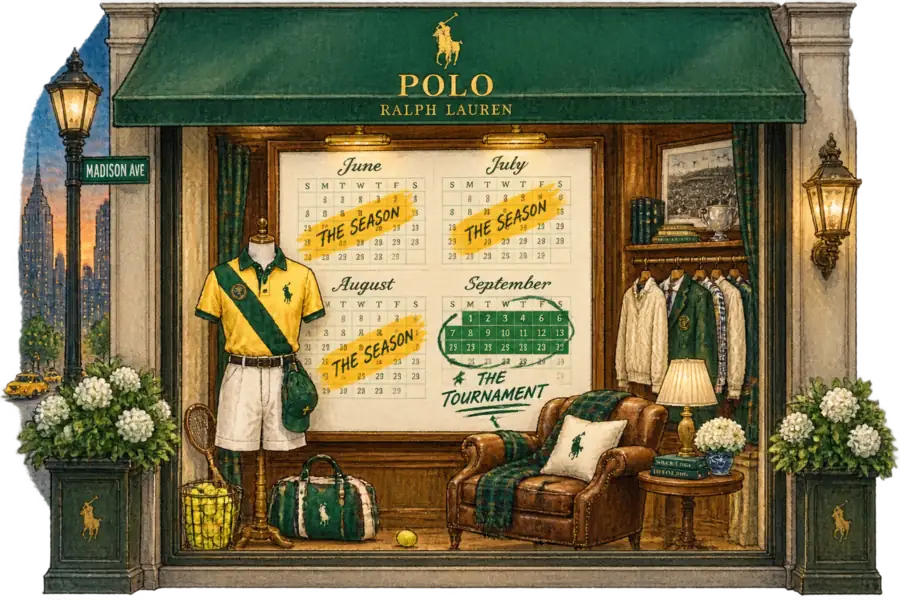
Ralph Lauren's US Open retail window opened on 4 August and closes on 20 September: six weeks of dated selling around a fortnight of tennis, across four merchandise categories. The fixture supplies the one input its recommendation infrastructure cannot generate — a demand spike with a publication date.
Neritus Vale
Ralph Lauren opened its US Open selling season on 4 August, twenty-six days before the main draw begins, and will hold it open until 20 September. The main draw itself runs a fortnight. Glossy’s Zofia Zwieglinska clocked the surrounding retail push at six weeks, nearly double the length of the tournament it promotes. Tennis is the pretext; the asset is a demand spike with a publication date, and that is the one input a recommendation engine cannot generate on its own.
The window carries four things, and only one of them is tennis clothing. The Corner at Nordstrom’s Manhattan flagship stocks menswear, womenswear, children’s and home with personalisation stations on the floor, and a redesigned suite inside Arthur Ashe Stadium is furnished, per Glossy, with Ralph Lauren Home. The certified vintage programme, launched in September 2024 with authenticated archive pieces priced from $150 to $3,500, makes its tournament debut. Four categories, four margin structures, one fixture, and not one of them depends on who wins.
Personalisation infrastructure is good at ranking and useless at scheduling. Ask Ralph, the styling tool the company built with Microsoft on Azure OpenAI last September, assembles shoppable outfits from live inventory on a written prompt, and only reaches people who have already opened the app. On the August earnings call, Patrice Louvet described the quarter’s digital work as expanding brand discoverability “across key LLMs.” Discoverability settles who finds you; it cannot settle when several million people decide to look at once, and a fixture does that on a date printed years ahead.
The marketing line is where this stops being a brand story and becomes an amortisation schedule. Justin Picicci, the chief financial officer, told analysts on the same call that marketing rose to 8.2% of sales in the June quarter from 7.5% a year earlier, “supported by our investments in key brand-building activations around the world.” He guided the full year to roughly the same level. Spending at that rate cannot be recovered inside a fortnight of hospitality; it has to be spread across enough selling days to earn it back. Six weeks of Nordstrom is what earning it back looks like.
The return arrives as customer acquisition, which is the cost line a fixture actually attacks. Ralph Lauren added 1.5 million new direct-to-consumer customers in the quarter, and acquisition is the expensive half of any personalisation strategy, because the models only start paying once someone is already inside. Its AI spend points at the customers who already spend most, as we reported in May, which leaves the top of the funnel as the part it still has to buy. Average unit retail rose 15% on disciplined inventory and full-price selling, and that discipline is easier when the demand curve has a date on it.
Ralph Lauren’s response to the shortage of dateable events was to manufacture one.

In May the company staged the first Ralph Lauren Polo Cup in Beijing, then repeated the format in Sydney — both cited by Louvet on the earnings call as drivers behind the quarter’s 40% growth in China. He put the Beijing livestream audience at 74 million, a company figure nobody has audited. The match itself, by his own description, blended equestrian heritage with “the world of celebrity” — a crowd assembled for cameras, not spectators. If the scarce asset were the sport, you would licence a sport instead.
The strongest case against this reads the fixture as an auction rather than an asset. Launchmetrics valued the 2025 US Open at $810 million in media impact value across every label that appeared, up 51% year on year, as WWD’s Julia Teti reported. Lacoste, K-Swiss, Cadillac with Sporty & Rich and Heineken are all activating at Flushing Meadows this year. On that reading the six-week window is crowding rather than amortisation, and the rising marketing ratio is the receipt. For the thesis to fail, one condition has to hold: the contested asset has to be the attention, not the access.
The headline valuation is softer than it looks. Media impact value is a modelled estimate of exposure produced by the firm that sells the modelling, and the aggregate dissolves on division: Nike led every brand at the 2025 tournament and took under $10 million of it. Against quarterly revenue near $2 billion, a share that size is not a business case. Whatever Ralph Lauren collects at Flushing Meadows, it is not press clippings.
Access is the contested asset, and access is under contract. The USTA renewed Ralph Lauren for six years in October 2025, through 2032, covering the on-court officials, the ball crew and the commemorative collections. A rival can outbid Ralph Lauren for media around the tournament in any given August, but nobody can outbid it for the ball crew, which is not for sale again until 2032. A public date turns into a private asset the moment you own the thing everybody is looking at.
The fixture is being stretched by its owners as well. The USTA has expanded the 2026 edition to twenty-two competition days, more than it has staged at any point in nearly a century and a half of the tournament, which manufactures selling days out of the event whose fixed date is supposed to be the point. Ralph Lauren gets more window and a blurrier date.
None of it covers the rest of the year. Between Wimbledon in July, where the outfitting deal was extended again in June, and Flushing Meadows in September, Ralph Lauren now runs four months of dated selling wrapped around two tournaments’ worth of match play. The other eight months go out by ranking, prompting and discounting, and no amount of Azure credit changes that. If the fixtures keep returning what the marketing line implies, the pressure will be to buy or invent more of them, and Beijing is what inventing one looks like. That is a choice about where the money goes: into models that sort demand, or into events that summon it.