
SMCP Bought Its Resale Data Back. The Green Story Was Camouflage.
SMCP's move to internalise its resale channel through Faume's white-label infrastructure isn't a sustainability play — it's a data and margin recapture operation. Half the customers redeeming buyback vouchers weren't in the brand's CRM. That's the number that explains the strategy.
Admiral Neritus Vale
Half the customers redeeming SMCP’s resale vouchers weren’t in the brand’s CRM. That single figure, reported by FashionUnited in its analysis of SMCP’s internalisation strategy, explains what the group is actually doing by bringing second-hand in-house through white-label platform Faume — and it has very little to do with circularity. When Vinted and Vestiaire Collective built their resale audiences, they weren’t just educating consumers about pre-loved fashion: they were steadily extracting three assets brands had ceded without fully pricing — customer data, brand experience control, and margin on the extended product lifecycle.
SMCP CEO Isabelle Guichot described the inflection point plainly: “Seeing the volume of our own items on platforms like Vinted was a wake-up call.” What she is describing is a revenue recognition event. The pre-loved market for Maje and Sandro garments was already large; the question was who was capturing the economics of it. Third-party platforms handled the transactions, kept the behavioural data, set the presentation standards, and pocketed the margin on facilitation. The brand provided the desirability and received nothing from the aftermarket except the occasional indirect reputational benefit of items circulating at sustainable price points.
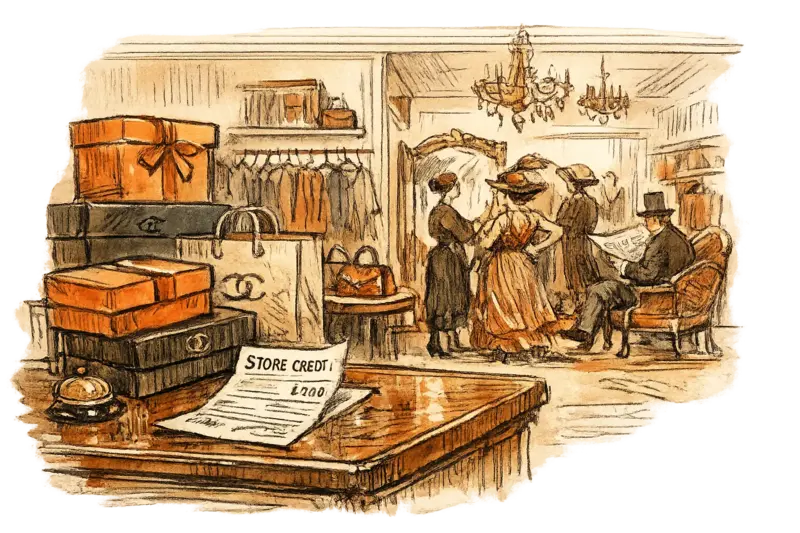
The economics of the fix are precise enough to be convincing. Customer acquisition cost through traditional digital channels can exceed €100 per customer, according to AlixPartners partner Olivier Abtan, cited in the same analysis. A second-hand transaction, by contrast, functions as a largely self-funded acquisition event — the resale margin offsets the outreach cost. SMCP’s internal data shows approximately 30 percent of customers who first interact with the brand via the second-hand channel go on to purchase new products within eighteen months. The average buyback voucher runs around €60 — which is the mechanism as much as the number. A new Maje piece costs more than €60. The customer supplements the voucher. The brand captures the transaction, the upsell, and the CRM entry all at once.
The physical store’s role in this is not peripheral. SMCP runs buyback through roughly 50 European points-of-sale per brand, and a drop-off visit is structurally different from a digital browse — it requires intent, involves face-to-face interaction, and generates the kind of profile data that clienteling systems need but rarely get from e-commerce behaviour alone. Faume CEO Aymeric Déchin describes the presentation standard: “A second-hand product should never be synonymous with a degraded experience. Desirability lies not only in the object, but in the tone, imagery, and every interaction.” Products are authenticated, refurbished, and shipped in original house packaging. The second-hand tab on Maje’s site is designed to mirror the main boutique — not distinguish itself from it.
The broader French retail pattern running in parallel is worth tracking as confirmation rather than coincidence. FashionUnited’s coverage of Chaussea’s acquisition of Kickers — following San Marina and Pataugas in 2023 — maps the same structural insight playing out in footwear: a distributor-operator that owns the brand and controls the distribution channel can absorb margin at every stage of the value chain. Ba&sh’s 2025 recovery — back above €300 million in turnover, with accessories growing 20 percent — tells a similar story from a third angle: find the higher-margin categories within your own brand, stop conceding them to adjacent players. The unifying logic is the same: own the value chain or watch someone else extract the economics of the segment you created.
The counter-case is Kering, which invested in external platforms rather than building internal channels. That choice is defensible at true luxury price points, where the platform’s arm’s-length distance can reinforce scarcity signalling — Hermès does not need to run its own pre-owned channel because scarcity is the product. But SMCP sits in the accessible luxury tier, where volume and repeat purchase are the actual growth levers. Ceding the second-hand flow at that price point is not scarcity management. It is margin donation at scale.
The largest play is further out. SMCP’s stated near-term objective is to unify all interactions — purchase, resale, rental, repair — within a single data environment capable of mapping non-linear, multi-touchpoint customer journeys. Guichot: “The purchasing journey is no longer linear. We must be present at all touchpoints, whether it’s social media, e-commerce, shop windows, or the resale market.” If that unification executes, the brand holds behavioural data on wardrobe renewal frequency, real price sensitivity by category, and upcycle patterns that no platform will willingly share. The pre-loved segment is forecast to grow at roughly 10 percent annually through 2030, outpacing the primary market by a substantial margin. The brands that read that figure as a sustainability story are misreading it. It is a market-share question — and the entities currently holding that share are Vinted and Vestiaire. SMCP has decided to take some of it back. The circular economy language made the strategy legible to press releases. The CRM data is what makes it strategic.