Shein Asked For 25 Times Earnings. The Market Priced A Freight Company.
Shein's investor documents argued for a multiple matching Inditex's 25 times earnings. Hong Kong listed it at under thirteen, reclassifying the company from a technology platform to a logistics operation. The same reclassification is waiting for every retailer selling its algorithm as the asset.
Sir John Crabstone
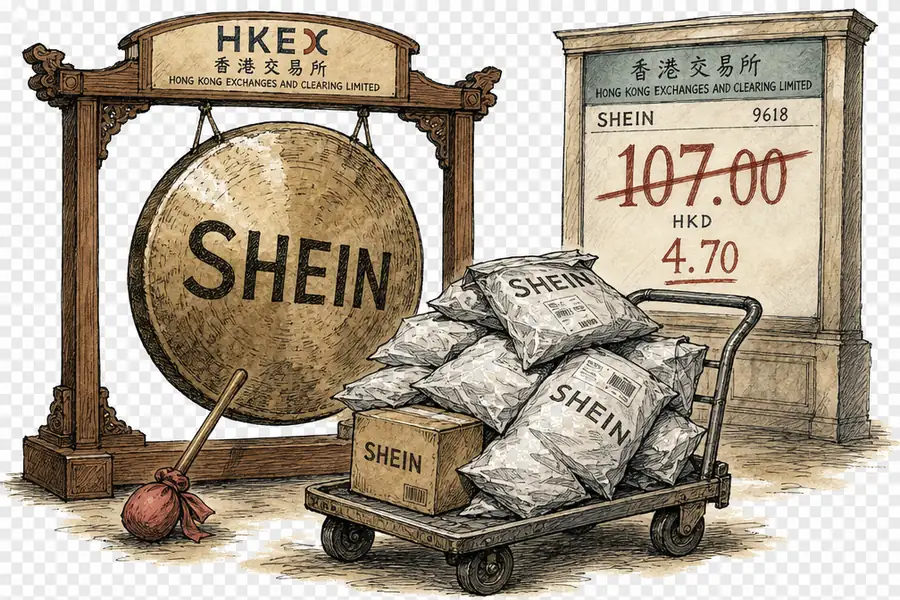
Shein wanted to be valued like Inditex. Documents put to investors, reported by the South China Morning Post, argued for a multiple matching or exceeding Inditex’s 25 times earnings and H&M’s 20. It listed at under thirteen. Nobody contested the prospectus figures; the argument was over which industry produces figures like those.
Shein priced at HK$48.56 a share on 1 September. That valued it at HK$205 billion, or about $26 billion. The mark is 73 percent below its $98.2 billion peak in 2022 and 59 percent below the $64 billion of its last private round. Caixin logged an intraday fall of almost ten percent and a close six Hong Kong cents under the offer. Nobody was buying the dip.
The prevailing account is a cost story. Glossy’s podcast gave three reasons this week: bad press, Gen Z drifting to Temu and TikTok Shop, and the end of duty-free parcels. Each is true. Together they explain why Shein earns less, and not one of them explains why every dollar it earns is now worth a third less. That is not a discount — it is a reclassification.
Pull the two declines apart. Net income fell 39 percent last year to $2.06 billion, on revenue that rose 8 percent to $41.8 billion. Hold the last private round’s multiple constant and apply the earnings fall, and Shein’s own numbers put it near $39 billion. By that math it listed some thirteen billion below its own number, and none of the gap was profit. It was the multiple investors had agreed to pay for it.
Somebody named this in July. Winston Ma, a former managing director at China Investment Corporation, told Reuters that institutional buyers would “zero in on the 2.9 per cent operating margin” and re-price Shein “away from a pure hyper-growth tech platform toward a physical retail and logistics player navigating high-friction global trade.” That was a forecast. Hong Kong has since supplied the number.
The distinction is about durability. A software advantage compounds, and no ministry can repeal it overnight; a freight advantage is rented, and its landlord is a customs schedule. Shein’s design cycle was real. It was also downstream of an $800 exemption Washington closed by executive order. Real is not the same as defensible.
Shein’s algorithm is as good as it ever was; the parcel is what got repriced.
The prospectus has not caught up. Forty percent of the net proceeds, about $1.7 billion, goes to technology development, another forty to brand and expansion. Two fifths of the proceeds will fund the argument the order book has just declined to buy.
The multiple could recover. Shein lost $99 million in the first quarter, a figure that includes a one-time $328 million fair-value accounting charge, not pure trading results, and a company that returns to growth is re-rated on the way up. It would have to get there by selling something a customs schedule cannot reach.
Every fast-fashion retailer now argues its algorithm deserves a growth multiple. Shein made that case with an on-demand supply chain and 273 million annual buyers, and was priced on its freight bill. The rest are making the same argument with worse code.