Shanghai's Fair Is Called International. 2,086 Visitors Were.
CHIC opens in Shanghai this week with 738 exhibitors and 60,000 buyers expected, almost all of them Chinese. The fair's scale has become a reading of what China buys, not of what it can ship.
Sir John Crabstone
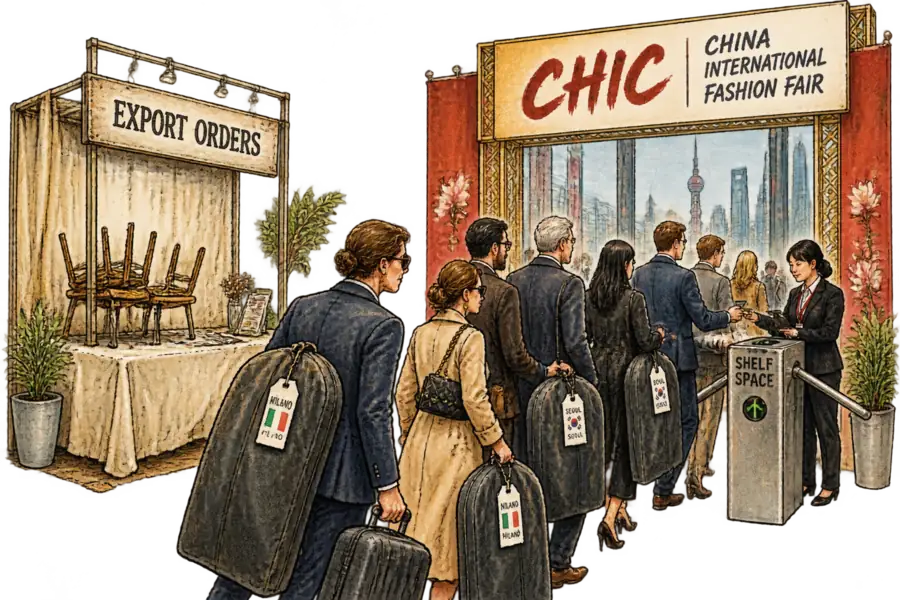
CHIC opens in Shanghai on Tuesday, and the name is carrying more than the numbers will bear. The China International Fashion Fair has booked 738 exhibitors into 53,000 square metres and expects more than 60,000 trade visitors. Twelve years in the city have changed what the floor is for. It stopped selling Chinese capacity to the world some time ago. What it sells now is shelf.
Count the passports. Last September’s edition put more than 650 exhibitors on 60,000 square metres and drew 60,977 visitors, 2,086 of them from outside China. Chen Dapeng, the fair’s president, called it “the central platform where the future of the global fashion economy is shaped”. That economy sent 239 Europeans and 85 North Americans.
This week’s floor is smaller than last year’s and holds more sellers. The exhibitor count is up; the space is down by some seven thousand square metres. Stands shrink when the queue forms on the selling side. Buyers do not need much room to stand in.
Autumn is the lesser edition, and the objection is fair. March filled 117,200 square metres with 1,091 exhibitors and expected over 160,000 visitors. The seasonal gap is real. It does not touch the ratio.
China does run a fair for the world, and it is not this one. The Canton Fair drew around 314,000 foreign buyers from 220 countries across 1.55 million square metres in April and May. That is where capacity is sold, by the container, not by the exhibitor badge. Shanghai gets the ones who came to buy their way in.
A trade fair prices whatever is scarce, and Shanghai has stopped pricing factories.
The customs ledger says it more slowly. Garment exports fell 5% to $151.22 billion last year on customs figures compiled by SunSirs, while clothing imports came to $10.2 billion, of which Shanghai alone handled 69.7%. The export column is fifteen times the import column. It is also falling at more than twice the rate.
Domestic demand went the other way. Retail sales of clothes, shoes, hats and textiles reached 1.52 trillion yuan in 2025, up 3.2%, on the statistics bureau’s count, which reaches only the larger retailers. Converted at any rate you please, that comfortably exceeds what the export book earned, though the two are not priced the same way: one is a shop tag, the other a factory invoice. The growth is modest. It is attached to the only column that rose.
The organisers prefer the phrase “two-way bridge”. Bridges are judged by their traffic. Four matchmaking sessions run on Tuesday and Wednesday, two of them to walk overseas labels in front of Chinese partners, and none of the four ran the other way.
This is also the first autumn edition to give Chinese Style its own dedicated area. That area is not for export.
Six Italian labels appear on the exhibitor list. One of them, Franco Giazzi, called itself “satisfied” after last year’s fair and said it would return; satisfaction, on this floor, still runs in only one direction.