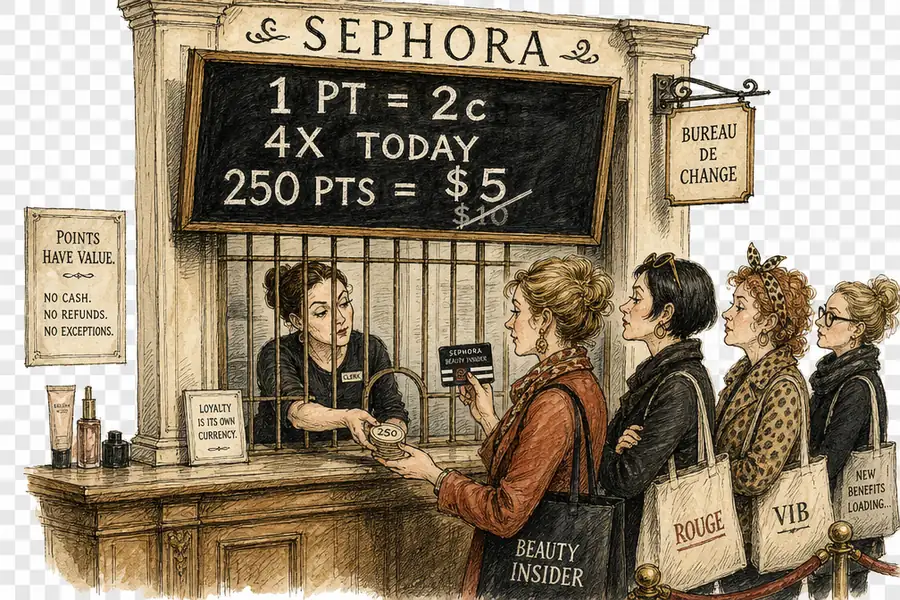
One Point Per Dollar Is Sephora's Least Reliable Number
Sephora posts one point per dollar, then spends the year overriding it with four-times multipliers, challenge bonuses and a halved redemption floor. A currency issued that freely no longer records what a customer spent, which is why the games arrived.
Sir John Crabstone
Sephora posts a price for loyalty: one point per dollar. It spent August overriding that price, paying four times the rate on foundation, then on Clarins and Too Faced, then on entire baskets during Rouge Weekend provided the basket held a Sephora Collection item, by The Points Guy’s tally of the month. The same month it halved the redemption threshold, letting 250 points buy $5 where 500 had been the floor. A rate suspended that often has stopped measuring anything.
The base rate no longer sorts customers. Insider, VIB at $350 a year and Rouge at $1,000 all earn one point per dollar, and all redeem at two cents. What the top tier buys is twenty per cent off at the seasonal sale against fifteen for VIB and ten for Insider, plus the right to trade 2,500 points for $100, on the published rates. A programme obliged to invent a second exchange rate for its largest spenders has conceded what the first one stopped saying.
Ulta still pays for spending with the currency itself. Its Platinum members earn 1.25 points per dollar and its Diamonds 1.5, and the ladder climbs from three cents a point to six and a quarter for anyone who holds 2,000, under Ulta’s own rewards terms. Patience is priced there. At Sephora every point pays two cents, whatever was done to get it.
A debased currency is not one that buys less; it is one that remembers less about who earned it.
August’s challenge made the forgetting deliberate. Four tasks paid a hundred points each, with a hundred more for the set: an order collected in store on $50, then $25 of bath, $25 of hair, $25 of mini fragrance, as Beauty Deals BFF logged it. Twenty-five dollars of shampoo, stacked with the challenge bonus, could out-earn a hundred spent in an ordinary week. A balance no longer records what its holder paid. It records when its holder was paying attention.
Points are the cheap instrument, which is the whole attraction. LVMH’s selective retailing division, where Sephora sits, turned €8.4 billion of revenue into €893 million of recurring profit in the first half, a margin of a tenth against 22.5% for the group, on its own half-year figures. Twenty per cent off at a savings event comes out of that tenth. A point costs two cents and can be aimed at a category.
The trade reading is Gen Z. Customers asked for gaming elements, Sephora’s loyalty chief said when the feature launched in 2023.
That reading treats the game as an addition. The rate card reads more like a replacement. We priced this same points-to-dollars mechanic when the challenges launched: a hundred points bought about two dollars then, and the arithmetic hasn’t changed since. The only thing cheaper than a discount is a bigger number, and the numbers have not stopped rising.