Rothy's Reached $200 Million by Testing the Channels Allbirds Bet On
Rothy's made its first store prove itself before opening five more at once, and waited six more years to try wholesale. Allbirds ran the same two channels in the opposite order, and announced them inside a turnaround plan.
Sir John Crabstone
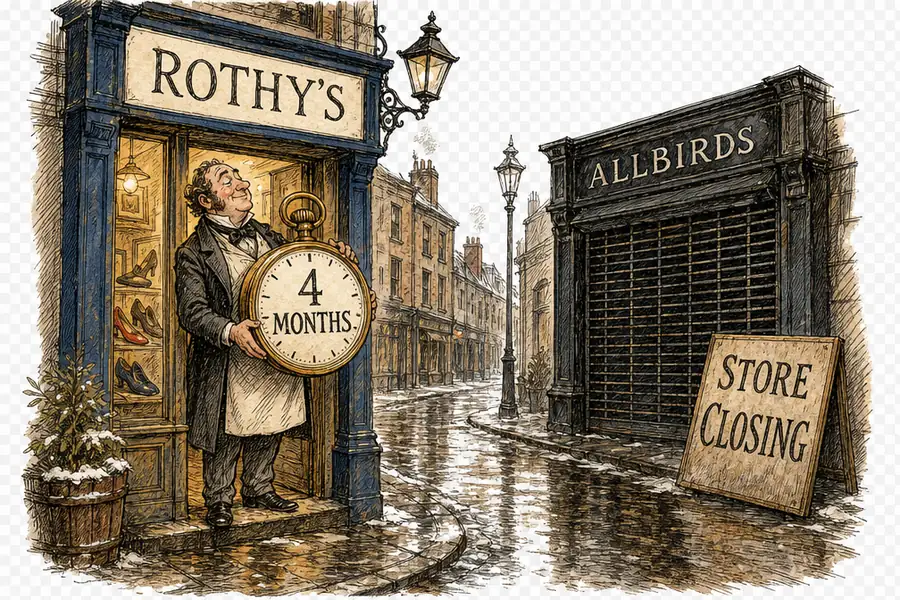
Rothy’s first store turned a profit four months after opening, and it took a year for the brand to open its next stores — five at once, not a second. Wholesale waited six more years. That sequence, not the channel mix, is why Rothy’s is a $200 million footwear business and Allbirds is a ticker with a different name.
The ceiling was named early, and in public. Rothy’s then-president, Kerry Cooper, told Modern Retail in 2019 that the brand would never run hundreds of American stores, because that is “where you see the proclaimed death of retail, where stores have too many locations and not enough traffic.” Stating the limit before the sixth lease makes expansion a decision rather than a reflex.
Rothy’s now runs 40 stores on $227.7 million in revenue, with a wholesale business it has already tripled. The reason, from Dayna Quanbeck, is a cost sentence rather than a growth one: wholesale is “accretive to the top because the infrastructure is in place to support it.” Infrastructure that already exists converts a channel from a commitment into a question.
The wholesale test began in 2024, with Anthropologie, Bloomingdale’s and Nordstrom, in a year that closed with the fleet at 26 stores and same-store sales up 20 per cent. Nothing about that timing was forced. Rothy’s opened the channel while it still had the option of closing it.
The stated worry now is distraction. Quanbeck told the Modern Retail Podcast this week that the discipline is patience and the trap is expanding too soon — a strange anxiety for a company whose growth has never been the complaint. Brands in this category do not die of caution.
Allbirds ran the same two channels in the opposite order. It opened 19 U.S. stores in 2022, cut the next year’s plan to three, and introduced REI, Dick’s, Nordstrom and Scheels inside the same transformation plan that did the cutting. The loss that forced that plan was $100.3 million in FY22, Allbirds’ first full year as a public company. Allbirds pitched that plan as a recovery route, a document projected to re-accelerate sales growth in 2024. It didn’t. That is not a channel strategy, it is a receipt.
A channel opened from strength is an experiment; the same channel opened from weakness is a confession.
The easy explanation blames the product: one silhouette, a sustainability pitch that never closed a sale on its own. That story cannot account for why the survivor sells through the same Nordstrom shelves. Allbirds shut its remaining U.S. full-price stores in February, and the shoe business was sold out from under the listing weeks later. The stores were never the mistake; the hour at which they were asked to pay for themselves was.
Quanbeck puts the American ceiling at another 30 to 40 stores, close to doubling a fleet built over eight years. It will be spent one lease at a time. The discipline cost Rothy’s nothing while the company was small. It has not yet been priced at scale.