Rhone Invented the Merchant's Job Twelve Years In
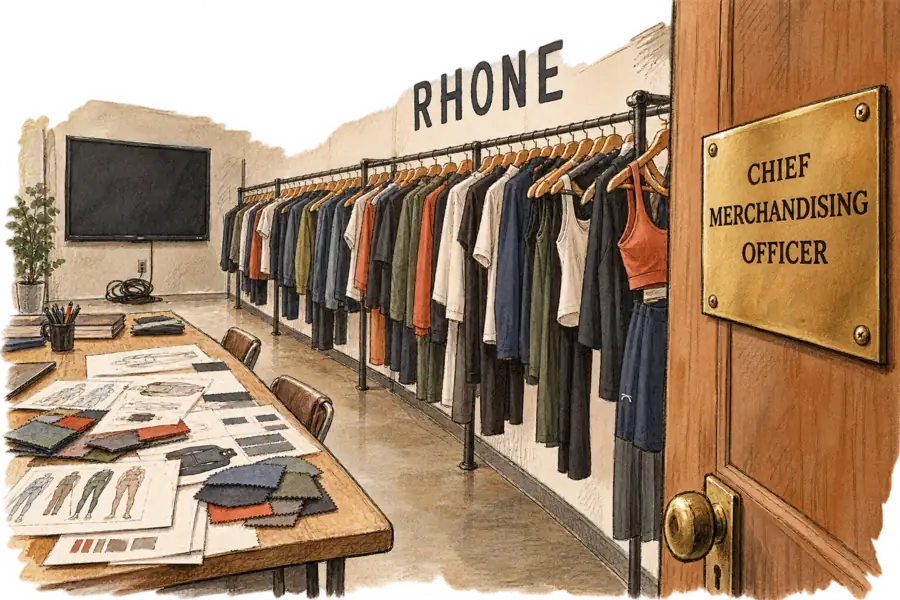
Rhone ran for twelve years without a chief merchandising officer, then hired one out of Puma and Lululemon and placed design underneath her. The appointment is a ruling on where the assortment decision lives, and the answer is not the model.
Sir John Crabstone
Founded in 2014, Rhone has just appointed its first chief merchandising officer. Alexa Andersen arrives from Puma North America, by way of Lululemon. Twelve years without a merchant is not an oversight; it is a thesis, and this week it was withdrawn.
The provenance is the argument. Andersen ran Puma’s North America merchandising organisation across wholesale and direct-to-consumer, and earlier led product creation and merchandising for strategic initiatives at Lululemon. FashionUnited reports that she will oversee merchandising and design together. Nate Checketts, the co-founder, said she understands that great product and long-term brand building go hand in hand. That is an unremarkable sentence. What is remarkable is that Rhone required a new officer of the company to hold the view.
The buy grew faster than the org chart. Rhone launched womenswear in May 2024 across fifteen stores and its wholesale accounts, and Checketts has said he wants the women’s business eventually to match the men’s. A brand planning for half its revenue to come from a category it has sold for two years is past the point of deciding assortment by instinct. There are simply too many decisions for anyone holding the job part-time.
Digitally native brands were sold a tidier arrangement. Customer data would reveal demand, the model would size the buy, and merchant judgement would be reclassified as overhead — a cost of the analogue era, to be retired once the signal got good enough. The trade press has filed this appointment under executive moves. Filed correctly, it is a retraction.
Stitch Fix always paired algorithmic sizing with human stylists; the purest version of the model was never pure. In the quarter it reported in June, net revenue rose 4.7 percent to $340.3 million while active clients fell 1.9 percent to 2.309 million, and Adjusted EBITDA and free cash flow both turned positive. The company remains unprofitable under GAAP. The growth came from charging the clients who stayed more. Matt Baer, the chief executive, credited the gain to improvements in “our client experience and assortment,” not to the algorithm.
An algorithm can rank the buy; it cannot answer for it.
The obvious objection is that this is what growing companies do. Ranges widen, someone senior takes the buy, and none of it says anything about software. The objection is right about the timing and wrong about the content. Hiring a merchant is a staffing decision. Putting design underneath one is a ruling on where taste is allowed to originate.
The ruling did not arrive alone. Rhone hired a chief operating officer whose career runs through PVH and Walmart last November, and handed him operations and technology. The brand founded to avoid a conventional org chart is assembling one, office by office.
Rhone has bought the judgement it once expected to infer. The data it gathered in the meantime has not gone anywhere. It simply no longer has the last word.