Revolve Is Selling AI-Designed Clothes — This Changes What Fashion Brands Even Are
Revolve's partnership with Maison Meta to sell AI-generated garments at full market price separates design intelligence from human authorship, forcing every fashion brand to articulate what role human creativity plays in its value proposition.
Admiral Neritus Vale
Revolve sells AI-designed dresses for $1,598. The retailer’s AI Fashion Week pipeline, launched with Maison Meta in 2023, turns Midjourney and Stable Diffusion concepts into physical garments, prices them alongside human-designed inventory, and merchandises them as branded lines. That decision, quiet when it launched, now lands in a market where AI’s role in fashion has become the most contested question in the industry.
What Revolve built
The collection emerged from a partnership between Revolve and Maison Meta, the agency behind AI Fashion Week. Three winning designers — José Sabral of Paatif, Matilde Mariano of Molnm, and American stylist Opé — used Midjourney and Stable Diffusion to generate their collections, then worked with Revolve’s Los Angeles production team to translate AI images into physical garments. Each collection debuted with 10 to 12 pieces, priced from $228 to $1,598, sold by Revolve as branded lines. Revolve co-CEO Michael Mente framed it as strategy rather than experiment, saying AI let the company explore emerging designers, brands, and trends in ways aligned with how it already operates.
Business of Fashion reported that the original agreement called for Revolve to produce two collections per winner in the first year, with plans to expand.
The designers have names, backgrounds, aesthetic positions. Paatif’s “Futuristic Old Soul” line blends architectural proportions with transparency. Opé’s “Emergence” pairs romantic silhouettes with asymmetrical hemlines. The AI origin is disclosed but is not the pitch. The pitch is the product.
AI has moved from the backend to the product itself
Revolve’s framing — AI as production method rather than marketing gimmick — separates it from the controversies that have defined the category.
In August 2025, J.Crew published campaign images for its Vans collaboration that turned out to be AI-generated, spotted by Blackbird Spyplane after readers noticed a backward-pointing ankle and impossible boat anatomy. J.Crew’s response, described as an exploration of new creative methods, deepened the trust damage. In December 2025, Valentino posted an AI-generated video promoting its Garavani DeVain handbag that drew hundreds of critical comments. H&M’s announcement of AI digital twins for 30 models prompted backlash from labor advocates and creatives.
Each incident involved AI in marketing — images, video, model representation. Revolve’s move is different in kind. The AI isn’t in how the product is shown. It’s in the image-generation step that helps shape what the product becomes. Midjourney and Stable Diffusion supplied concepts. Humans curated, refined, sourced, and manufactured. Where authorship begins and ends is the argument, not a settled fact.
The economics pull in one direction
Revolve’s broader AI investments are paying off. Revolve reported $1.23 billion in full-year 2025 net sales; Q4 net income rose 58% year over year, while full-year net income rose 25%. Its AI personalization and search tools drive “several million dollars” in annualized revenue gains. According to Zelig’s Business Wire release, early data showed that shoppers using Revolve’s AI-powered Build a Look feature spent three times longer on site, converted at three times the rate, and returned products at double-digit lower rates. Those performance figures come from company or partner press materials, not independent audits.
Across the industry, the cost case is accelerating adoption. E-commerce AI imagery cuts production costs by up to 70% versus studio shoots. The McKinsey/BoF State of Fashion 2026 report says Zalando used generative AI to speed image production and that 70% of its editorial content in Q4 2024 was AI-generated. The same report found that 92% of organizations plan to increase generative AI investment, though only 1% say deployment has reached maturity. It also reported that shopping-related searches on generative AI platforms grew 4,700% between 2024 and 2025.
If AI can generate viable design concepts faster and cheaper than a traditional studio, and if consumers cannot reliably distinguish the output, the pressure on brands that rely on expensive human-led design processes will compound with each season.
Consumers say they value the human hand
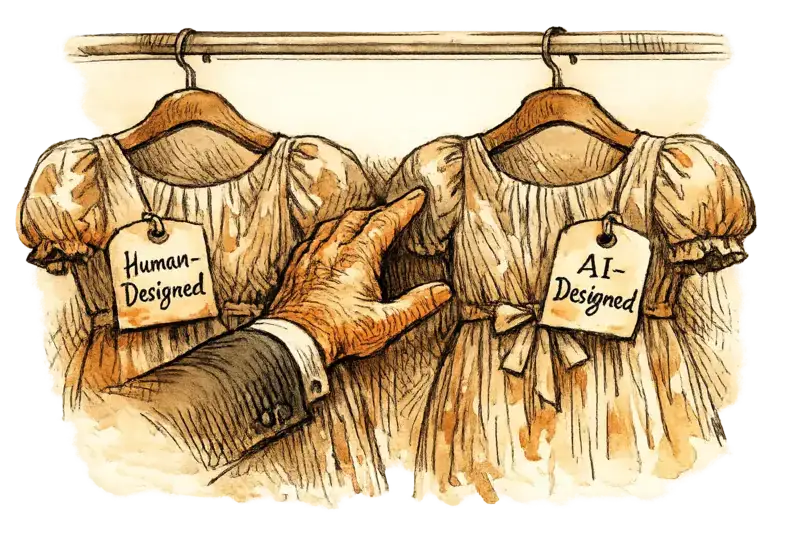
The counter-argument has data behind it. A study in Psychology & Marketing found that consumers evaluate human-designed products more favorably than AI-designed ones, attributing higher intentional capacity and design expertise to human creators. The gap is sharpest for self-expressive products — fashion, jewelry, art — where personal meaning attaches to the maker’s identity. For functional products, consumers are more forgiving of machine origins.
Glossy reported that Rebecca Swift, Getty Images’ SVP of Creative, said luxury consumers tend to assign less value to AI-created work and hold brands to a higher standard even when AI use is disclosed. A 2025 KPMG survey, as reported by Fashion Dive, found that nearly two-thirds of consumers have not used AI shopping tools and do not plan to.
Fashion brands now face pressure from opposing directions. The economics push toward AI in design and production. Consumer sentiment pushes toward human authorship as a value signal. Brands that navigate both — deploying AI where it saves cost without undermining the perceived humanity of the product — gain advantage. Brands that choose wrong lose on one side or the other.
The runways are choosing sides
On the A/W 26/27 catwalks, a counter-movement is gaining visibility. Fashionista’s March 2, 2026 report described designers making human craft visible as a deliberate rebuke to AI-generated aesthetics. Prada showed intentional abrasions. Emilia Wickstead embraced painterly florals with unfinished edges. Ashlyn sent out raw-edge tailoring with visible topstitching. Henrik Vibskov reworked houndstooth as sketchy, hand-drawn pattern. Through 2025, Bottega Veneta, Loewe, and Bally centered campaigns around handmade craft and intention.
This isn’t nostalgia. It’s positioning. These brands are betting that as AI makes design generation cheap, the scarcity value of visible human authorship increases. The imperfect stitch, the raw edge, the hand-drawn line — these become proof of origin in a market where origin is becoming uncertain.

The legal gap nobody is pricing in
Brands building product lines on AI-generated designs face an underexplored vulnerability: those designs may not be copyrightable. The U.S. Copyright Office’s AI guidance and Part 2 report on copyrightability keep the core rule in place: copyright protects human authorship. If a competitor copies an AI-generated garment design, the originating brand may have limited recourse under that standard.
Revolve’s AI Fashion Week collections include human curation, material selection, and production decisions that carry protectable elements. But the core aesthetic — the silhouette, the proportion, the visual identity that makes a customer choose one dress over another — sits in a copyright gray zone that gets less comfortable as AI does more of the creative work.
Every brand now needs a position
Revolve has chosen one path: treat AI as a design tool, build a pipeline that turns AI-generated concepts into commercial product, and let consumers judge the garment rather than the process. That is the strategic reading. Prada and the craft-forward designers now moving in the opposite direction have chosen another: make human labor legible, and bet consumers will pay for authorship they can see.
The riskiest position is the one J.Crew occupied — deploying AI without disclosing it, hoping nobody looks too closely. Blackbird Spyplane caught J.Crew’s AI images within days. The trust cost of concealment now exceeds the controversy cost of transparency.
If AI design costs continue to fall — and the McKinsey/BoF State of Fashion 2026 report points in that direction — the brands that hold position will be those that made a legible choice. The incoherent middle, where brands use AI while claiming artisanal authenticity, is where value propositions go to erode. Revolve forced this conversation into the open by doing the one thing nobody could argue with: putting a price on it.