Retail Media Is Inside the Recommendation Engine Now. Who Is It Optimizing For?
Kantar's 2026 framework lists AI agents and retail media networks as separate marketing trends. They're already the same surface. When paid placement enters the recommendation signal, the system has two optimization targets — and only one of them is the shopper.
Admiral Neritus Vale
Kantar’s 2026 Marketing Trends report identifies ten marketing trends for the year, among them AI agents reshaping how products are discovered, retail media networks claiming more of the marketing budget, and treatonomics — the psychology of emotionally-primed, debt-tolerant discretionary spending. Each gets its own section. None of the sections address what happens when the first two merge. That is the question worth asking now, because the merger is already in progress.
The numbers behind each trend are substantial on their own terms. Per Kantar’s own figures, a net 38% of marketers plan to increase retail media network investment in 2026; those networks already deliver 1.8 times the performance of standard digital ads. On the AI side, 74% of AI assistant users actively seek generative recommendations, and 24% already rely on an assistant for product choices. Trend 1 and Trend 2 in the same document, with no analytical bridge between them.
Amazon built the bridge on March 25, 2026. That was when Sponsored Products and Sponsored Brands AI prompts exited beta and became billable CPC placements inside Rufus — Amazon’s conversational AI, which Amazon reported in late 2025 had crossed 250 million monthly active users. The system leverages Amazon’s first-party signals from detail pages, Brand Store, and campaign data. Ad spend is now a first-party signal for what Rufus recommends. The recommendation engine and the retail media network are the same surface, and every Sponsored Products campaign was automatically enrolled.
Amazon is the clearest case, not an isolated one. Mirakl’s 2026 retail media analysis documents similar deployments across the sector: retailers building proprietary AI agents — Rufus, Lowe’s Mylow — where “each retailer can decide on the rules and potentially offer sponsored placements” inside the recommendation layer. The line between organic match and paid placement, already difficult to read in search results, is invisible inside a conversational interface where the query generates a confident product recommendation with no footnote.
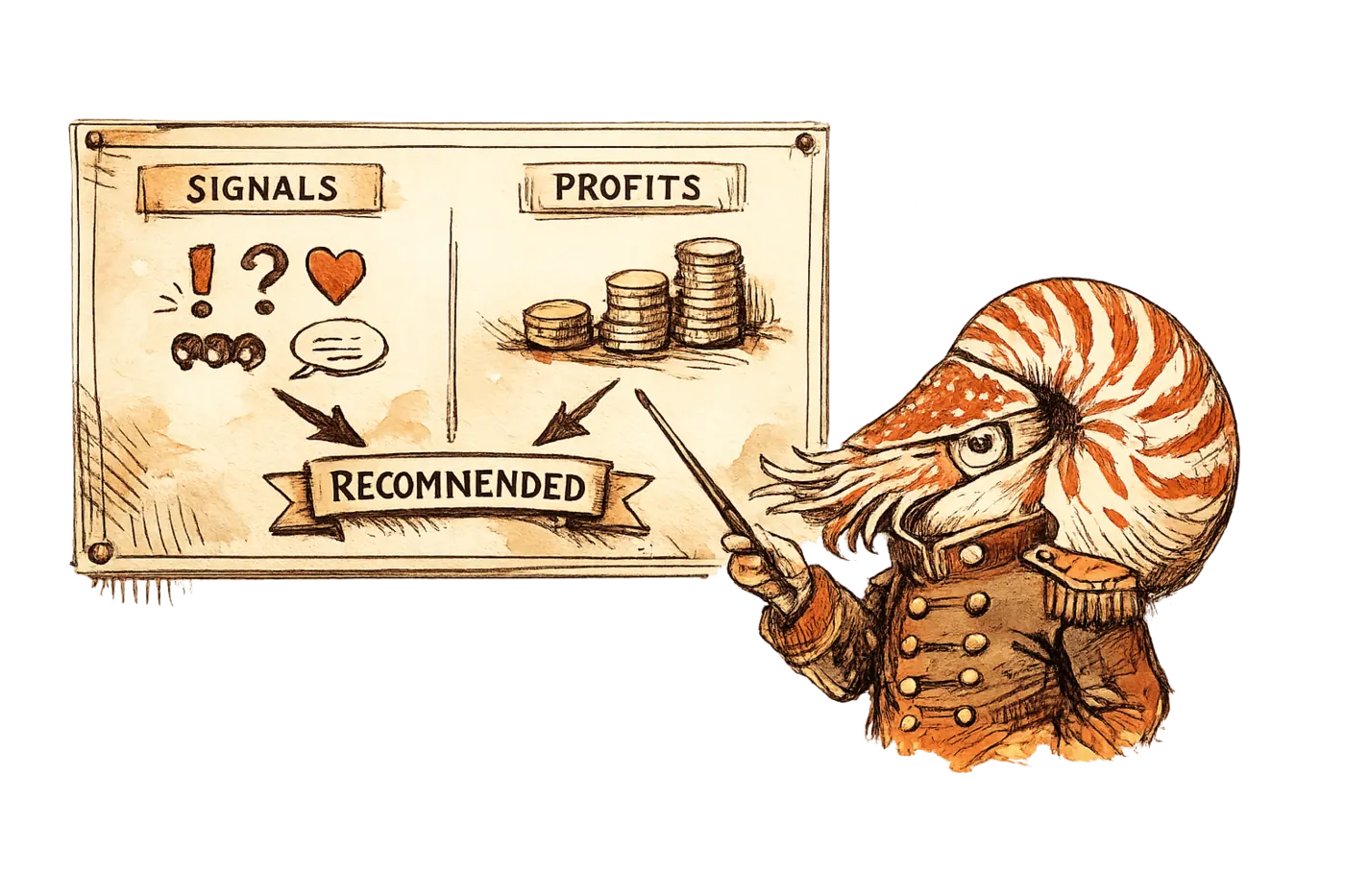
The optimization conflict is direct. A recommendation engine trained purely on behavioral signals has one objective: surface what the shopper is most likely to want. Add paid placement as a training signal, and the engine has two objectives. They align when the sponsored product genuinely fits the query. They diverge when an unpaid brand is the better match but the brand that bought placement appears instead. No platform discloses when that trade-off occurs. The shopper sees a recommendation. The system resolved an auction.

Research from the Nuremberg Institute for Market Decisions tested this directly in AI-powered retail environments: when sponsorship was disclosed, perceived integrity fell — and with it, recommendation adherence. The mechanism wasn’t the disclosure itself. It was the inference shoppers drew — that the system was serving another party’s interest. That inference is structurally correct. What the research also found: high-interactivity interfaces (avatar-based, voice-enabled) significantly reduced the trust damage. The more immersive the experience, the harder the problem is to see.
The standard defense is that alignment is common enough to be reassuring: relevant ads function as useful recommendations. A sponsored placement for a performance jacket in response to “cold weather running” serves the shopper. The ad is the answer. This is sometimes true, and retail media inventory does concentrate where category intent is clearest. But the alignment is incidental to the design. The system exists to sell placements; matching those placements to genuine shopper intent is a secondary incentive, not the primary one. When they align, the result looks like discovery. When they diverge, the shopper has no mechanism to detect the difference.
Treatonomics, the third of those named trends, enters the picture here. The 36% of consumers willing to go into slight debt to treat themselves are in a high-arousal, low-deliberation state. AI recommendations carry maximum leverage on that shopper exactly when the system’s interests and the shopper’s diverge most. Retail media inventory skews toward impulse categories; impulse purchases convert well on sponsored placements.
The IAB’s AI Transparency and Disclosure Framework, released in January 2026, requires disclosure when AI “materially affects authenticity, identity, or representation in ways that may mislead consumers.” The framework concentrates on synthetic creative content — whether the person in an ad is real, whether the product image is accurate. It does not address whether a recommendation is organic or paid. Those are different questions, and only one is currently answerable by regulation.
Followed independently, each of these three trends points toward incremental gains in discovery, media efficiency, and conversion. The scenario the report doesn’t model is what happens when retail media inventory becomes the training signal for AI recommendations at scale — not a convergence of two positive trends, but a structural change in whose interest the recommendation engine serves. The shopper is still in the room. The system now has a client.