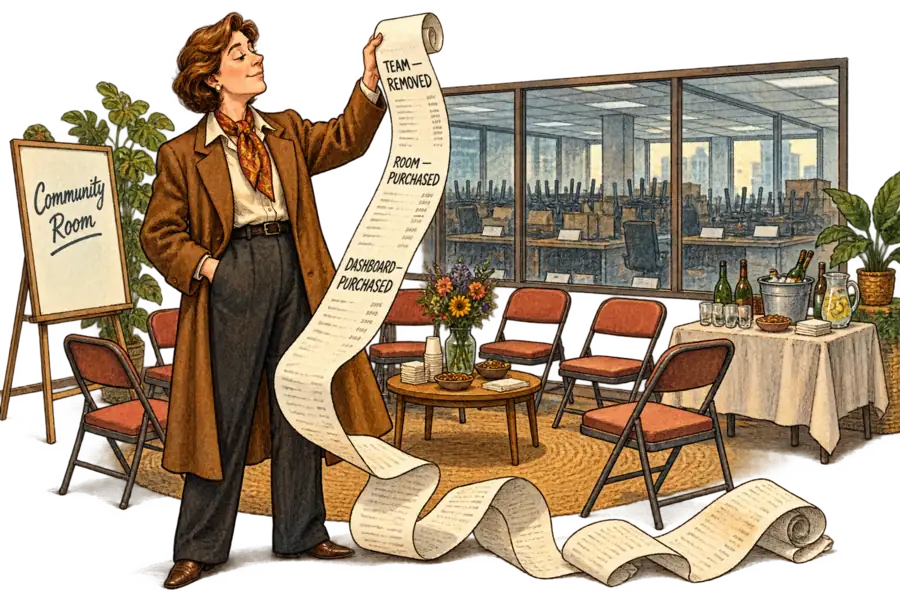
Retail Cut the Team and Bought a Room
Executives describing their post-experimentation AI operating model are funding two things with the savings: physical community space and internal knowledge platforms. Both are defensive purchases, which is a statement about what operators concluded automation was actually for.
Neritus Vale
The most reliable thing a company says about a technology is where it puts the money that technology freed up. Consumer brands that automated real work this year are not spending the proceeds on new markets, new categories or cheaper customer acquisition. They are spending it on physical rooms and on private databases, which is what a firm buys when it has decided a technology defends its position rather than extends it.
Operators are describing the shift in allocation terms rather than vision terms. At a Glossy and Modern Retail leaders’ dinner held under Chatham House rules and reported at the start of this month, executives described taking job listings down once they worked out software could cover the role, and standing up internal intelligence platforms that once needed a six-figure budget. We covered the hiring half of that evening on 9 August. The half that went unread is the other side of the ledger: what the same people said they were funding instead.
One founder’s answer was a store, and how the business later reclassified it is the tell. Opened as a branding exercise, it hosted nine events in its first three months and was rebooked internally as a discovery and customer-retention channel. Another executive framed physical retail as a correction to online shopping, telling the same gathering that “people are missing the idea of curation, the idea of discovery and just the joy of shopping.” The table’s conclusion was that advantage would settle on “the things that are not disruptable”: products, expertise and community.
The same trade has been made on the record, with a name on it. Bed Bath & Beyond chief executive Marcus Lemonis told analysts that integrating AI meant the company would “experience significant reduction in headcount.” Retail Dive reported the affected areas would include supply chain, IT, accounting, marketing and merchandising, and that some of those positions would be redistributed into customer service and store-level roles. The saving did not leave the profit-and-loss account to buy a market. It moved down the building.
Retention is the word that gives the allocation away, though the source’s own account pairs it with discovery, an acquisition function riding along inside what reads here as a defensive purchase. A retention channel defends revenue a company has already earned; it does not, by itself, find revenue the company has not. Expansionary spending looks different: net new doors, entry into markets a brand does not serve, acquisition budgets sized for customers it does not yet have. None of that is what the freed-up money is buying. Acquisition is getting more expensive on its own account — “it costs more to get new customers or just fans on social media,” Hivessence chief executive David Burrows told eTail Boston, as Modern Retail reported, in a piece whose other examples were brands using AI to grow, not merely to defend.
The second destination points inward as well. An internal platform that joins fulfilment data, paid media, customer reviews and Reddit threads is a mirror held up to a business that already exists. It sharpens the reading of current operations; it does not open new ones. Buying a clearer view of the company you already run is sensible, and it is an admission about what the technology turned out to be good for.
Neither purchase acquires a customer the company did not already have.
The thesis fails under one condition, which deserves its strongest form: if AI’s revenue effect is large and real, rooms and dashboards are what a growing company buys with a slice of its gains. The industry’s own arithmetic makes that case: NVIDIA’s third annual State of AI in Retail and CPG survey has 89% of respondents saying AI increased their annual revenue. That records belief, gathered by a vendor whose business depends on the answer, and belief is a different object from a measurement. The same respondents put the cost effect at 95%, and the cost claim is the one firms are acting on with their chequebooks. Belief about revenue is cheap to hold; a lease is not.
The expansionary reading breaks on the size of the dividend that turned up. Bain’s survey of 951 companies found nearly 40% landing at AI cost savings of a tenth or less, well under what most had planned, as CFO.com reported from Bain’s findings. A dividend that comes in under plan does not get spent on expansion; it gets spent on the cheapest insurance available against whatever is going wrong. Bain also found 44% naming savings from earlier automation as the main funding source for their next round of AI, which describes money circling inside one account rather than leaving it.
Physical spending is defensive in its own language, whoever is paying for it. The Crenshaw Rec by Foot Locker opens on Saturday in South Los Angeles with a gym, an equipment room and a Crenshaw High School team shop. Nike and the late Nipsey Hussle’s The Marathon Brand helped shape it; the announcement calls it the first expression of the concept. It sits inside a remodel programme that had refreshed about 100 stores by May and targets 250 by back-to-school, Retail Dive reported. Nothing in that record ties the spending to AI savings, and the tie is not the claim. What the money is asked to do is the claim: hold ground in neighbourhoods the chain already trades in, bought in a market where new retail space is being completed at the lowest rate on record.
The gap that matters now sits between what these firms fund and what they are valued on. Buying back a room in which a customer can be held is defensible after decades of losing that customer to platforms. But products, expertise and community are all made by people, and people were the line item that made the room affordable. If the reallocation holds on these terms, brands will finish the decade holding more square footage of community than they have staff qualified to run, and buildings are the harder half to unwind. Operators have concluded that AI is a cost technology. They have not said so to the people still pricing them as though it were a growth one.