Poshmark's 15-Year Redesign Settles the Question: Resale Now Competes on Curation, Not Inventory
Poshmark's first major app redesign since launch centers on AI-powered discovery rather than supply expansion. At 165 million users, Poshmark has identified the actual limiting constraint in recommerce — and it is not listings.
Admiral Neritus Vale
Poshmark has 165 million buyers and sellers. It did not touch its app for 15 years. The company redesigned this week anyway — and built the redesign around AI-powered discovery rather than seller acquisition or supply expansion. That choice is the signal. A platform at that scale recalibrating its entire interface toward curation has answered, in engineering and product investment, the question the recommerce industry has been circling for years: at sufficient depth, the limiting constraint shifts from how much is listed to how well the platform can find what a buyer wants before the buyer gives up looking.
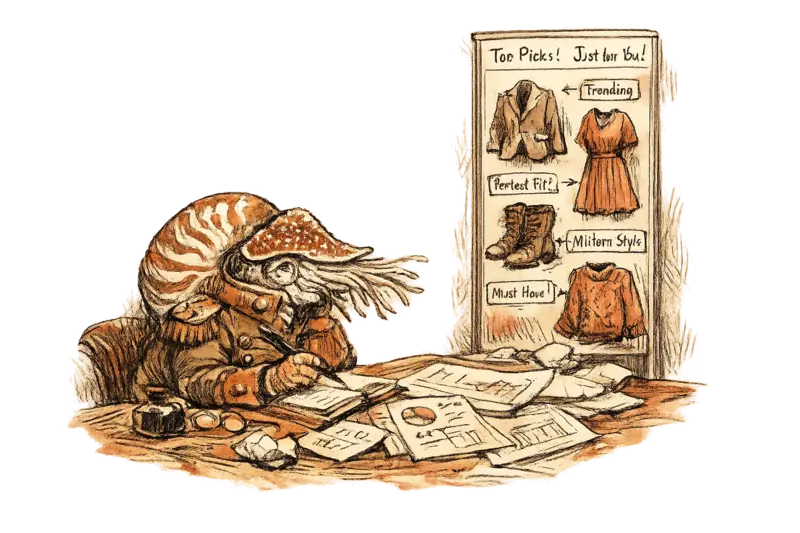
The redesign introduces three things: an AI-powered “For You” home feed that surfaces recommendations from browsing and purchase history, larger portrait-format product images replacing the previous square grid, and a consolidated Seller Hub combining listing tools, analytics, and order management. Chief Product Officer Heather Friedland told Modern Retail the goal is moving “away from that hunting and pecking experience…toward being smarter about what we can suggest to people, so that the experience feels magical, like the right thing was put in front of me at the right time.” She is not describing a platform that lacks product. She is describing one that has saturated its discovery surface.
The market timing supports the logic. The U.S. secondhand apparel market is projected to reach $74 billion by 2029, per ThredUp’s 2025 Resale Report, as cited by Modern Retail. Poshmark’s parent Naver reported Q4 GMV and revenue growing over 20% year-over-year — a platform already in expansion, not one searching for users. Redesigning to capture demand would mean adding categories, lowering seller friction, and running acquisition spend. Redesigning to improve personalization means the platform has diagnosed a different problem: demand is there; the mechanism connecting buyers to the right supply is not working hard enough.
The SMCP case, which we analyzed yesterday, maps the same diagnosis from the brand side. When SMCP CEO Isabelle Guichot described seeing the volume of her brands’ items circulating on platforms like Vinted as “a wake-up call,” the problem was not supply — those garments were circulating in volume. The problem was that third-party platforms captured the browsing data, the transaction context, and the behavioral profile. The brand received a residual reputational benefit and nothing else. SMCP brought its resale channel in-house through Faume to reclaim the discovery layer — the browsing behavior, the voucher-to-purchase conversion, the CRM entry at point of return. Poshmark is building the equivalent layer directly into its platform. Both are responding to the same finding: in recommerce, the entity controlling discovery controls the customer relationship.
The counter-argument runs like this: inventory depth is the prerequisite for discovery to function. Without sufficient supply, personalization AI surfaces irrelevant items, which is worse than a search bar. The objection is sound in principle. A discovery layer over thin supply is not a strategy. But Poshmark’s supply constraint resolved years ago. A buyer looking for a size-6 Manolo Blahnik in a specific season’s colorway is no longer limited by whether those shoes exist on the platform. She is limited by whether the platform finds them before she opens a browser tab elsewhere.
What is shifting across recommerce is the competitive surface. Earlier platforms competed on liquidity — the question was whether the specific item in the specific size existed anywhere in the catalog. Achieving reliable liquidity required scale, and the race to build it produced the major platforms in their current form. Poshmark, Depop, Vestiaire Collective, and ThredUp each accumulated supply deep enough to answer that question. The liquidity race is largely closed. The new competition is different: whose platform understands buyer taste well enough to surface items a buyer did not know to search for? Behavioral data compounds over time. A platform generating persistent browsing and purchase history — and building a recommendation layer on top of it — creates a switching cost that raw inventory depth does not. The buyer who trains a platform over three years of browsing is not going to rebuild that profile elsewhere for a marginal improvement in listing volume.
The seller investment in the redesign is part of the same architecture, not a separate priority. Top Poshmark seller Alex Mahl has accumulated over 240,000 followers and $500,000 in lifetime sales. The Posh Kings operation grew 500% in 2025 and 700% year-to-date in 2026, as reported by Modern Retail. These are not individuals offloading wardrobes — they are professional resellers operating curated inventory at scale. When sellers at that level have better analytics and consolidated operations, listing quality improves: better photography, accurate condition grading, consistent descriptions. That quality improvement feeds directly into discovery quality. The Seller Hub is an input to the recommendation engine, not a separate feature.
Friedland’s phrase — “staying in lockstep with technology” — understates the decision. Poshmark is not matching feature parity with a competitor. It is recalibrating which technology creates defensible advantage. If the pattern holds across recommerce, platforms that compound behavioral data into personalization quality will find scale a diminishing differentiator. The 15-year design freeze ends exactly when the competitive surface shifts. That timing is deliberate.