A Pollster Bought the Trend Agency. The Panel Was the Asset.
Ifop, a public-opinion institute founded in 1938, has bought the French forecasting house NellyRodi. The buyer's identity reclassifies trend forecasting as survey research, because a documented sample is the only kind of taste evidence a purchaser or a model can price.
Admiral Neritus Vale
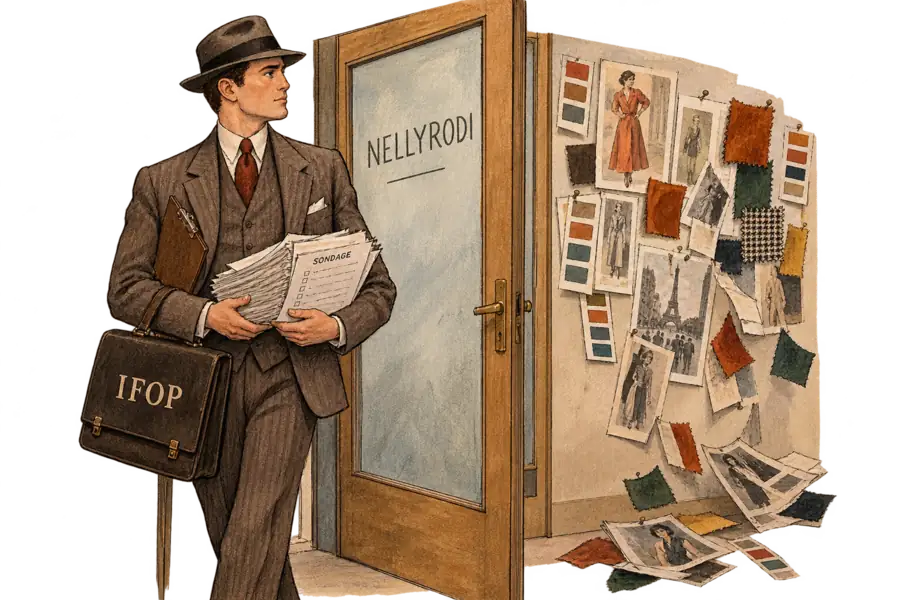
Ifop Group took 100 percent of NellyRodi on 8 September, and the identity of the buyer carries the argument. A forecasting house founded in 1985 and run for twenty-five years by the founder’s son did not go to a media group, a creative holding company or a design consultancy. It went to a public-opinion institute founded in 1938, a firm that prices exactly one thing well: a documented record of what a sample of people said. Trend forecasting has been moved out of the column marked authority and into the column marked research. The panel was the asset, and the pollster is the party that knew how to value it.
The trend book stopped being the asset when it stopped being expensive to make. FashionUnited argued on 11 September that generative models now hand every agency the same baseline reading of the same scraped inputs, pushing agencies to compete on filtering rather than on finding. That is right about the symptom and quiet about the consequence. If the colour card, the mood board and the eighteen-month silhouette call can be regenerated on demand, none of the value a client pays for survives inside the object delivered. What survives is provenance: a record of who was asked, when, and what they said. Research groups own the machinery for producing that, and creative agencies do not.
Ifop’s own shop window states the asset without embarrassment. The group’s capabilities page sells fieldwork at 5,000 to 150,000 interviewees per study and a weekly omnibus, which is infrastructure rather than insight. Its AI page goes further, promising “des données authentiques, issues de répondants réels” — authentic data, from real respondents. That line is not a technical boast. It is a chain-of-custody claim, and custody is worth money only to the firm that owns the first link.
Ifop has spent more than three years building the machine that turns that custody into inventory. It became the first design partner of the synthetic-data firm Fairgen in early 2023 and co-developed DataBoost AI, an engine that manufactures additional respondents out of a real seed sample. Fairgen counts more than 325 boosts delivered since launch, and the revealing number is what they were for. Nine in ten went to sub-segments too small to read on their own, which is a panel owner’s problem and was never a trend agency’s. Synthetic respondents inherit their credibility from the real ones beneath them, so the seed is the scarce input and the model is the commodity. A weekly general omnibus reaches fashion, luxury and beauty thinly; NellyRodi’s observatories do not.
The two firms already knew how to make a survey together: their joint luxury observatory polled 2,400 women across France, China and the United States.

Three recent exits price the distinction. Apax completed its purchase of WGSN from Ascential in February 2024. The deal, struck the previous October at an enterprise value of up to £700 million, priced a subscription platform and its datasets rather than the taste of its forecasters. Heuritech, which built a machine reading of social images, was absorbed by the data intelligence firm Luxurynsight. Promostyl, registered in Paris in May 1966 and selling judgment for most of the sixty years since, was put into simplified judicial liquidation on 17 April. Taste did not lose in any of this. It priced only where something countable came attached to it.
Ifop has not said it bought NellyRodi to widen a seed sample, and Pierre-François Le Louët, the agency’s chief executive, makes the opposite case in FashionNetwork: AI, he says, “makes us smarter” but “doesn’t give us a head start or provide original ideas,” and clients come to NellyRodi for “that touch of humanity” no model can supply. That is the strongest case against this reading: a panel cannot manufacture taste, and NellyRodi’s roughly €6 million of turnover last year would then be the price of a point of view rather than of a respondent file. But the reporting structure argues the other way. Le Louët keeps day-to-day control of the agency and now answers to Nicolas Riou, who runs Brain Value, the strategic-planning firm Riou joined in 2023, and interpretation has been filed under a function the group already owned. That is how a buyer treats a capability, not an authority it plans to leave alone.
The model market values the same input, and values it more sharply. A joint team from Stanford, Northwestern and Google DeepMind grounded generative agents in two-hour interviews with 1,052 Americans, then scored those agents on General Social Survey items withheld from them. The interviews were the expensive part of that construction and the model was not, which is the inversion worth sitting with. Agents scored 83 percent on interviews alone and 86 percent once survey data was folded in, both figures close to how consistently the same people answered themselves two weeks later.
A demographics-only baseline (same survey items, no interview) manages just 74 percent, and that gap is the price of the interview itself. It also measures the distance between the two products a forecasting house has always sold at once. A trend report supplies an archetype: the neo-nomad, the quiet-luxury convert, the resale buyer who wants the label. Named respondents who answered specific questions on a specific date are a different product entirely, and a much harder one to fake. The paper tested civic attitudes and personality items rather than handbag preference, so carrying it across to taste is an inference and not a finding. It is a short inference, because the mechanism has nothing to do with the subject matter.
What brands lose here is cover. A trend subscription supplied an outside name to cite in the merchandising meeting when a colour call went wrong, and it worked because the authority behind it could not be audited. Research is built to be audited; it arrives with a sample size, a field date and a stated method, and a client who dislikes the answer can interrogate how it was reached. If Ifop runs NellyRodi the way it has run Occurrence and Brain Value, the trend book will keep its pictures and gain a methodology page. That serves everyone who wanted to know and costs everyone who wanted to be told. Brands have until the next renewal to decide which of the two they were buying.