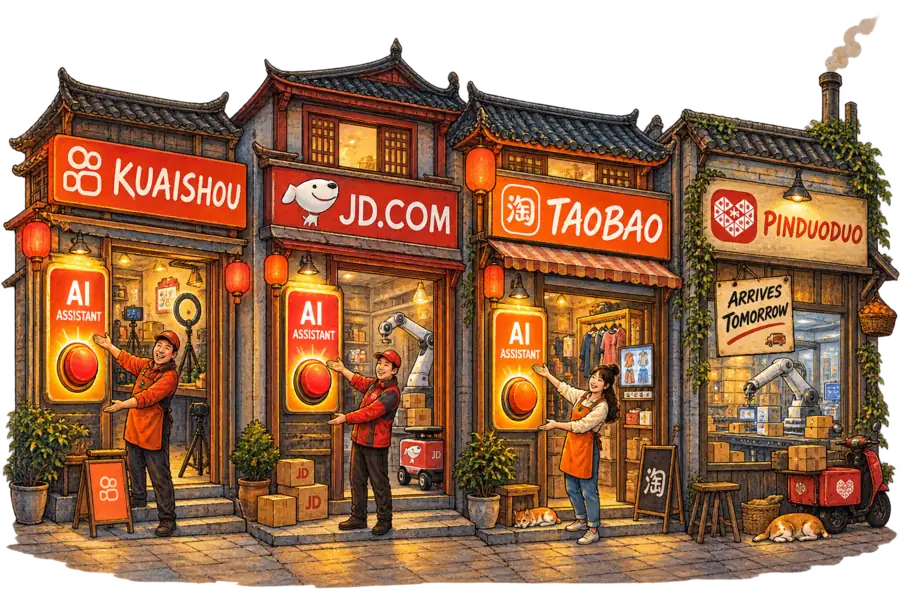
Pinduoduo Gave the Home Screen to Delivery, Not to AI
Kuaishou pinned an AI assistant to its search page in July and Alibaba published a relevance number; Pinduoduo raised research spending 40% last week and never said the word. The silence is a merchandising choice, and the gap between the two disclosures measures how much of China's retail AI is written for shareholders.
Sir John Crabstone
Pinduoduo gave prime home-screen space to a delivery promise. TechNode logged the “arrive as early as tomorrow” entry beside the platform’s subsidy section, the sort of high-traffic slot rivals have spent this year handing to AI. Pinduoduo owns the retrieval and withholds only the label. A button that advertises intelligence invites the shopper to judge on quality, and quality is the comparison a discounter loses.
Kuaishou pinned its assistant to the bottom right of its search results on 20 July. 36Kr’s account describes the work it does there: natural-language requests, comparison tables of specifications and final prices. JD had wired its own agent into Tencent’s Yuanbao five days earlier. Both put the entry where a shopper would find it, then said so. Neither buried it behind a delivery banner.
A comparison table is an argument that price is not the only axis.
The received explanation is friction. 36Kr argued in July that an AI entry point is defensive necessity for Taobao and would only disrupt Pinduoduo’s rhythm, since its buyers arrive knowing what they want and long dialogues cost conversions. The same piece notes that commission now out-earns advertising at Pinduoduo, which removes any motive to defend an ad auction. The reasoning holds for the button and collapses at the engine. Pinduoduo built the engine anyway.
We reported in July that the company had quietly begun trialling natural-language search able to read a request down to the grip and grade of one badminton racket. There is nothing modest about the engine. The modesty is all in the signage.
Alibaba published the number Pinduoduo never will. Semantic indexing across two billion listings lifted relevance on complex queries by twenty percentage points, disclosed in its own newsroom before Singles’ Day, alongside merchant ad ROI up 12%. Relevance is a quality claim with an engineer’s signature on it. A platform that wins on price has no use for one.
Announcement follows need. Kuaishou launched into last year’s e-commerce GMV of ¥1.6 trillion and daily users up 2.76%, which is the profile of a company that must be seen moving. An assistant costs little and reads well on a slide. Pinduoduo, whose growth argument is still price, carries no such obligation this quarter.
The accounts settled it six days ago. Non-GAAP research spending reached ¥4.3 billion, up 40% year on year while revenue rose 8%, and management filed the increase under platform governance and risk prevention. The word AI appears nowhere in the transcript, though management did use “intelligent technologies” once — the same evasion in softer clothing. That is not a lag. It is a merchandising decision, repeated almost every quarter and never explained.
Set the two disclosures side by side and you have a rough measure. Alibaba’s announced AI and Pinduoduo’s unannounced AI do comparable work; only one was written up for shareholders. The other was simply released, without ceremony, into a search bar. The gap between them is the share of China’s retail AI addressed to the market rather than to anyone shopping. The day Pinduoduo names its own, price will have stopped doing the work.