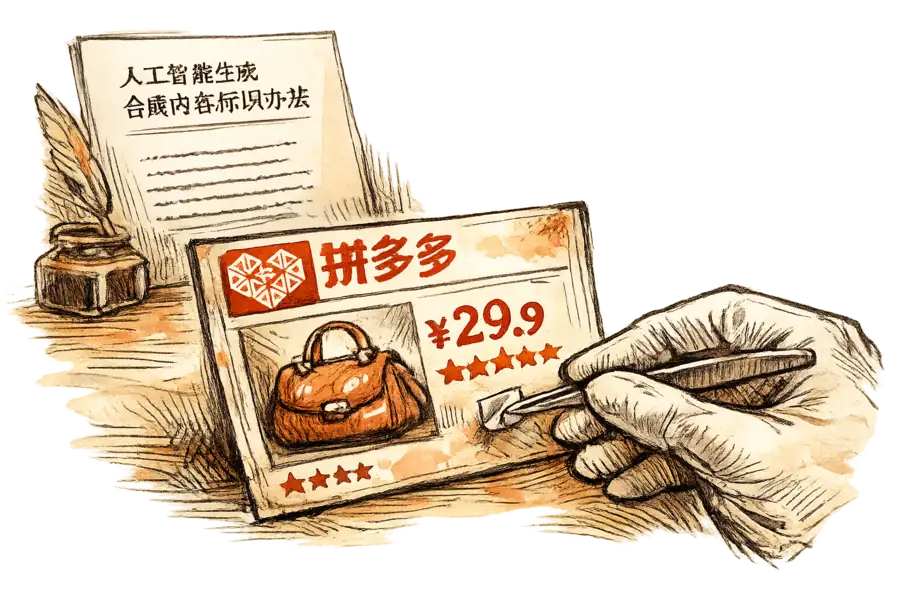
Beijing Wrote The AI Labelling Rule. Pinduoduo Filed It Under Seller Discipline.
China's AI labelling regime imagined enforcement at the generator. Pinduoduo's 盗图 framework treats watermark removal as a seller infraction, making the listing — not the model — the compliance surface.
Sir John Crabstone
Beijing’s Measures for Labelling AI-Generated Synthetic Content, effective 1 September 2025, require explicit labels on synthetic content that may cause public confusion and mandate metadata embedding for all AI-generated material; watermarks are recommended, not required. Article 10 prohibits malicious removal of either, though Article 9 permits the explicit label to be waived by agreement with the service provider. The regulation imagines a generator-side world: the tool stamps the image, the user must not strip it. Pinduoduo’s enforcement architecture imagines no such world.
Pinduoduo’s 盗图 (image theft) rule predates Beijing’s watermarking measure by years. It imposes two penalty points and immediate delisting per offence; the seller has seventy-two hours to remove the listing, settle with the complainant, or produce the original. For a stolen photo, “produce the original” is an evidence problem. The diffusion-generated case is metaphysical: there is no original to produce. A graphic designer in Shenzhen and a diffusion model in Hangzhou are, for the platform, the same actor.
That equivalence is the entire trick.
The CAC’s text prohibits removing or tampering with markers, including providing tools to do so. The Chinese-language web nevertheless offers a thriving market of 去水印 utilities tuned to Pinduoduo’s image layer, free and platform-specific. The CAC has not visibly moved against the toolmakers, as of this writing. Pinduoduo deletes the listing the moment a watermark complaint clears verification. The generator-side regime exists on paper; the seller-side regime exists in the takedown queue.
The Measures themselves name platforms as the enforcement front line, required to flag, remove, and document non-compliant content. Pinduoduo discharges this duty through the seller-penalty system it had built years earlier. The platform satisfies the regulator’s letter; the cost stays with the seller.
The move is deliberate. Beijing has every reason to want the synthetic-content question answered at the model: the policy is cleaner, the enforcement finite, the affected parties few. Pinduoduo has every reason to want it answered at the listing, because that is the only point at which the platform exercises real leverage. The seller signs a merchant agreement. The model does not.
The consequence is that AI-content governance, on the most-trafficked Chinese marketplace, is collapsing into the compliance surface that handled counterfeit Nike trainers in 2018. The synthetic image is not a new category of risk; it is image theft with a different supplier. Pinduoduo’s April 2026 ¥1.5 billion penalty for ghost-delivery listing violations — where active obstruction of the investigation was cited as aggravating conduct — confirms the platform’s instinct: when regulators arrive, push responsibility down the supply chain until it lands on someone holding inventory.
Brands should expect the seller-as-compliance-surface model to travel. Temu, PDD Holdings’ international marketplace, operates on the same merchant framework. Western marketplaces watching Brussels and Sacramento approach AI labelling will notice the same thing — policing generators is harder than policing the merchant who uploads the result. The listing carries the offence; the model is a footnote in fine print no regulator reads.
Pinduoduo has not defied the AI labelling regime. It has simply re-filed it under shoplifting.