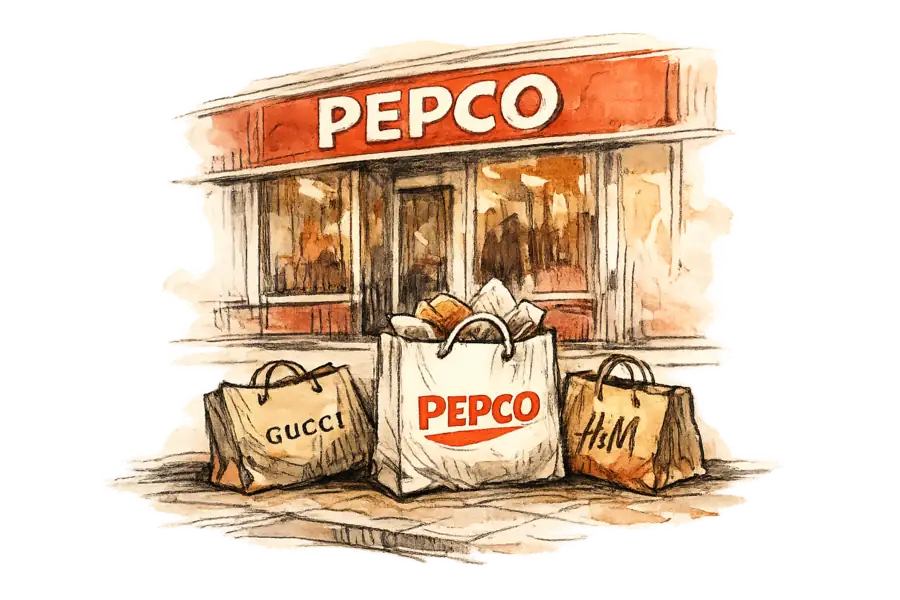
Pepco Grew Revenue Five Percent. Profit Grew Fifty-Two.
Pepco's half-year underlying profit after tax rose 52.3% on revenue growth of 5%. The ratio confirms discount-retail margin leverage, not premium recovery, is the dominant European retail outcome in 2026.
Sir John Crabstone
Pepco Group lifted half-year underlying profit after tax by 52.3% on revenue growth of 5%. The ratio is the story. European retail’s 2026 outcomes are not being decided at the top line.
The Polish-headquartered variety discounter posted gross margin of 49.7% in the six months to 31 March 2026, up 250 basis points year-on-year. Underlying EBITDA reached €516m, up 17.5%; underlying earnings per share grew 56.6% to 35.4 cents. CEO Stephan Borchert credited “the hard choices we made to simplify and refocus the business” in the interim release. The Pepco brand alone now prints 51.3% gross. The 250 basis points reflect the exit from low-margin grocery alongside improved apparel mix and sourcing, not price.
Kering’s first-quarter revenue fell 6.2%, with Gucci alone down 14.3%, per WWD. At LVMH the same quarter produced a 5.9% decline in reported revenues, with Fashion & Leather Goods down 2% organically. The recovery European luxury has been promising for three years has not arrived.
H&M Group sales fell 1% in local currencies in its three months to 28 February 2026, weighed by store closures, reports Sourcing Journal. Inditex, the only premium-leaning operator producing the numbers everyone expected, grew constant-currency sales 3.2% in its fourth quarter. Mid-market is losing share to discount below and to premium fast-fashion above.
Operating leverage at this magnitude rebases what a European retail multiple should be. The discount cohort has spent the cycle building cost structure; the rest spent it explaining what cost discipline would eventually look like.
Pepco did not grow into its margin; it cut into it.
The Pepco brand has now posted six consecutive quarters of positive like-for-like growth, the FMCG exit is unwinding through the second half, and Dealz is scheduled for separation by end of FY26. Pre-IFRS 16 net debt of €139m represents 0.2x LTM EBITDA. The board has authorised up to €400m of capital returns this year, with the regular dividend payout target climbing progressively to 40% of underlying earnings. The shape of a company defending its multiple has appeared in variety retail.
The Western European expansion is the more revealing detail. Pepco plans at least 600 new stores in the region between FY27 and FY30, doubling its footprint, with double-digit like-for-like there across the six weeks to 16 May. The economics that justify that pace are not survival economics.
There is a longer piece to write about what apparel gross margins should be when the discounter prints 51.3% and the luxury house posts a decline. For now the European retail desk should rewrite its 2026 model on one observation. Pepco grew revenue at one-tenth of profit. The recovery did arrive. It arrived in the wrong bag.