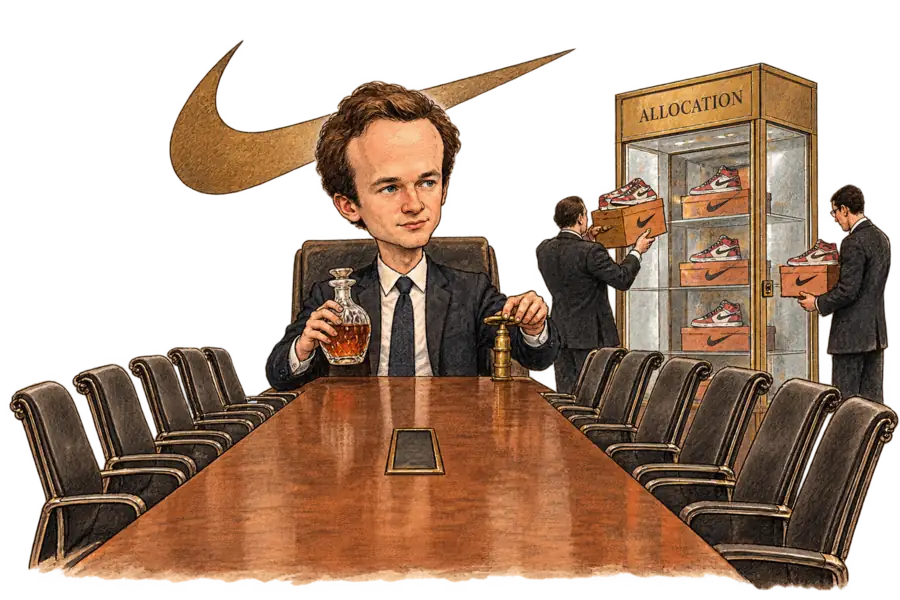
Nike Put an Arnault on the Board and Filed It Under Digital
Nike expanded its board to twelve and seated Moët Hennessy's deputy chief executive under a brief about innovation and digital transformation. The résumé says the board has diagnosed a price and distribution problem, not a demand one.
Sir John Crabstone
Nike has added Alexandre Arnault to its board and widened it to twelve directors, effective immediately. He is deputy chief executive of Moët Hennessy, where the work is deciding how much cognac a distributor may have and at what price. Nike has bought a supply discipline and filed it under digital.
Elliott Hill welcomed him for “experience across innovation, digital transformation and brand building.” Nothing in that résumé is digital. Arnault’s trade at Moët Hennessy is allocation: deciding what ships, to whom, and at what price, in a category built on scarcity rather than scale. Digital is the least of what he brings.
Nike has not yet decided where to seat him. The filing records that committee assignments “have not yet been determined,” alongside a sign-on award of $200,000 in restricted Class B stock. A board hiring for a known gap knows which committee holds it. This one wanted the man before it settled the job.
Nike’s own accounts had already made the diagnosis. Full-year wholesale revenue rose 6 percent to $27.5 billion while Nike Direct fell 6 percent to $17.7 billion and Brand Digital dropped 12 percent. Inventory finished flat at $7.5 billion on flat revenue of $46.4 billion. A company losing its direct channel by accident does not finish the year with inventory that tidy.
The clearest number was spoken aloud. On the fourth-quarter call Hill said Nike had “taken $2 billion out of the market in FY 2026 of our classic franchises,” with off-price down by half and digital being repositioned as a premium business. No marketing department can withhold two billion dollars of saleable product. Only a supply plan can.
A brand that cannot control where its product lands does not have a price; it has a suggestion.
The commentary has read the appointment as taste, not structure. At Inside Retail, Deanna Andersen credited Arnault with making Rimowa and Tiffany wanted again; Frankie Margotta credited him with understanding “restraint, controlled distribution and scarcity.” Only the second observation describes work a director can do. The same piece’s lead voice warned that Nike cannot accessorize its way out of a turnaround while its own stores shrink. Boardrooms reach the supply plan before they reach the design floor. That warning is the argument this appointment has yet to answer.
The market priced it as a courtesy. Shares closed up 1.6 percent at $36.36 the next day. Footwear News found Stifel and Williams Trading declining to weigh in, and Matt Powell allowing that it was “not a game change, but a good add.” Restraint does not show up in a week. It shows up when the next Dunk is hard to find.
The method is sound and it is slow. It shrinks a business before it enriches one. Nike has already surrendered roughly $200 billion in market value since its 2021 peak, and lost its place among America’s hundred biggest blue-chip companies last week.
Arnault’s seat runs only to the 2027 annual meeting. The board has bought patience; it has not asked the shareholders whether they have any.