New York Named Two Founders to the Council. Nobody Called the Trade Body.
Mayor Mamdani's inaugural Business Advisory Council seats fifteen operators and not one trade association. Etsy's chief executive and Brandon Blackwood will carry marketplace fees and storefront costs into the room; the Garment District, rezoned last August, has nobody to carry it.
Sir John Crabstone
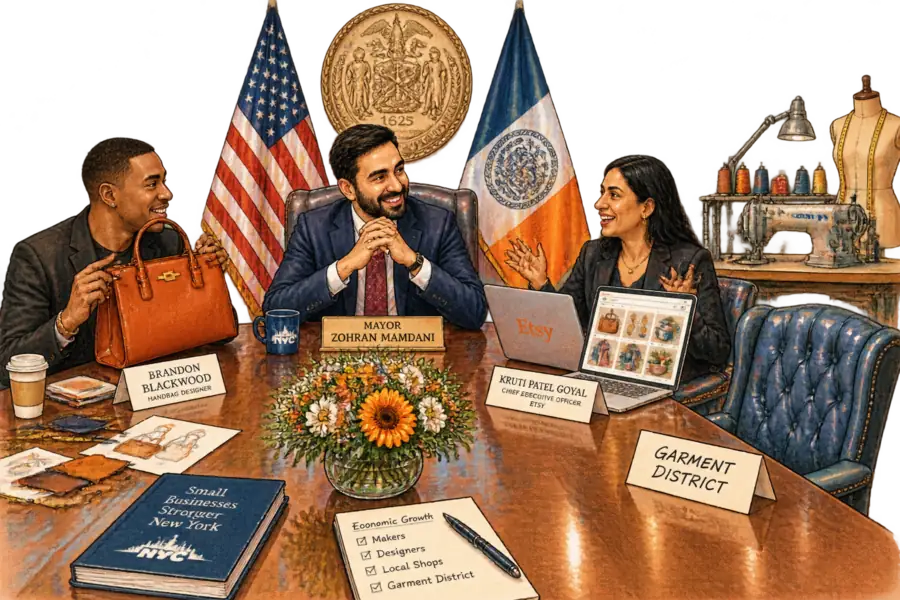
Fifteen people now hold a standing quarterly appointment with New York’s mayor. Two of them sell to shoppers: Kruti Patel Goyal, who runs Etsy, and Brandon Blackwood, who makes handbags, both named on Thursday to the city’s inaugural Business Advisory Council. Neither arrives on behalf of an industry body, and that settles which retail problems will reach City Hall.
The coverage has fixed on absent names. Fortune found no serving executives from JPMorgan, Citigroup, American Express, BlackRock, Meta or Alphabet on the roster; a mayoral spokesman attributed the gaps to scheduling conflicts, missing corporate clearance and a distaste for the publicity, not to refusal on principle. The more useful census counts kinds rather than names. Every seat belongs to an operator. Trade associations exist to carry the complaints of firms too small to be asked; none appears on the roster.
Goyal brings a marketplace. Etsy’s marketplace sales reached $2.6 billion last quarter, up 7.5 percent, with the take rate rising mainly on advertising. That growth comes increasingly from what sellers pay to be seen, not from what they sell. Listing fees, ad load and the price of visibility are subjects she can raise without notes, because they are her revenue. Marketplace seller economics now has a chair.
Blackwood brings a storefront. In July the administration published “OPEN for Small Business”, more than fifty reforms aimed at the fines and paperwork borne by roughly 180,000 small businesses. That agenda already had believers inside City Hall. It now has a founder whose own business bears those costs.
Both are real problems, and both belong to the half of the trade that sells finished goods to consumers. Garment production has nobody. The City Council rezoned 42 blocks of Midtown South last August, lifting protections that had reserved the Garment District for making things. City Planning judged 779 businesses within half a mile to be at risk, and the CFDA counted 114 that could be displaced outright, as Manufacturing Dive reported. The Fashion Manufacturing Initiative, which put grants into 54 factories and supported more than 2,000 jobs, ran out of money in 2024. What replaced it is a $1.5 million state fund for sixteen to twenty applicants.
A brand buys production; it does not speak for it.
City Hall’s own biography notes that Blackwood belongs to the Council of Fashion Designers of America and describes his handbags as “designed in New York”. The trade body is present, then, as a line on a résumé. Designed is the word the city reached for, and it is the distinction the Garment District has spent years losing. Wholesale fares worse still: no famous founder, no line in the announcement, no seat.
The remit lists finance, technology, real estate, sports, entertainment, retail and health care. Neither manufacturing nor wholesale appears on it. A quarterly hour is a scarce good, and scarce goods get spent on the grievances someone in the room already owns. Everything else applies for a grant.