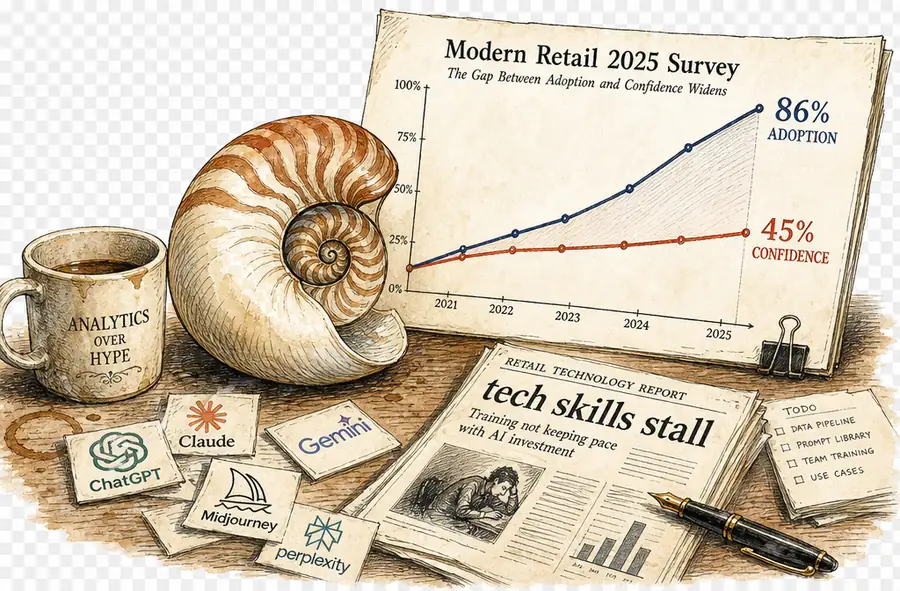
Modern Retail's Adoption Hit 86%. Confidence Stopped at 45%.
Modern Retail's annual marketer survey reports AI adoption climbed from 44% in 2022 to 86% in 2025, while MiQ's parallel study finds only 45% of marketers confident they can apply it successfully. The buying curve cleared; the validation curve never started.
Neritus Vale
Modern Retail’s annual marketer survey reports that brand and agency AI investment nearly doubled across three years — from 44% in 2022 to 86% in 2025. The publication’s May 14 headline names the matching finding: technical skills have stalled. The two findings combine to one line: most marketers are now shipping AI outputs they cannot evaluate.
The trajectory is the easy number, but the survey did not quantify the harder one. Modern Retail’s 142 respondents report how their companies use AI; their ability to evaluate the output is treated as commentary, not as a measured variable. Of those buyers, 85% reach AI through out-of-the-box vendor tools, and validation is hardest where the operator sees the least. When the model is a vendor product the operator did not build, the failure mode stays invisible until the output ships.
The skill curve was never reported with the same precision, but MiQ’s November 2025 confidence study tried. Across 3,169 respondents in 16 countries, 72% planned to expand AI use in the next year; only 45% felt confident applying it successfully. The gap between intent and skill is the part Modern Retail’s survey could not measure.
That spread is not theoretical, because the role expanding AI use is rarely the role that can tell you whether last quarter’s AI worked.
The MiQ data goes further on the operating layer: 44% of respondents reported they cannot track AI results against the right business goals, defaulting to proxy metrics like clicks and traffic. A click is the data point you reach for when you cannot reach the one that matters. The substitution does not register as a failure on any dashboard, which is the worst version of a failure to validate.
The Modern Retail full report identifies where this deficit will bite first: copy generation leads, with creative production and marketing workflows close behind. Copy is the soft case. A wrong line of copy survives because a human reads it; a misfiring workflow rule reroutes ten thousand customers before anyone notices it ran.
The honest counter is that most marketing AI use does not need expert validation. It is disposable copy variants, image crops, headline tests — the kind of work where a human eye is the cheapest filter. That argument holds only if the AI use stays inside that perimeter, and Modern Retail’s own data does not support it. The full report places multimedia generation and marketing workflows among the leading applications; neither scales to human review.
In fashion retail, the validation problem carries higher stakes. Copy and creative production — the survey’s leading AI applications — mean product descriptions, lifestyle imagery, and segmented send sequences: outputs that determine what a customer believes about a garment before it ships. If a model fabricates a fabric composition or a fit attribute and no one with the skill to catch it sees the output, the validation failure registers as a returns rate, not as a marketing error.
The agentic AI finding in the full report makes the point sharper. A majority of respondents report that their companies do not yet use agentic AI, citing trust and complexity as the principal blockers. The marketers who declined to deploy autonomous agents may have read the validation problem better than the ones who deployed and assumed it would solve itself.
Whether the skill of evaluating AI outputs keeps pace with adoption determines who pays for the eventual mistake. Dan Gardner, co-founder of Code and Theory, told the publication that emphasis has been on implementing tools rather than on the new way to work; that remark locates exactly where validation should have entered the curriculum. The choice still on the table is whether to spend the next survey cycle adding the skill layer the buying curve has outrun, or to keep ramping adoption and let the brand absorb the audits as they come. If marketer AI adoption keeps climbing while the skill of evaluating its outputs does not, the cost of catching a mistake moves from the agency that bought the tool to the brand that shipped its output.