Mangano Closed 90% Of Sales In 60 Seconds. The Dashboard Looked Elsewhere.
Joy Mangano's CleanBoss sees up to ninety percent of its daily sales within sixty seconds of an infomercial airing. The number exposes how thoroughly the industry has under-counted direct-response television: a performance channel still producing measurable lift, below the dashboards most brands consult.
Sir John Crabstone
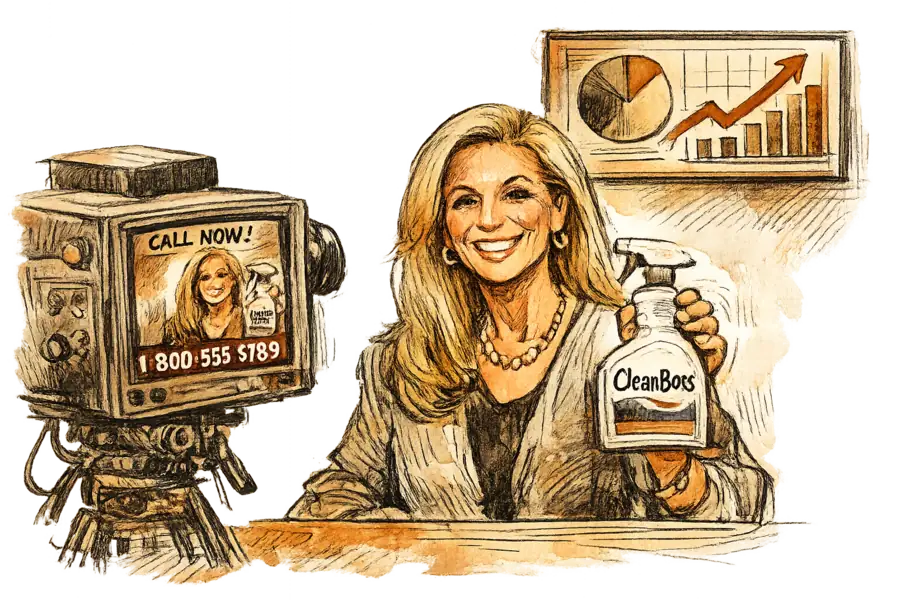
CleanBoss sees up to ninety percent of its daily sales within sixty seconds of an infomercial airing. Joy Mangano, the QVC veteran whose cable spots now move non-toxic cleaning products, calls the channel her best-kept secret. She offers it as flattery; it reads as indictment. The dashboards most brands consult contain no row for it.
The thesis is unfashionable. Direct-response television, the medium that made the Miracle Mop and lifted Proactiv into a billion-dollar property, never stopped working. It stopped being legible. DRTV drives twenty-five billion dollars in annual retail sales, produces measurable lift inside fifteen-minute windows, and routes a significant portion of its conversion to Amazon. A brand marketer knows what a Sephora pop-up buys. A sixty-second cable spot whose lift lands on someone else’s ledger is harder to file. The harder it is to file, the smaller the line item, and the smaller the line item, the cheaper the inventory.
CleanBoss tracks lift in fifteen-minute, one-hour, and twelve-hour windows around each airing. The attribution is proprietary; the arithmetic is public domain. Eat Cleaner, the brand’s vegetable wash, became Amazon’s category leader within thirty days of its first cable spot.
The halo is the part the dashboard refuses to count. A Philips Norelco DRTV campaign produced a 34% increase in retail sell-through — downstream lift that never appears in the infomercial’s own column. The infomercial sells the bottle. The planogram sells the brand. Each is measurable; together they are unaccounted.
Mangano supplies the line that names the misallocation: “When I started on QVC, TV was expensive and crowded. Today, it’s the opposite.” The migration of brand budgets toward retail media, creator commerce, and connected TV has left linear under-bid, even as it keeps producing the cleanest conversion signal outside paid search. Lower CPMs, broader reach, an order arriving inside the next quarter-hour. The same buyer paying fifty-dollar CPMs for YouTube preroll balks at a tenth of that for a slot that demonstrably triggers an Amazon click.
What the dashboard cannot count, the strategy will not buy.
The failure is institutional. Measurement frameworks for converged TV flag the attribution gap directly: inconsistent methodologies, walled-garden data, marketing-mix models that under-credit any signal not arriving in the same dashboard as Meta and Google. DRTV’s measurability has improved markedly; the industry’s permission to look at it has not. Channels feeding that dashboard look measurable; channels that do not look like nostalgia. A medium becomes unfashionable when the numbers arrive in the wrong format, not when they are missing.
It is tempting to read CleanBoss as nostalgia: the Pitbull cameo, the 1-800 number, the late-Sunday-cable aesthetic. The numbers say something less sentimental. A channel priced as legacy is performing as direct response, below the line items where most brands look. Mangano is not reviving a medium. She is collecting on one she never left.