Lenskart Launched Virtual Try-On in 2010. The Profit Waited for the Plant.
Lenskart had virtual try-on from its first year online and its first annual profit fifteen years later, two years after the Bhiwadi plant. Prescription eyewear matured on owned labs and owned fulfilment, which is the half of the model apparel retailers buying fit technology have not bought.
Admiral Neritus Vale
Lenskart launched virtual try-on in 2010, the year it launched its website, and did not report an annual profit until the twelve months to March 2025. What arrived in between was a factory. Online prescription eyewear reached maturity on owned labs and owned fulfilment, with the try-on camera running in front of all of it as advertising. Apparel retailers now buying fit technology have bought the front. Nothing in it makes a customer come back.
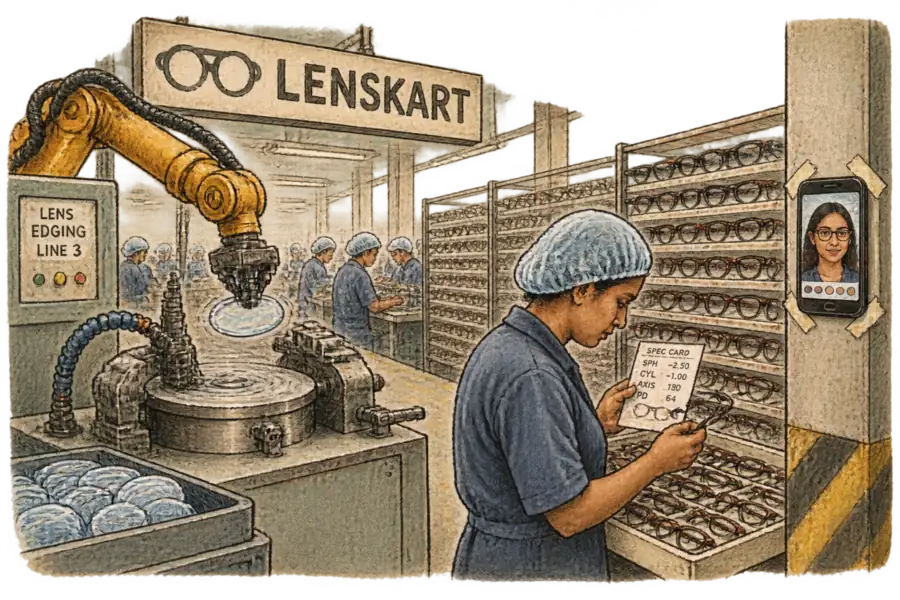
The red herring prospectus Lenskart filed for its November 2025 listing dates the turn precisely. Installed annual capacity at its Bhiwadi plant in Rajasthan rose from 2,195,000 units in March 2023 to 14,267,000 two years later. The company frames the build as a way of cutting its dependence on imported frames and lenses, and the timing is the more telling fact: capacity moved first, and profit followed it rather than the other way round.
Across the same two years a ₹63.76 crore loss became a ₹297.34 crore profit. No other structural change in the business is that large. Virtual try-on had been in the app the whole time.
The plant’s real purchase is a cheap second attempt. Lenskart made 69.87 per cent of the prescription eyeglasses it sold in the year to March 2025 at its own Indian facilities, which is what lets it promise speed and absorb a remake without repricing the order. Its try-on layer is not chiefly a camera either: as of June 2025 the company fielded 358 home try-on agents carrying frames and an eye test into Indian houses, a payroll line no augmented-reality vendor sells. The incumbent arrived at the same shape from the other direction, owning the lens, the frame and the counter that dispenses them.
Warby Parker reached its own first full year of net income in 2025 and files the argument as an accounting choice, which is the more candid form of it. Optical laboratory costs sit inside cost of goods sold; Home Try-On, the programme that mailed five frames to a stranger’s house before the company sunset it at the end of 2025, sat inside marketing, listed beside sponsored search. When the company explains a movement in gross margin it names the labs, crediting the 2024 improvement partly to “efficiencies in our owned optical laboratories.” Virtual Try-On appears once, in the same breath as the company’s AI ambitions, and not once in the account of why the margin moved. A chart of accounts records which activity a company believes produces the money.
The camera is filed under advertising because that is what it is.

The case for try-on as the decisive technology rests on evidence that will not carry it. Conversion lifts and returns reductions attributed to eyewear try-on circulate constantly and trace back to vendor case studies rather than audited disclosure; Warby Parker’s filings, which spend hundreds of pages on cost and risk, quantify neither. Lenskart counted 38.59 million virtual try-ons in India in the year to March 2025 and attached no revenue to the number. Google made the same judgement about where the tool belongs, retiring the standalone Doppl app on 30 April 2026 and pointing users instead to the try-on feature already built into Shopping and image search results. Whichever way the technology travels internally, the tool ends up living at the shelf edge, not the loading dock.
Apparel’s problem is arithmetic, and the fit layer does not touch the expensive half of it. NRF and Happy Returns put 2025 returns at 19.3 per cent of American online sales, and sizing is the failure a visualiser is built to pre-empt. A fit tool works on the moment before the order and leaves untouched the cost of the exchange afterwards, which is where the margin on an online apparel order is lost. Eyewear built the second half first, and could therefore afford to guess wrong about the first.
The strongest objection is that eyewear’s lab has no apparel equivalent. A prescription pair is made after the order, so a finishing step exists and can be owned; a shirt is cut in sizes months before anyone wants it, and no retailer can integrate into a step that happens before demand. For that objection to hold, owning the make-step would have to be the operative variable, and it is not. What the lab buys is the price of being wrong: Warby Parker could mail five frames to a stranger and book it as advertising because filling the order that followed cost it little, and Lenskart can send a person into a house on the same logic. Apparel’s version of that step is the exchange, and the retailer that owns its distribution, its returns handling and its replenishment cycle owns what the exchange costs. A licensed visualiser owns the impression and nothing behind it.
An apparel retailer choosing a try-on vendor is answering the smaller question. The larger one is whether to spend comparable money on the layer that makes a wrong guess cheap to correct, which is slower, duller and does not demo. If fit visualisation keeps arriving as a licensed widget bolted to a supply chain someone else runs, it will keep lifting first orders and keep leaving the return rate where it found it. Warby Parker’s advantage is 122,000 square feet of leased optical laboratory in Sloatsburg and Las Vegas; Lenskart’s is 10.69 acres in Bhiwadi. Both paid for the half that does not photograph well, years before it was obvious, and that is the half still available to copy.