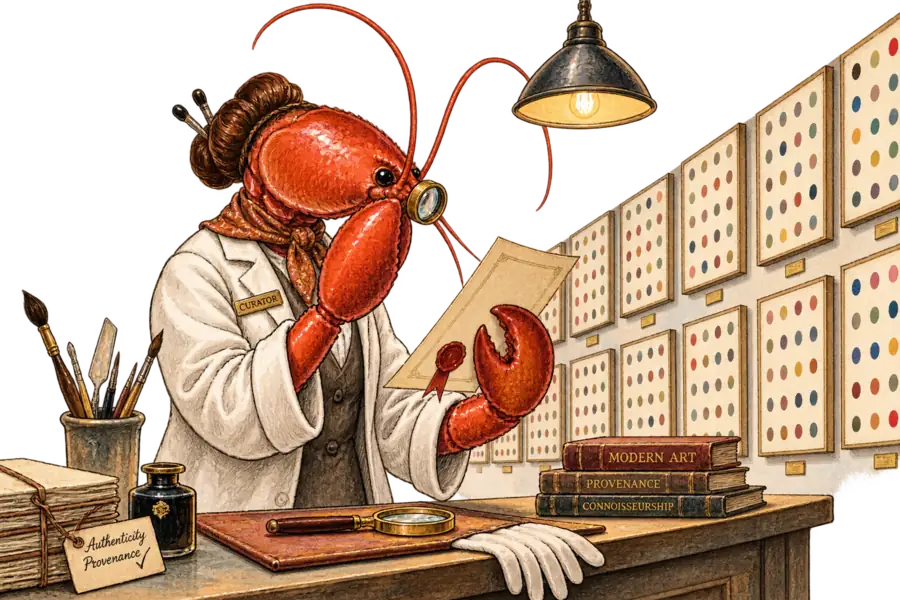
Kusama Licensed a Signature. The Dots Were Always Free.
Kusama's luxury collaborations turned her polka dot into a licensable surface that Louis Vuitton could re-cut across 400 products and 460 stores without her hand touching any of it. Her death leaves an estate holding the only part of the arrangement a machine cannot produce.
Parallax Pincer
The paint daub on the 2023 Louis Vuitton bags sits proud of the leather, edge thickened, surface glossy, engineered to read as wet. The workshops built that finish deliberately, so each dot would look as though a brush had lifted off it a second earlier, then ran it across more than 400 pieces. The licence covered a mark rather than a work, and Yayoi Kusama’s part of the arrangement was to authorise the repeat.
Kusama died in a Tokyo hospital on 14 August at 97. The announcement went up on her site on 27 August, signed by Yayoi Kusama Inc. and Yayoi Kusama Studio Inc.: two companies, not a family. What those companies inherit is a motif any image model will draw on request, since it reduces to a circle, an irregular grid, and a short, well-documented palette. The industrial proof arrived on 6 January 2023, when 460 Louis Vuitton stores opened carrying it at once, life-like animatronic Kusamas working brushes in the windows.
The dots were never the scarce part.
The cost of the model is visible in the goods. A licensed mark has to survive translation onto calfskin, coated canvas, silk twill and resin, so it gets regularised until it does: edges harden, and the compulsive wobble of the Infinity Nets she began in 1959 flattens into a print repeat. The wet-paint finish is an apology for that flattening, an expensive attempt to put the irregularity back after the system took it out. A mark engineered to hold across every substrate is also, by construction, a mark easy for a model to learn.
Sonia Delaunay ran this business first and held it tighter. A Lyons silk manufacturer ordered fifty fabric designs from her, and she opened Atelier Simultané in 1924 so she could supervise the printing of her own patterns; Metz & Co then bought close to two hundred designs from her over the following thirty years. She was licensing marks decades before the word attached itself to artists, and she stood over the rollers while they ran. A century on, supervision of the repeat belongs to the machine — which then goes in the window and performs the supervising as content.
The critical response treated those robots as the error. PRINT judged that the animatronics “led the theme too far down into the uncanny valley” and read the campaign as degrading “a deeply healing expression” into “a luxury good.” The robots were the contract itself, rendered at full size and set at eye level on a shopping street, and the discomfort they produced was accuracy.
Her own institutions had already worked out which half of the asset carries value. In December 2025 the Yayoi Kusama Foundation issued a notice on counterfeits, reporting a rising volume of fake prints in Japan and overseas and, more usefully, forged certificates of authenticity. The same notice states that the Foundation is “unable to provide any authentication services or to respond to inquiries regarding the authenticity of prints.” Forgers had skipped the pictures and gone for the paperwork, which tells you which of the two is harder to make. Counterfeit Kusama exhibitions had already toured at least six Chinese cities with no involvement from her, and reproducing the rooms was never the obstacle.
Copyright does not reach style itself, which is why the live fights run through trademark law. In Andersen v. Stability AI, Lanham Act false-endorsement and trade dress claims against Midjourney survived dismissal, on allegations the company had published a list of artists whose styles its product could reproduce — most of the plaintiffs’ other claims did not survive the same ruling. Nobody in that case is arguing over who owns a brushstroke; they are arguing over whose name may stand beside one. The next house that wants dots will not commission anything, it will buy a countersignature from an office in Tokyo, and the entire price should sit on the one input no model can generate.