Instacart Will Rent You an Assistant. The Questions Stay With Instacart.
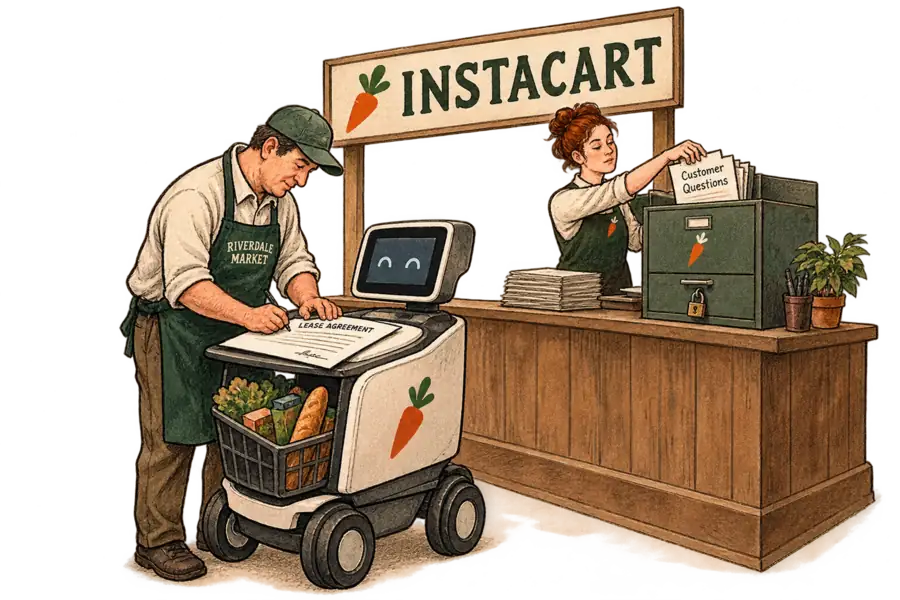
Instacart has turned its shopping assistant into a white-label product regional grocers can rent, live this week at Food Bazaar, Heritage Grocers Group and Woodman's. The retailer gets a branded interface; the query log, the only new demand signal conversational shopping produces, stays on the vendor's side of the contract.
Admiral Neritus Vale
Instacart has put a price on the thing every grocer spent 2025 trying to build. On September 9 it took Cart Assistant live at Food Bazaar, Heritage Grocers Group and Woodman’s, with Aldi U.S., Harmon’s, Save Mart and Stew Leonard’s to follow. The retailer supplies the catalogue, the customer file and the name on the interface; Instacart supplies the model and the seat from which every conversation is observed. That seat is the asset. A rented assistant answers the retailer’s shoppers and collects the only new demand signal conversational commerce produces: the question, in words, before anything is clicked.
The assistant stopped being a differentiator the moment it became a purchasable SKU. Walmart, Amazon and Kroger launched their own assistants, and Kroger put advertising inside its own on day one. Gartner’s Digital IQ tracking put generative-AI chatbot adoption among multi-brand retailers at 21% in 2025, roughly four times the year before, as Modern Retail reported. Heritage Grocers’ chief experience officer, Adam Salgado, said building one alone “would have required significant time and resources,” which is a defensible reason not to. A capability available at vendor prices has simply stopped proving anything about the retailer holding it.
What the assistant manufactures is not a better answer but a sentence. Instacart’s own examples make the point: a shopper can ask for a week of budget-friendly kid lunches, high-protein easy dinners for two, or “everything for a football watch party for 20 people.” Each names a constraint no clickstream could infer: a budget ceiling, a dietary rule, a household size, an occasion with a date on it. A click records which product won, never the condition that made it win, and merchandising has always had to guess at that. Retailers buy panel data to approximate this; the assistant produces it continuously, in the shopper’s words.
The retailer keeps the customer, the catalogue and the brand; the sentence that reaches all three arrives through somebody else’s model.
Instacart has said what that sentence is worth to it. On the deals letting shoppers start in ChatGPT, chief commercial officer Ryan Hamburger was explicit: “We’re not sharing the same level of data with OpenAI as we would with the shopping assistant embedded on our platform… that data remains a competitive advantage for us and for our retail partners.” The order of that last clause is the argument. A company grading counterparties by data access is keeping a ledger, and its launch copy calls Cart Assistant “made smarter by the same technology and intelligence behind Clementine.” Learning flows toward the model, and the retailer is not where it lives.
Instacart already sells grocers a way to read their own data. Agentic Analytics, announced in the November 2025 release that first named Cart Assistant, layers its AI onto a retailer’s data stack and returns insights through portals for merchandising, marketing and operations. The grocer generates the signal inside a rented assistant, then subscribes to a dashboard in order to see it. That is a licensed view of an asset, not the asset.
The advertising business explains the patience. Advertising and other revenue reached $297 million in the second quarter of 2026, growing faster than the delivery business beneath it. Ads are priced on knowing what a shopper wants before the shopper finds it, which is what a query log improves. Carrot Ads already runs white-label retail media across more than 240 ecommerce sites, so the pipe from partner storefront to Instacart’s ad stack is built. Cart Assistant adds a second pipe, carrying intent stated before the search box rounded it into a keyword.
The strongest case against this reading is that the leverage sits with the retailer. Cart Assistant runs on the grocer’s own catalogue and customer file, and Hamburger’s pitch is against standardisation: retailers “want to make sure they can continue to build on the brands that they’ve built over the last 100 years.” For the argument to fail, one condition must hold: the retailer gets the query log raw and exportable, keeps it when the contract ends, and keeps it out of any cross-retailer model. No published agreement says so, and a full copy would not close the gap anyway. The vendor’s advantage is not the rows but the count: Instacart sits across over 1,800 retail partners fielding the same questions.
Fashion has already run the storefront version of this experiment, and the clients took the work back. Farfetch Platform Solutions ran e-commerce for Harrods and Manolo Blahnik, and Neiman Marcus Group walked away in February 2024, days after Coupang closed the acquisition, saying it would invest in its own capability instead. Coupang shut the unit that August. What was recoverable is the instructive part: Emilio Pucci, Proenza Schouler and Phillip Lim rebuilt their storefronts in-house. A conversation history cannot be reconstructed after the fact, and a retailer that never held one has nothing to carry out the door.
Zalando shows what the owned version accumulates. Close to 10 million customers asked its Assistant for advice in the first quarter of 2026 alone, the company reported. That is a corpus rather than an engagement metric: every session is a stated constraint attached to a known customer, and the Assistant now covers beauty as well as fashion, so one conversation crosses two buying calendars. Across the whole of 2025 the figure was six million. Zalando’s Assistant is not a product on offer to other retailers, and the volume behind it is now large enough to matter. No rental contract accounts for that difference.
If apparel and beauty retailers rent assistants at grocery’s pace, the cross-retailer map of stated demand will belong to a few vendors within two buying cycles. Merchandising teams will license it back at a price set by the only party that sees all of it. The remedy is not to build a model, which most retailers cannot afford. It is four lines in a procurement document: raw transcripts delivered, exportable, retained on exit, excluded from cross-retailer training. The assistant is a reasonable thing to rent. The questions are not, and nothing in the contracts now being signed prevents a retailer from saying so.