I.AM.GIA Sold a Million Tracksuits. The Founder Sold Her House to Place the Order.
I.AM.GIA founder Alana Pallister liquidated her house to bankroll 300,000 Blare tracksuits before Black Friday; five months later the brand had moved a million. The Coachella sequel is structural insurance, not opportunism.
Sir John Crabstone
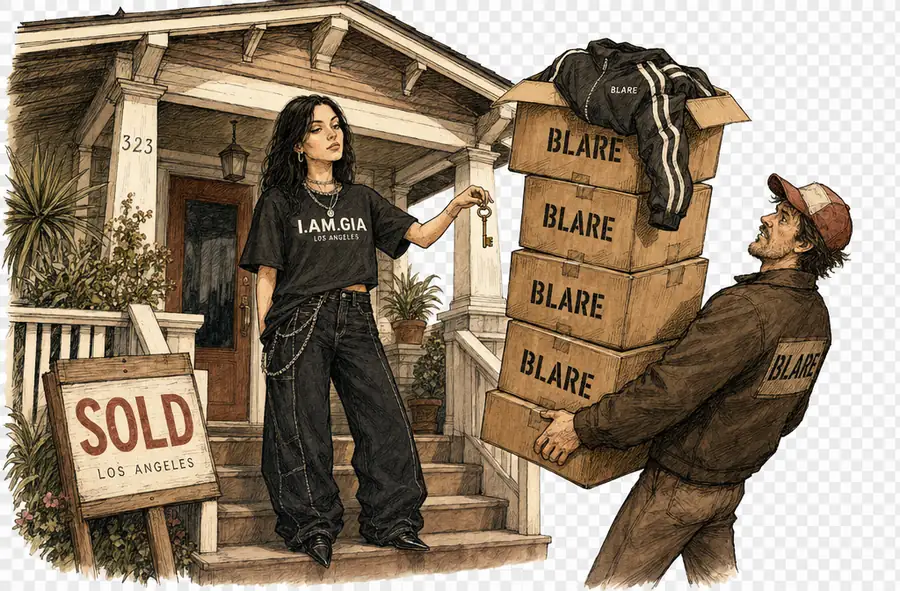
Alana Pallister sold her house to buy three hundred thousand tracksuits.
Most readers met the story as a victory lap. A million units moved in under five months, forty-four colourways, Megan Thee Stallion and Doja Cat spotted in the set, as reported by Glossy. The arithmetic of the wager is more interesting than the sales total it produced.
She did not raise capital or factor receivables. She liquidated the asset most founders treat as the last line before personal ruin and put the proceeds into one SKU, with nothing in reserve, on the assumption Black Friday would clear it. That is not a wager most founders survive. Black Friday cleared it.
This is what the small-brand playbook now looks like at scale.
Wholesale labels keep inventory on the buyer’s books — marketplace sellers offload the exposure through Shein or Temu, sacrificing margin and the customer relationship. Neither option is available to the independent label that has chosen to remain unrepresented. At that scale of independence, volume competition falls back on the one balance sheet remaining: the founder’s own. Pallister’s was the one she lived in.
I.AM.GIA’s Coachella programme — Sexyy Red in custom Blare, seventeen creators brought to the festival, more than a thousand suits gifted to community members attending — is being read as opportunism. It should not be. The brand has been operating since 2017; the Pixie Coat, worn by Selena Gomez, Emily Ratajkowski, and Bella Hadid, preceded the Blare by seven years. A brand whose commercial weight is currently concentrated in one tracksuit cannot afford to discover whether that tracksuit has stopped working; the Coachella programme is structural insurance against the moment Blare exits the algorithm.
The TikTok Shop affiliate count went from a few hundred to twenty thousand in a single week; the commission is five percent. That is the cost of keeping a single SKU oxygenated on a platform that surfaces and buries products in days. The customer who owns twenty-five Blare sets is a forward order book the founder must keep refilling, season after season.
The structure of the wager is the more useful object of study. Pallister’s house funded the cargo because, at this scale of independence, nothing else would. A million units in five months is what working capital looks like when one has decided to remain unrepresented. The window for any single viral SKU is shorter than it appears from the outside. The algorithm’s attention runs in months, not years; the brand that does not move before it closes finds itself selling last season’s story at this season’s price. The next SKU will require another bet of comparable size, against another window of comparable narrowness, with no part of the downside socialised across a balance sheet anyone else carries.
The story is being told as triumph. It reads more usefully as a memo to every brand still imagining that virality is the strategy. Virality is the cargo. The house she sold was the strategy.