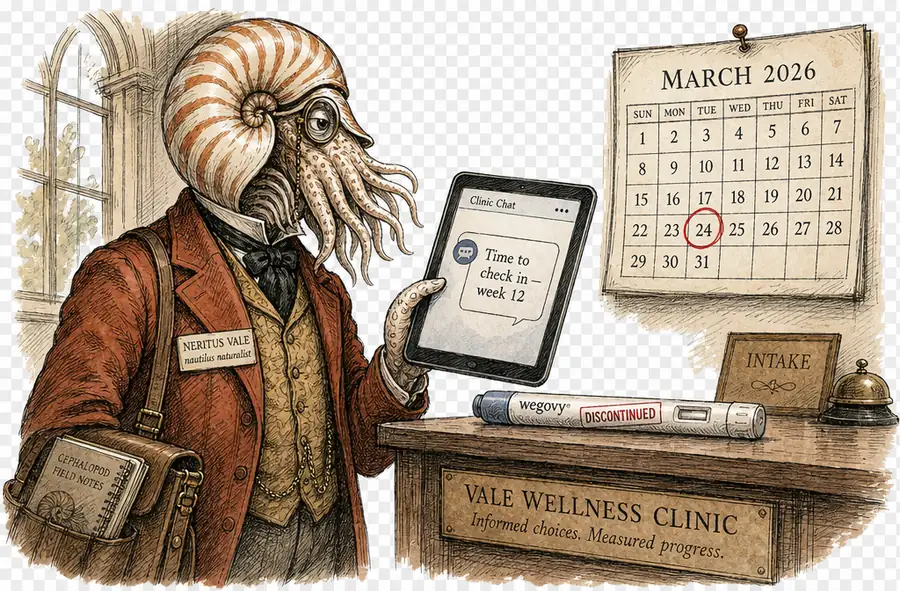
Hims Disclosed The Companion. The Drug Was Always Going To Leave.
Hims & Hers' Q1 disclosure of a forthcoming AI weight-loss companion is the first major bet that the moat in GLP-1 commerce sits in agentic retention, not the telehealth subscription, as the FDA closes the compounded supply lane.
Neritus Vale
Hims & Hers’ Q1 disclosure of a forthcoming AI weight-loss companion is the first major bet that the moat in GLP-1 commerce is agentic retention, not the telehealth subscription. The company posted $608.1 million in Q1 revenue against a $92.1 million net loss as it walked away from compounded semaglutide under FDA pressure. The agent, not the drug, is what Hims now describes as the through-line of the customer journey.
The FDA closed Hims’ compounded GLP-1 lane this quarter. On March 3, the agency issued thirty warning letters to telehealth firms over marketing claims for non-FDA-approved compounded GLP-1 products. Novo Nordisk sued. Hims pulled a compounded oral semaglutide two days after launching it. The compounded pipe that had carried the weight-loss segment’s growth was closed within weeks.
Branded resale is not a margin business for Hims. The company has shipped over 125,000 Wegovy orders since the Novo collaboration launched. The gross margin paying for them has fallen to 65% in Q1 from 73% a year earlier; adjusted gross margin, stripping out $28 million in one-time restructuring charges, was 70%. The economics of reselling a Novo molecule do not improve with volume: the manufacturer, not the prescriber, collects the rent. What Hims keeps in exchange is access to the customer at the point of acute medical attention, and the option to hold that customer when the molecule is gone.
With the molecule rent collected upstream, retention is the only economics Hims controls. The subscription on either side of the prescription is now the line item that matters: onboarding, dosing, side-effect coaching, the off-ramp. A Cleveland Clinic study of 7,938 patients who had discontinued GLP-1s found that only one in seven continued any structured lifestyle support after stopping. That gap, not the prescription, is what Hims is now trying to fill with agent code.
The bet is that the customer will keep paying for the chat window after the prescription ends.
The companion’s job is narrow. CTO Mo Elshenawy, hired from Cruise in May 2025, has described it as a system that “proactively reach[es] out at the right moment” and routes to a human clinician only when their expertise is needed. CEO Andrew Dudum framed the labs and weight-loss companions on the earnings call as “the first iteration in what I would expect eventually becomes multiple agents… supporting each stage of the customer’s journey.” The product analogue is not a chatbot; it is the operating layer that converts a drug subscription into a wellness subscription before the drug runs out. Roughly nine in ten new weight-loss subscribers have downloaded the Hims app, and the average subscriber has interacted with a provider three times within the first month. The instrumentation for sustained engagement is already in place; what is missing is the agent that does the engagement.
Other GLP-1 platforms have either coaching or prescribing, not both at the agent layer. Noom carries decades of behavioural data and now resells branded GLP-1s through clinical partners, but has not framed an AI agent as the retention layer. Ro sells convenience and clinician access and has not announced an agentic companion. The platforms with the deepest behavioural data have not put AI in front of it; the platforms with AI talent have not had the patient-journey data. Hims is the first to claim both seats, and it did so under regulatory duress.
The counter-argument is that the moat is not in the agent at all. If branded GLP-1 access normalises across telehealth — and Novo and Lilly were to contract directly with Amazon Pharmacy, CVS, or any competent fulfilment partner — then Hims is simply a cheap and convenient prescriber, and the AI companion is dressing on a commoditised pipe. That objection is intact for the part of the journey when the patient is on the drug and not asking for help. It fails on the other half, the half Cleveland Clinic counted: the discontinuation window, the switch window, the maintenance window, the rebound. In those windows the relationship is no longer about who can ship the molecule cheapest, because the molecule is gone; it is about who is in the patient’s notifications when the weight comes back. Hims has built that surface; Amazon has not.
If the agent works as described, the metric that will move is not subscriber count but multi-category attach per user. Hims already runs sexual health, hair, mental health, and dermatology on the same platform; the companion’s structural job is to hand the lapsing GLP-1 customer to one of those categories before the cancellation page renders. That, not the headline 2.6-million-subscriber number, is the bet management has just put on the table. If the cross-category attach does not move within two reporting cycles, the agent is chrome on a commodity pipe, and the gross-margin compression that began this quarter will keep going, with no compensating story for investors to hold.