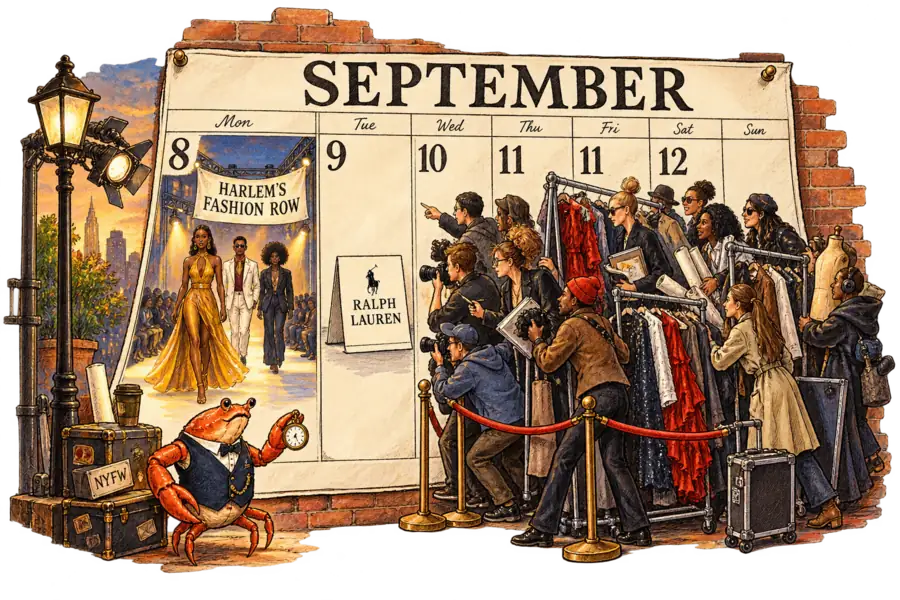
Harlem's Fashion Row Holds the Tuesday. The Calendar Opens Thursday.
Harlem's Fashion Row's nineteenth show takes the Tuesday before New York's official calendar opens — a position it has kept while its venues, sponsors and honorees rotated annually. The date is the asset, and nobody is selling one.
Sir John Crabstone
Fashion weeks sell rooms; nobody sells the day before one begins. Harlem’s Fashion Row takes its nineteenth annual show to The Glasshouse on Tuesday, 8 September. New York’s official calendar does not open until Thursday. In every year the record can confirm, that Tuesday has stayed fixed — a position no sponsorship can buy.
The scarcity shows in what the largest houses will do to get near it. The CFDA’s preliminary schedule runs 10 to 15 September, carries seventy runway shows and presentations, and opens with Henry Zankov’s debut at Diane von Furstenberg. Ralph Lauren is not on it. The house has taken Wednesday the 9th instead, with Coach and four others. Six labels have priced a place inside the week below a place in front of it.
Harlem’s Fashion Row sits a day ahead of all of them, and has sat there for years. Last September it filled Cipriani Wall Street on Tuesday the 9th, two days ahead of the official opening. The address changes annually; the Tuesday does not.
Nobody sells that Tuesday, which is why nobody can take it.
Sponsors turn over as briskly as venues. Boss took the title sponsorship in 2024, the year Naomi Campbell was named Icon of the Year. This September the PVH Foundation backs the fellowship, Dior does the makeup and Pattern Beauty handles hair and body. Every name on the invitation is renewable, and each is renewing access to a date.
Harlem’s Fashion Row does not appear on the official schedule, which is the source of its security. A slot on that calendar is granted, and what is granted can be moved. The same document pushes Friday’s shows to a ten o’clock start for the twenty-fifth anniversary of September 11th. Sponsorship is granted on the same terms, one year at a time. The evening before a calendar begins is administered by nobody. Years of confirmed, uninterrupted use are how one takes title to land one never bought.
Three designers take the runway on it this year: Atelier Ndigo, Rey Jaiteh and Chuks Collins. None of them could have bought the date. Each will show to a room that years of somebody else’s persistence assembled.
The trade reads Harlem’s Fashion Row as a measure of the industry’s commitment to Black designers, which makes the platform look fragile in a season when that commitment is being repriced. Brandice Daniel, who founded it in 2007, called the regression in fashion disheartening in a 2024 interview, and little in the industry’s subsequent retrenchment has proven her wrong. The reading watches the money. Money is the part of this business that can leave.
What the date produces is the part worth counting. In 2018, at Capitale, Nike used the stage to unveil a LeBron designed by three of the women showing that night, the first of the line made for women. This September the same evening carries a hundred-thousand-dollar Runway Ahead prize and a new Breakthrough Award. That is not advocacy underwritten by brands — it is brands underwritten by advocacy.
The official calendar will offer to make room eventually. Accepting would be the demotion.