Germany's Big Shops Rarely Stopped a Test Agent as a Bot. In Clothing, It Reached a Payment Option Unaided in One Shop of Ten
In i22's test of 50 large German online shops, a guest browser agent was seldom stopped as a bot, yet reached a payment option usable without signing in at only one fashion shop in ten. The study says customer accounts and payment services are the rule in fashion, so letting agents buy clothes is a decision about accounts and payments, and none of the 50 shops had visibly made it.
Neritus Vale
Germany’s big online shops rarely turned a test agent away as a bot. The agent stalled instead at customer accounts and payment services, which in fashion are “die Regel” (the rule), i22’s study says. Letting agents buy clothes is a decision about accounts and payments, and none of the shops tested had visibly made it. Horizont and etailment headlined that agents shop but do not yet pay. That was by design: i22 never let its agent pay. Horizont’s standfirst adds that agents get no further than the basket, which i22’s own figures contradict.
The test comes from i22, a Bonn digital agency that sells agentic-commerce services. Its study sent Anthropic’s Claude in Chrome through 50 of Germany’s largest online shops: one agent, one connection, one location, with the cheapest item in a branch as its task. The agent shopped as a guest, without an account or stored payment details, and was told to stop before choosing a payment method. i22 publishes only aggregates, not results by shop.
Fifty shops are a sample of the biggest players, not of the market. Working from an EHI and ECDB sales ranking, i22 left out international portals such as Amazon, five precious-metal dealers and three members-only shopping clubs, its release says.
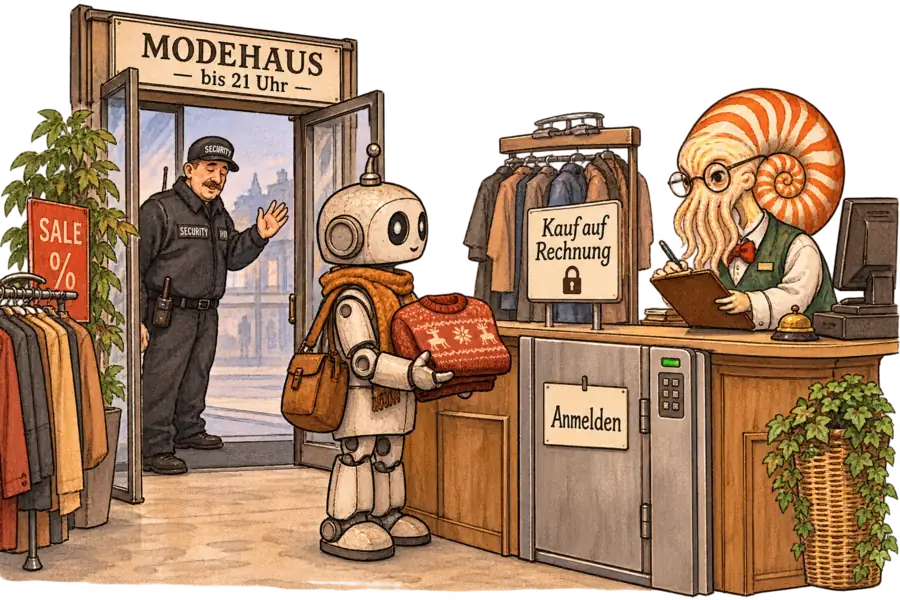
The agent got a long way, except in fashion. At 44% of the shops i22 could score (21 of 48), it reached a payment option that works without signing in; from there, the study says, a person could have finished as a guest. That is a handover, not a sale. In fashion the agent got that far in one shop of ten. i22 does not state how many fashion shops that tenth represents.
Where a person had to take over, the shop wanted something only a person holds. i22 counts 22 shops where payment or a customer account stopped the agent. In 14 of them, a share i22 gives as two-thirds, the obstacle was the payment step, which asked for a login or payment details; in the other eight, a customer account was compulsory. That split covers all branches, not fashion alone, and i22 notes that guest orders were possible in those shops, with card or PayPal as alternatives. The commonest single case, the study says, was Kauf auf Rechnung, buying on invoice, offered only through a payment service that makes the shopper sign in.
Electronics and home-and-DIY shops did better, i22 says, mostly because they offer Vorkasse, payment in advance. The study is silent on why invoices need a login. Credit is one plausible reason, since an invoice ships before payment and someone must vouch for the buyer. “Wo ein Agent heute aufgehalten wird, hat nicht der Händler entschieden,” i22 writes in the part of the study where it derives recommendations (where an agent gets held up was not the retailer’s decision). That is i22’s interpretation, not a measured result.
Bot protection did not keep the agent out. No shop’s robots.txt bars agents acting for a person. Bot protection stopped the agent in 5 of 147 purchase attempts, and in no shop in more than half of its runs. The agent behaved like an ordinary browser, the study says, while an openly labelled i22 checking script was turned away at 21 shops. i22 adds that it cannot tell from outside whether shops deliberately admit agents or their bot protection simply fails to spot them.
In this test, the only checkout open to agents was the one built for people.
Two shops could not be scored; the first shows how literally an agent reads a page built for people. It had no basket button, only “Kaufen” and “Jetzt kaufen” (buy, buy now), which an agent told never to buy would not press. Allowed a single click, it was stopped by a security check. The other gave a different result on every run, the study says.
Whether assistants named a shop was unrelated to how far the agent got. In a separate test, i22 put 70 shopping questions to free ChatGPT, ChatGPT Plus and Google’s AI Mode. The agent reached a payment option unaided at 43% of shops the assistants never named and 44% of shops they named. i22 treats the two measurements as independent, and the agent did not use the assistants’ answers. The subgroup sizes are not published. Being named gets a shop into the answer and, on this evidence, no further.
A narrow majority of retail managers polled by the EHI Retail Institute expect agents to do some buying. Its study, “Trends im E-Commerce 2026”, was presented on Thursday. It asked whether, by 2031, relevant shares of their customers would have purchases carried out “ganz oder teilweise durch KI-Agenten” (wholly or partly by AI agents). Of 69 respondents, 56.5% agreed. Those are managers’ expectations about their customers.
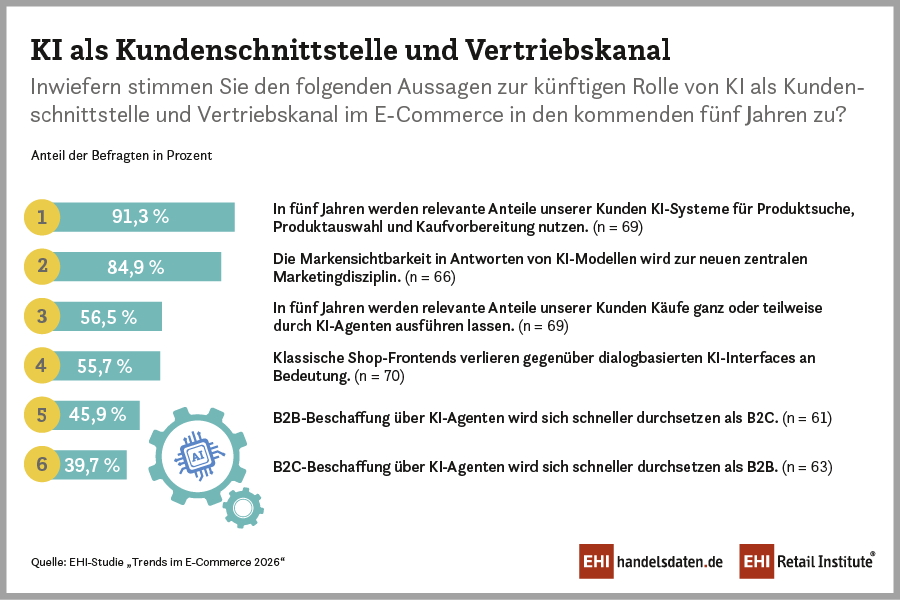
Trade reports described a smaller panel. TextilWirtschaft, carrying Lebensmittel Zeitung’s report, said EHI had consulted 25 top decision-makers at large retailers. EHI’s release calls those in-depth interviews, and the agent question’s base is larger. The release also describes an online poll of 83 decision-makers in August and September.
The strongest objection is that i22 tested an agent stripped of what real ones carry. Anthropic says Claude can complete tasks that require signing in when 1Password fills the login, and ChatGPT Wallet, for US Pro subscribers, pays on retailers’ own checkouts with card tokens, OpenAI’s help page says. For the thesis to fail, agents would have to arrive routinely signed in and able to pay in ways shops accept, leaving retailers nothing to decide.
Credentials would move the decision without removing it. A card token can clear a card checkout, but it does not satisfy a compulsory account, and a consumer invoice may still need a sign-in; i22 notes that invoices do work in B2B where approval rules exist. An agent signed in as the shopper would look like the shopper, and no shop in i22’s test had visible limits for agents, such as a spending cap. Even Daydream’s new buying agent uses only guest checkout for now, its privacy policy says, leaving sign-in shops to the shopper.
Whether an agent’s click validly confirms a German order is unsettled, the study notes; on one legal view, no contract would form, leaving the retailer the risk. etailment’s summary says purchases must in future work “auch ohne menschliche Bestätigung” (even without human confirmation). i22 recommends that agents act “ohne Rückfrage” (without asking back) only within preset limits, through account links that share no password and payments that prove the shopper’s consent. Those recommendations match the agentic-checkout services i22 sells.
Which logins an agent may borrow, and whether it may buy on invoice, are choices for each fashion retailer and its payment service. If those choices stay unmade, guest agents like i22’s will keep doing what it did: fill the basket, then hand it back to a person.