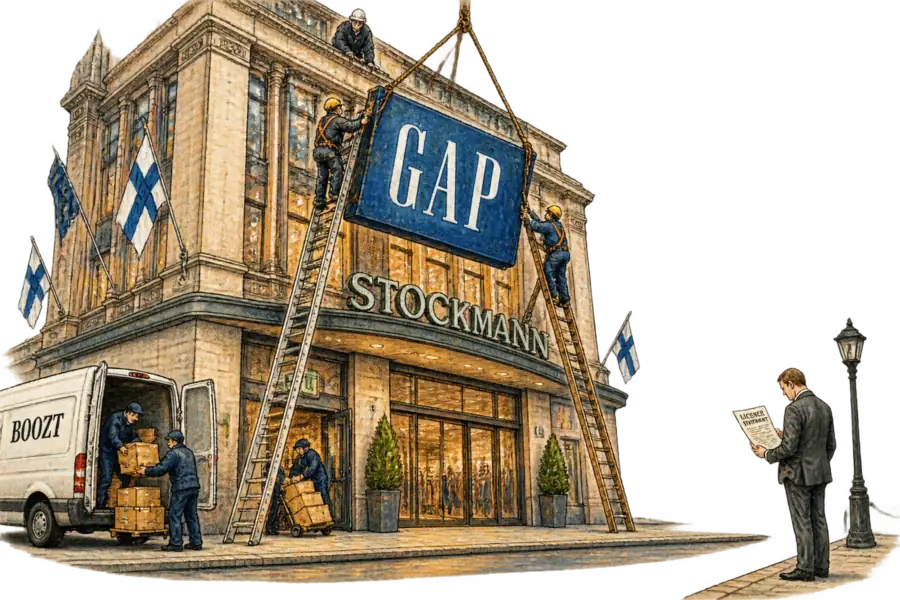
Gap Returned to the Nordics Without Signing a Lease
Gap's Nordic and Baltic re-entry runs on an exclusive licence held by Iconic Brands Nordic, which typically turns the cost of the market into a royalty line. It also leaves the sizing, seasonality and returns data with Boozt, Stockmann and the licensee.
Sir John Crabstone
Gap has returned to the Nordics without leasing a square metre of it. The exclusive licence for the Nordic and Baltic markets belongs to Iconic Brands Nordic, a joint venture formed last year by Brandgate Group and Tristafan. Gap lends the name; Iconic Brands carries what the name costs.
The sequence announced this week is instructive. Gap arrives first on Boozt in Sweden, Denmark, Norway and Finland, then in Stockmann concessions in Finland, Estonia and Latvia, then in a store of its own in Estonia in September. Each stage puts the brand in front of more customers and behind more intermediaries. Someone will sign that Estonian lease. It will not be Gap.
Abroad, this is policy now. Gap closed every company-operated store in the UK and Ireland in 2021, calling franchise partnerships “a strong and cost-effective way to amplify the brand in international markets.” The phrase is true. It prices what the stores cost and ignores what the stores knew.
Gap signed the same shape of deal in the Gulf nearly three weeks ago. Chalhoub Group took Gap, Banana Republic and Athleta for the UAE, Saudi Arabia and Kuwait. Two regions in one month, neither of them on Gap’s books. The exception has become the method.
The books show the drift. Gap Inc ended fiscal 2025 with nearly 3,500 locations in about 35 countries, of which 2,474 were company-operated. Something close to a thousand shops carry the name without appearing in the lease schedule. Gap’s footprint and Gap’s accounts parted company some time ago.
None of this is a mistake. A brand that walked out of the UK has earned its caution, and a licence fee — typically paid as a royalty on sales — cannot post a negative number. The sales arrive; the knowledge of who bought them stays in Malmö and Helsinki.
A royalty tells Gap what sold; the partner is the only one who sees what came back.
Boozt has already put a number on what that is worth. The platform blocked 42,000 accounts in 2023, Euronews reported: under 2 percent of its customers, and roughly a quarter of its returns. A retailer that can name its worst returners can plan a season and edit a size curve. Gap will get a statement.
The trade filed this as expansion. It is a re-entry, and the first attempt was partner-led too. Gap’s four Norwegian stores lasted about a year and went down in 2000 with the agent that ran them; the Scandinavian rights sat with a French company. Gap did not leave Norway. Its agent did, and the brand went with it. A licence costs nothing until you want it back.