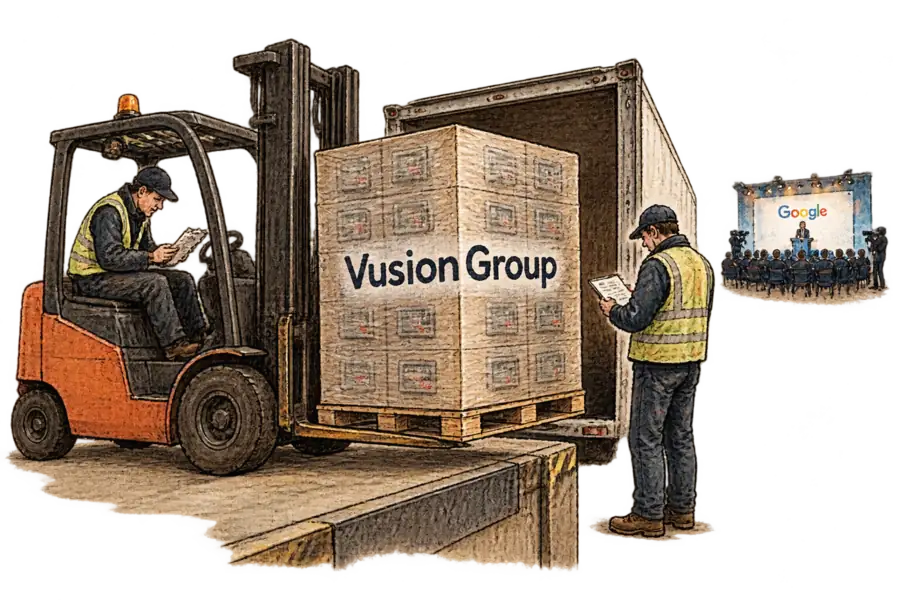
Europe's Retail AI Arrived on a Pallet
Morrisons is fitting 497 supermarkets with 10.8 million electronic shelf labels while the retail-AI headlines go to model partnerships. Europe's real purchase order is for equipment, and the French company writing it books most of its revenue in hardware.
Sir John Crabstone
Morrisons is fitting all 497 of its supermarkets with 10.8 million electronic shelf labels, a system built to plug into the shelf-edge cameras it already runs and an upgraded store wi-fi network. This is what retail AI looks like in Europe: a delivery schedule and a depreciation line. The announcements everyone reads are about models, and the invoices everyone signs are for equipment.
The supplier is French and has been selling this since before the discourse existed. VusionGroup, listed in Paris and called SES-imagotag until its January 2024 rebrand, booked €839 million in adjusted first-half revenue, of which software and services came to €125 million. The rest arrived on pallets. European revenue grew 6 percent over the half; everywhere else grew 39 percent.
Europe finished this purchase first, which is why its growth line looks dull. SES-imagotag had 50 chains and 9,000 stores in France on the system by late 2023. Saturation looks like weakness on a growth chart. The contracts were signed years ago.
A shelf label does not give interviews.
The announcements that travel look nothing like this. At an Alliance du Commerce roundtable in July, Républik Retail reported that revenue reaching Galeries Lafayette through large language models doubled in the first half of 2026. It amounts to 0.3 points of turnover. Google France’s marketing solutions lead told the room that a retailer’s new shop window is its data. Doubling is the figure the trade quotes; 0.3 is the figure it should.
The gap is procurement, not ambition. A label programme passes a capital committee and a write-down schedule; Grocery Gazette put the Morrisons rollout in the multi-millions without naming a number, which is how capex gets discussed in public. A platform partnership passes a press office. Only one of them survives an audit.
The order book is indifferent to the argument. Asda is installing more than 700,000 labels across 250 Express stores, about 2,800 a shop, after a three-month trial in Manchester. Those are convenience formats, where space is scarce and margin thinner. Group order intake fell 22 percent year on year this half, against a tough comparison with Walmart’s 2025 orders. The kit still reached the small shops before the sector finished arguing about the large ones.
The objection writes itself. Hardware is plumbing, intelligence lives in the cloud above it, and the labels are a commodity someone cheaper will take. The arithmetic runs the other way. VusionGroup’s recurring software revenue rose 73 percent to €61 million in six months, and every euro of it bills against a surface the retailer already paid to screw to a shelf. Nobody sells shelf intelligence into a shop that has no sensor on the shelf.
This is the same trade we traced when online’s share stalled at 16 percent: capital walking back to the floor it spent a decade writing off. Britain’s grocers have bought several million small screens; Morrisons is folding its into a shelf-edge camera system already running on trial. They were sold a way to stop printing paper. What went in was a machine that watches the shelf and files what it sees, and nobody at the capital committee asked who gets to read the file.