eBay Rents the Scene That Sells the Clothes
Depop's first campaign under eBay is six artists' wardrobes and a Spotify playlist, not a better search box. The marketing line that buys that discovery has more than doubled, and eBay has just taken delivery of the renewal.
Sir John Crabstone
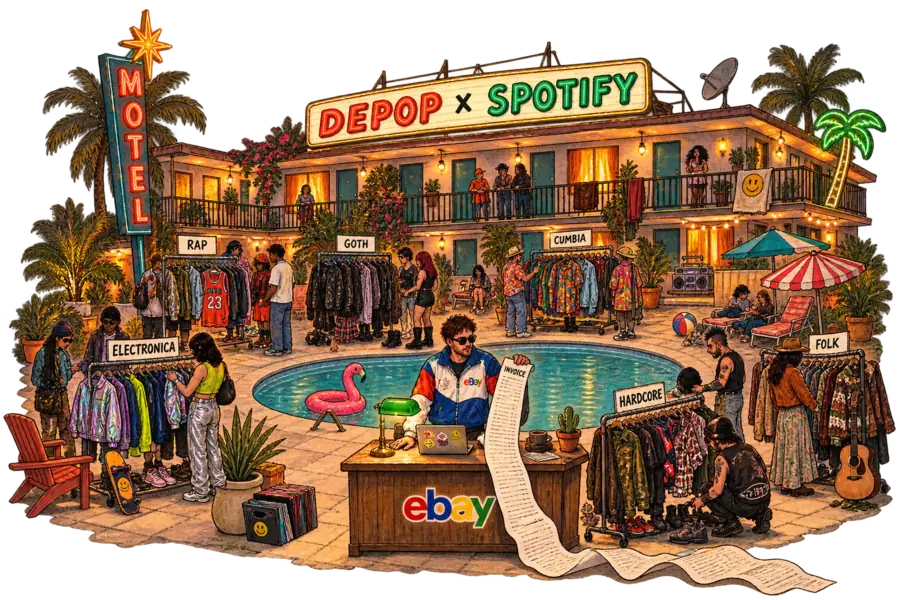
Depop’s first campaign under eBay is a playlist. Six musicians opened their wardrobes on the marketplace on 12 August, each closet opening onto one shared Spotify playlist that most of the six helped assemble. What eBay bought for $1.4 billion is not a search index — it is six audiences that have to be re-convened every year.
The roster gives away the method. Eve, Amira Elfeky, Estevie, Frost Children, House of Protection and Lily Meola between them cover rap, goth rock, cumbia, electronica, hardcore and folk-pop. No single taste holds all six. Depop and Spotify then took a motel on Hollywood Boulevard for two days of live performances. The roster is a coverage map; the motel is a date in a diary.
The method converts, which is what makes it expensive. Zara Larsson’s Depop edit went live in July and sold out in minutes, and June brought the company’s largest in-person activation to date, at Governors Ball. Depop has also been widening that budget into ordinary performance ads on Pinterest, Disney Plus and Roku, not just closets and playlists. None of that inventory was found by typing a word into a box.
The worry the market settled on is dilution. Neil Saunders of GlobalData told Modern Retail that eBay must be careful not to “eBay-fy Depop”, and eBay has said it will run Depop as a separate brand. That is the flattering version of the plan; the less flattering one is a marketplace built on secondhand chaos starting to look curated within an inch of its life. The marketplace turned over roughly a billion dollars in 2025. The risk everyone named is aesthetic; the one on the ledger is arithmetic.
The arithmetic is public. Depop recorded $42 million of marketing expense in the first quarter alone, against $119 million for all of last year. Citizens now estimates more than $250 million for 2026, as Value Added Resource reported. Set against last year’s roughly billion-dollar turnover, the marketing line is closing on a quarter of it.
Up-and-coming is a status that expires, which is why next summer’s campaign will need six more.
Depop has invested in the alternative and published the result. Buyers are now 42% more likely to find an item they want through search than they were before the platform’s recent investment in it. That stat is old money, spent once on infrastructure rather than an artist roster. A search index compounds and costs nothing to keep open. A motel has to be booked again.
Wells Fargo has already cut eBay to underweight over Depop’s spending, trimming its 2027 earnings estimate by 10% and putting the third-quarter cost at about fifteen cents a share, by Value Added Resource’s account. Part of Wall Street’s alarm is competitive, not just self-inflicted: Vinted’s paid search spend has jumped from about $16,000 to $236,000, pushing its ad impressions past Depop’s own, by the same account. eBay does not expect Depop to add to non-GAAP operating income until 2028. Nobody has said who picks the artists for 2027.