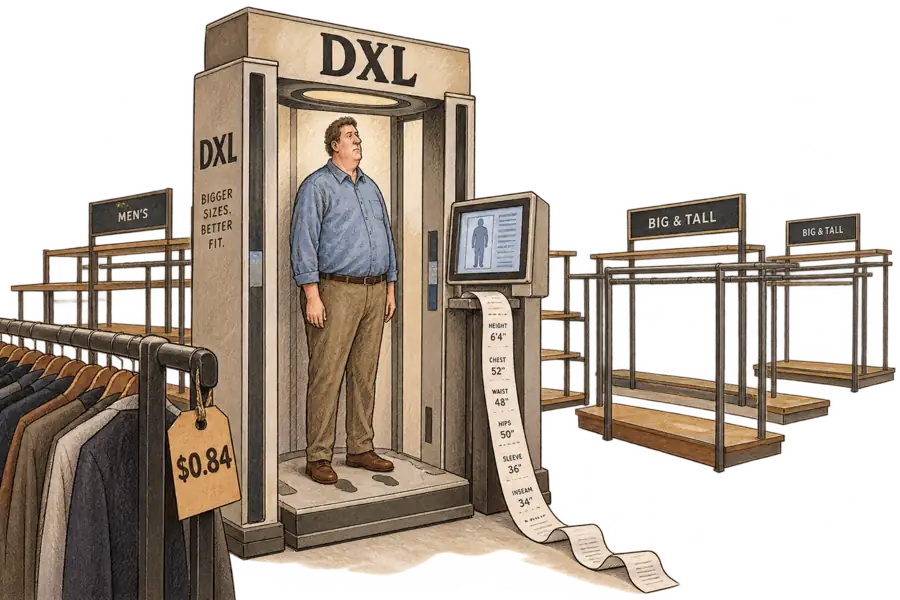
DXL Called the Body Scanner an Asset. It Just Hired a Merchant.
Destination XL's board rejected 84 cents a share partly on the strength of its exclusive body-scanning rights, then made its consultant an executive vice-president for growth. The second decision prices the first.
Sir John Crabstone
Destination XL’s board told shareholders in July that eighty-four cents a share was too little for the company. Among the assets it said the price ignored was an exclusive right, running to 2030, to a body-scanning platform. On 2 September it handed a consultant the title of executive vice-president and chief growth officer. One of those two statements describes a company that needs selling.
The filing is exact about what was being defended. The offer, the board wrote, “fails to reflect the intrinsic value of the Company’s business as a standalone enterprise, including its brand strength, loyal customer relationships, exclusive rights to Size Stream technology platform until 2030 and long-term growth opportunities.” Brand and customers are the ordinary furniture of a specialty retailer. The scanning rights are a lease with an expiry date, entered in the ledger as freehold.
The technology is real, whatever DXL’s filings call it. DXL’s annual report describes FiTMAP taking 243 contactless measurements and returning size recommendations across 29 brands, live in 188 stores by the end of February and used to scan more than 63,000 customers. Knowing a man’s 243 measurements tells you what will fit him. Nothing in the file tells him to buy it.
The business holding those scans contracted while they were being taken. Comparable sales fell 8.4 percent in fiscal 2025 and adjusted EBITDA finished at $1.6 million against $19.9 million the year before. The rollout finished. The earnings did not wait for it.
The board had made this kind of case before. In June it concluded that the FullBeauty Brands merger did not serve shareholders’ interests and began looking elsewhere.
Its July filing kept the merger’s arithmetic alive anyway. Stockholders would have held 45 percent of a larger company had the deal closed — an argument built on a merger the board had already declined to recommend. What survived the summer was the standalone case, and the standalone case leans on the scanner.
Shareholders were invited to trust it. When Zodiac’s offer expired on 21 August, 12,450,814 shares had been tendered into it, roughly 23 percent of the company, and none were bought because the minimum condition failed. Nearly a quarter of the register tried to take the price the board called opportunistic.
At 66.6 cents on 4 September, the market’s own estimate sits a fifth below the offer that was refused.
Jimmy Olsson has been consulting for DXL since September 2025, through the merger, the tender offer and the chief executive’s retirement in August. His brief covers the direct businesses, stores, merchandising, planning, sourcing and brand strategy — every part of the company except the scanner.
Second-quarter results are due on 9 September. The title arrived first.