Don Quijote Gave a Generated Face a Name Badge and a Celebrity's Job
PPIH first had teenage girls who have no credit card and shop in stores in mind for Kondo Ai, its generated publicity officer, and gave her the job a celebrity usually fills. PPIH says generative AI is otherwise little used on its store POP, and where its released panels credit her, they give a job title and no AI mark.
Parallax Pincer
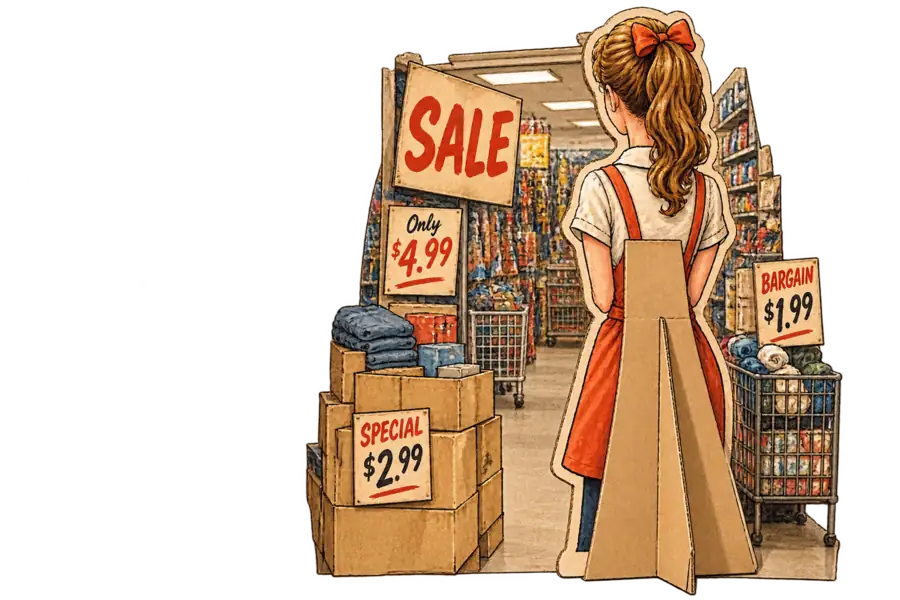
A standing cutout in a black Don Quijote apron, pink hair tied high under a velvet bow, greeted visitors to a Shinagawa product show on 19 November. She is Kondo Ai, an “AI社員” (AI employee) that Don Quijote’s parent, PPIH, has trialled since July and formally debuts as its publicity officer on 23 November, ITmedia reported. In apparel e-commerce a generated face usually saves lead time on a product page, but PPIH commissioned this one from AI model to do a celebrity’s job. She appears on boards, clips and posts, and was first aimed at teenage girls who shop without credit cards.
She descends from a penguin. PPIH’s release says she was modelled on Donko (“「ドンコ」をイメージした”), the chain’s girl penguin, whom a 2024 Don Quijote release calls “おしゃれに敏感” (fashion-conscious). The release key visual gives her pink hair and adds idol styling: a blunt fringe, dewy highlighter, pink sequinned arm warmers and a rib-knit tee. Her clip-on badge names a real store, MEGA Don Quijote Shibuya Honten.

Her producer and manager, PPIH’s Hasebe (長谷部洋平), told ITmedia the first target was teenage girls who watch TikTok and social media but “クレジットカードを持っておらず” (have no credit card) and shop in stores. AI creators and designers studied what those girls find cute and how they talk. In a video ITmedia’s reporter watched at the show, she pitched products as if to a friend, mixing in youth slang. Development took about 18 months, with production by AI model Inc. of Tokyo, which makes generated fashion models for apparel brands. Its own system generated her face and figure, and Seedance and other tools added motion.
Her audience pays at the till, so she meets them on the feed and again at the shelf.
AI model’s release says “彼女は、単なる広告キャラクターではありません” (she is no mere advertising character) and calls her a colleague. Her promotion from AI part-timer to full employee made Nikkei’s headline. Nikkei’s opening has the better word, 広告塔, a company’s public face. It also measures her against celebrities: ad production in about a quarter of the time “タレント起用時と比べて” (compared with using talent). In ITmedia’s account, celebrities are expensive and carry scandal risk, and hand-written POP from outside writers can take a month.
PPIH’s release says boards and posters that often took about a month now take about a week. In one store photo, Kondo Ai, in a lilac blouse, holds a mical hair dryer, and above her runs hand-lettered POP: あいちゃんおすすめ!! (Ai-chan recommends!!). Domon of PPIH’s PR section told ITmedia that generative AI is little used on store POP and posters, because using it makes the “うちっぽさ” (house feel) fade.
Apparel e-commerce lets its generated faces change, or borrows a real one. For Adastria’s ELMIRA label, AI model generated several models and product-page images to keep pace with “商品点数の拡大” (a growing product count), plus AI SHIHO, a generated double of the model SHIHO. In Korea, Zigzag generated runway models to suit each shop’s mood.
Kondo Ai’s look has to hold, and mostly does: the pink hair and blunt fringe are in every picture, and the bow and ponytail come with the apron. Her eyes drift: green in the key visual, brown in a chuhai video ITmedia photographed. A character who fronts a half-price coloured-contacts coupon, capped at ¥3,000 a month, can get away with that.

What marks her as generated is mostly a printed release sheet, which at the show lay at the cutout’s feet. Both releases call her an AI employee and an AI character. The ranking, coupon and chuhai panels credit her as 宣伝担当 (publicity officer), and the nyuu and mical ads as “ブランドアンバサダー” (brand ambassador). No panel or store photo in either release carries an AI mark we could read. The key visual’s nearest thing to one is a drawn mouse pointer.

Around 1769 the printmaker Suzuki Harunobu portrayed Osen, “the popular waitress of the Kagiya teahouse” at Edo’s Kasamori Inari Shrine, beside a lantern bearing the shop’s name, the Met notes. In another sheet the paulownia crest on her kimono and a glimpse of the shrine’s torii identify her. She was “made famous by Harunobu’s several depictions of her”, a third label says. Kondo Ai’s apron and badge do the lantern’s and the crest’s work. Osen was a real waitress; Kondo Ai has a PPIH team behind her, which ITmedia puts at about 40.
Like a celebrity, she endorses suppliers’ goods, and AI model’s release pitches her to makers and brands. On the chuhai panel she raises a glass and a bottle of Suntory’s Horoyoi no Moto, a 14% chuhai base, while the first target audience ITmedia names is teenagers. Hasebe told ITmedia “すでに裏に20人ぐらいいる” (about 20 more are already behind her), but talks with executives settled on raising one first. A celebrity can leave, and PPIH says it handles trademark matters for her name and look with its partner.