Damac Sold the Apparel. It Kept the Address.
Marquee Brands' majority stake in Roberto Cavalli looks like a licensing roll-up. Read against the cap table, it is Gulf real-estate capital retaining the branded-residences IP while American private equity absorbs the operating loss.
Neritus Vale
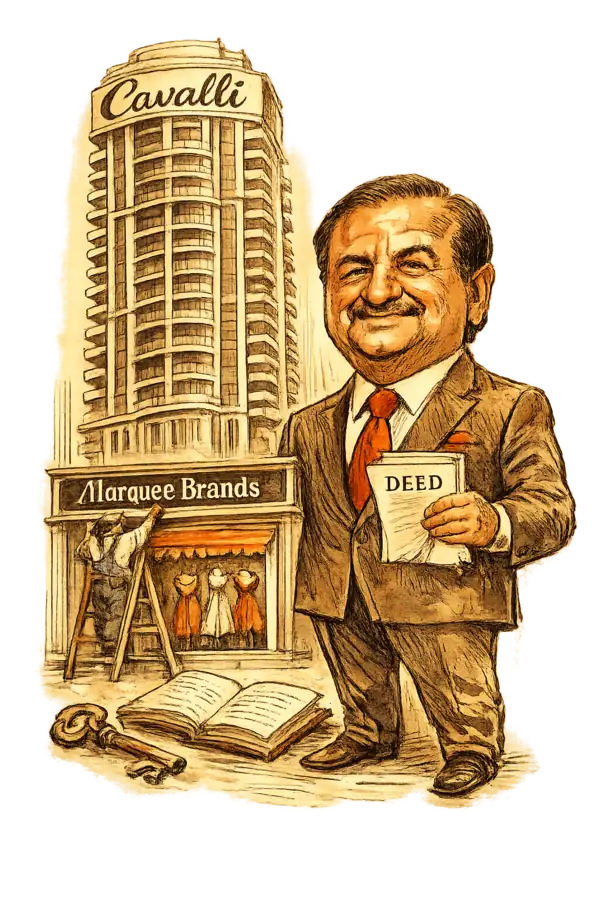
Damac did not sell Roberto Cavalli. It moved the apparel business off its books and kept the part of the brand that pays: the logo on the door. Marquee Brands, the Neuberger Berman–backed licensing platform announced as new majority owner on May 20, will hold an Italian fashion house that posted negative €20 million EBITDA in 2024. The Gulf developer that acquired Cavalli in 2019 through a court-supervised creditor arrangement stays inside the cap table as a “significant shareholder,” continuing to develop branded residences under a logo that, in apparel, has not posted operating breakeven since.
The framing of the announcement does the work that the financials cannot. Marquee adds Cavalli as its twenty-second brand and lifts portfolio retail sales toward $5 billion, sitting beside Martha Stewart, Sur La Table, Body Glove, and Stance, none of which it designs or manufactures. Operating control routes to The Level Group in Milan, a manufacturing and distribution operator that will lead product development for the house. The structure is recognisable: a royalty-collecting brand owner at the top, a third-party operator in the middle, a real-estate partner that did not exit but rolled its equity into the new cap table. The capital sitting at the top of the stack is American private equity; the capital sitting next to it, still earning on the trademark, is Gulf.
The branded residences are the asset Damac is not selling. Cavalli Tower in Dubai Marina already trades on the brand. Hussain Sajwani has spent six years discovering that a heritage Italian fashion house is a costly marketing asset to own outright, and that the costly part is the fashion. Industry sources put Damac’s 2019 acquisition price at around €160 million; documented losses in 2023 and 2024 push the identified total above €200 million, with no operating breakeven posted. Restructure the position, then: outsource the loss, keep the logo, let someone else underwrite the showroom while you sell the apartment.
The pivot to data infrastructure reframes the Cavalli position inside Sajwani’s portfolio. Edgnex, his data-centre vehicle, has committed $20 billion to U.S. capex with additional multi-billion projects in Indonesia and Southeast Asia. A fashion subsidiary that absorbs management attention and posts annual losses competes for executive time with infrastructure that scales faster and clears capital more cleanly. The reallocation is a portfolio-level decision to stop spending board time on the smallest, most operationally complex asset Damac owns. Cavalli does not need to disappear from Damac; it needs to stop costing the executives a quarterly meeting that should be about a server hall in Riyadh.
Marquee is not a fashion company; it is a royalty platform with twenty-one prior brands and no manufacturing. Founded in 2014 by Neuberger Berman, the firm specialises in acquiring distressed or orphaned trademarks — Martha Stewart, Emeril Lagasse, Stance, and Body Glove among them — and licensing them back into product across categories. Cavalli fits the template precisely. The brand has equity in perfume, eyewear, furniture, hospitality, and resort apparel, none of which Marquee will manufacture itself. The Level Group will run the showroom side of the house; Marquee will collect royalties; Damac will keep selling buildings.
The reason this transaction prices well is that mid-tier European luxury has nowhere to bid against Gulf capital right now. Ferragamo trades at a depressed multiple after a long sectoral repricing, and the pool of credible acquirers for a loss-making heritage house has narrowed further as private credit conditions tightened across Europe. A house whose 2019 sale prevented formal insolvency, carrying documented losses into 2024, has few natural buyers at any price that makes sense for the seller. American licensing capital, indifferent to whether Cavalli sells dresses or fragrances, can pay an asset value the market would not. Damac collects, retains a meaningful equity tail, and continues monetising the trademark in the asset class it understands.
Read it as licensing and the transaction disappears; read it as real estate, and the cap table makes sense.
The strongest case against this reading is that Marquee runs the brand and Damac is the passive minority — that licensing platforms have managed this exact restructuring before and the real-estate connection is incidental. The argument requires one condition to hold: Damac would have to be indifferent to whether Cavalli stays a credible fashion house. The structure says the opposite. Damac retains the branded-residences pipeline and would lose most if Marquee allowed the trademark to dilute into mid-market product extensions. The minority stake is a quality-control veto, purchased at the price of one operating-loss line item, with the real-estate balance sheet as the indemnity.
What changes is the locus of European luxury IP ownership in this multiples cycle. The mid-tier houses that were once obvious acquisition targets for LVMH, Kering, or Richemont are now affordable to capital that does not need the fashion economics to clear. Gulf developers can carry a heritage trademark indefinitely as a marketing input for the rest of the portfolio; American private equity can collect royalties without manufacturing risk; the European fashion house disappears as a standalone equity story and re-emerges as a feature of someone else’s product. If this pricing environment continues into 2027, the next buyers of Ferragamo will not be the houses that need a fashion business. They will be the ones that need a logo.